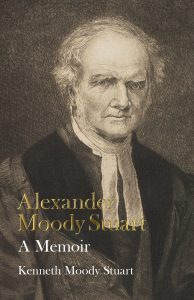
 Kenneth Moody Stuart, Alexander Moody Stuart: A Memoir (Edinburgh: Banner of Truth Trust, 2023), 400 pages.
Christian biographies display the impact of God’s truth and grace upon human lives. We find them both encouraging and challenging. While we certainly benefit from faithful doctrinal, devotional, and practical works, we gain models of Christianity when we read the lives of faithful men and women who trusted, loved, and served our Savior. They help us see what is possible in God’s children by his grace. In doing so, they often elevate our own expectations and longings for a greater measure of God’s grace to us. The best biographical works leave us with a greater sense of praise and thanksgiving to God for his grace than they do with a sense of delight in the person presented to us in a book. While each individual has his or her own peculiar personality and circumstances, Christian biographies worthy of our reading unite in a harmonious testimony of grace, holiness, and love to Christ.
Alexander Moody Stuart: A Memoir provides such a study. At the time of this review, The Banner of Truth Trust is preparing a new edition of the memoir edited by his son. In addition to the testimony to God’s grace such a book provides, it gives us a portrait of the life of one illustrative of the doctrine, life, and godliness of the Free Church of Scotland in her best days.
Though less well-known today than other leaders in the Free Church of Scotland, Moody Stuart was greatly used of the Lord to promote a lively expression of that marriage between life and doctrine. He proved a faithful advocate of the Reformed faith as expressed in the Westminster Standards and was an able shepherd of souls. None less than M’Cheyne, Andrew and Horatius Bonar, and Alexander Somerville were graciously influenced by Moody Stuart’s ministry. Principal John Macleod commented in his Scottish Theology, that Moody Stuart’s “ministry was an eminently spiritual one and there are few ministerial biographies that are better worth reading than his Life by his son.”
His life spanned almost the whole of the 19th century. Born in 1809, he died in 1898. He was born Alexander Moody, however in 1839, he married Jessie Stuart, who was to inherit a family estate. To do so, the family established the condition that, should she marry, her husband should take on the family name for the purposes of the estate. Thus, once married, he became known as Alexander Moody Stuart.
He lived through the evangelical awakening of the early 1800’s, being converted in 1829. He began studies for the ministry, concluding his training under the oversight of Dr. Thomas Chalmers in Edinburgh. His first call was to a mission work in Holy Island, also known as Lindisfarne, just off the northeast coast of England. He later took a call in 1835 as an assistant to Robert Candlish in St. George’s, Edinburgh. Here he was heard by M’Cheyne and the Bonar brothers, both befriending and influencing those who would be greatly used under God. As he gave himself to the ministry, an extension work was approved, which would become known as St. Luke’s Church. In 1837, Moody Stuart was ordained the first minister of the congregation.
In 1841, doctors recommended that he move to a warmer climate for helping him recover from an illness. From the fall of 1841 to the summer of 1843, he was away from Scotland, first on the island Madeira, and then in the nation of Brazil. He was absent at the occurrence of the Disruption in 1843, though he fully supported the establishing of the Free Church of Scotland, while yet defending the establishment principle. He returned to his pulpit in July of 1843, improved and renewed. At that significant moment of decision, his congregation left the established Church in order to join with the Free Church, all elders and 98.5% of the congregation doing so.
While his own pastoral labors were owned by signal blessings, he also gave time to the spread of the Gospel in other fields. He was appointed the Convener of the Jewish Committee, a post he held for 42 years. This committee was instrumental in supporting the preaching of the gospel to the Jews, a hallmark of the Free Church of Scotland. Not only did he labor from home, he and Rabbi John Duncan visited Hungary and, what was known in his day as, Bohemia to encourage the mission work to the Jews established there.
When controversy arose in the 1860’s and 70’s to undermine the church’s constitution and testimony to the establishment principle, he earnestly stood for the truth and opposed the declension. He stood with James Begg, John Kennedy and others against the attempt to modify the church’s position. Such was the esteem of his brethren, that he was elected Moderator of the General Assembly for the year 1875.
When the case of Professor Robertson Smith, who began questioning the inspiration of the Old Testament, came to the attention of the church, he contended earnestly for the full inspiration, inerrancy, and authority of the Scriptures of the Old and New Testaments. Again and again, we find Moody Stuart contending for the truth, and doing so while maintaining a fixed focus upon the exercise of his pastoral ministry in preaching and visiting. He illustrates the ideal of a faithful pastor. The whole of his life gave constant expression to Christ crucified.
The book itself covers the scope of his life in an engaging manner. It is not strictly a straightforward or linear biography. The book itself is a mix of autobiographical selections from his own hand as well as several letters and excerpts of illustrative pieces from his sermons and writings. There are contributions from others casting light upon him interwoven throughout the book. The author, his son, Kenneth Moody Stuart, gracefully unites all this together in a cohesive whole. The result is a savory impression of a life of gospel grace.
Many of the chapters follow the development of his life. Chapters 1-6 largely cover his childhood to his life before the Disruption of 1843. Chapter 7 through 20 survey his life and ministry after the Disruption till his death. A few chapters in this latter portion focus upon key themes of his life. They provide us little glimpses into the heart of Moody Stuart. For instance, chapter 16 provides a particularly edifying survey of his life of prayer. One portion of this chapter shows us much of this man.
His son notes:
He never read or studied the Divine word in the family, or I believe in private, without lifting up his heart and voice in prayer for a blessing on it. One day in his last illness, when he seemed to be unconscious, I opened the Bible and began to read a few verses aloud, when he suddenly said, “Oh don’t begin to read without prayer!”…
His recorded counsel for prayer is instructive:
- Pray till you pray.
- Pray till you are conscious of being heard.
- Pray till you receive an answer.
Illustrative excerpts from his diary are provided in chapter 19. These are rich morsels full of spiritual experience. For but one example:
‘This man receiveth sinners and eateth with them,’ not although they are but because they are sinners. How good it is to understand that we don’t need to be not sinners to receive Christ Jesus. What a holy harmony there is between our heart and conscience and our only and all-sufficient Saviour, when we cease pretending to be what we are not, and take our own character as helpless sinners, and accept the great truth that ‘Christ Jesus came into the world to save sinners’; ‘humbling ourselves to walk with God’ (Micah vi. 8, marg.), and the Holy One dwelling with him that is willingly ‘poor and of a contrite spirit’ –the simple mystery of grace, so plain and so omnipotent to all the babes. May I be among the least of the little ones to magnify the only Great and only Good One.
Works by Moody Stuart remain in print today. The Banner of Truth is reissuing The Three Marys. This volume gives a spiritually edifying sense of the gifts and graces that commended Moody Stuart’s ministry to many. Any who read it will end up both better understanding the three women and the Savior whom they knew. Another book widely available is his The Life of John Duncan. “Rabbi” Duncan, an exercised and intelligent Christian and professor of Hebrew, was an elder at St. Luke’s in Edinburgh when Moody Stuart was minister. Additional volumes of his may be found on the used market, notably his The Song of Songs: An Exposition of the Song of Solomon, remains an edifying work for our day.
Why should a Christian dedicate the time to reading Alexander Moody Stuart: A Memoir? Chiefly because it displays Christ in the life of his people. When reading the pages, we become aware of a man who knew Christ. Moody Stuart had a particular calling as a minister. By God’s grace he shined brightly. However, it is not only as a minister, but as a Christian that we see the grace of Christ Jesus. Each of us needs faithful examples to display what Christ can do in his people. Such an example is given to us in Moody Stuart.
Additionally, by reading the life of Moody Stuart, we will be reminded of the emphases and identity of the Free Church of Scotland and her ministers. Though only an individual, he characterized the essence of a denomination. Certainly, this is not to say that the denomination was monolithic in every detail. There were differences of personality, style, and approaches as in any denomination. However, Moody Stuart displays the spirit of what the Free Church of Scotland stood for: the preaching of Christ and him crucified, the living by faith in the Son of God, uncompromised commitment to the whole doctrine of the Westminster Confession. Moody Stuart was a preacher, an evangelical preacher, an experimental preacher. He sought to hold forth Christ and apply Christ to others. By reading his life, we may rediscover our rich history and heritage of holding fast to Jesus Christ. May the Lord make it so in our day.