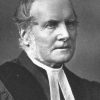
AuthorAlexander Moody Stuart (1809-1898)

Alexander Moody Stuart (1809-1898) was born Alexander Moody at Paisley in June 1809. He was educated at Glasgow and Edinburgh Universities, and was a missionary in Holy Island, Northumberland, from 1831 to 1835. Under the Kirk session of St George’s, Edinburgh, he began, in 1835, the work of gathering a congregation in Young Street. He was ordained to his first ministry at St Luke’s, Young Street, in July 1837.

When he married Jessie Stuart in September 1839 he took her surname in order that she should inherit the family estate at Annat. After the Disruption of 1843, Stuart joined the Free Church of Scotland, and became minister of St Luke’s Free Church, Edinburgh. He was Moderator of the General Assembly of the Free Church in 1875. He received the degree of Doctor of Divinity (DD) from the University of Edinburgh in 1875. He died at Crieff, Perthshire, in July 1898.

Stuart’s works include Life of John Duncan (‘Rabbi’ Duncan), who was a member and elder at St Luke’s, and The Three Marys.

The Fragrance of Christ

T
The meek and quiet spirit, which is in the sight of the Lord of great price, is the product of the desert, where no man is, and where Jesus with his name as ointment outpoured meets the soul in its desolation. Close beside it grows the plant of strong faith, of ‘precious faith’ like Abraham’s – which can hope against hope, and retain its savour though plunged in many waters. Prayer fills its golden vials full of odours faster in the desert than elsewhere, for in the day of trouble men call on the name of the Lord.

The Spiritual Condition of the Ministry in Its Influence on the People

T
It is almost overwhelming for a minister to consider the likeness of the people to the priest, to see his own image reflected on them for good or for evil, himself multiplied a hundredfold. No doubt the absence of this likeness is often very observable. You may see a member, an elder, a deacon, a precentor or doorkeeper in a church, sittting for twenty years under a ministry of a very marked character, without a single feature transferred from the pulpit to the pew; and over many of his hearers, the most faithful pastor must often complain, “I have laboured in vain, and spent my strength for nought.” But on the other hand, the minister is very commonly reflected in many of his people, and his cast of thought is frequently exaggerated in its reappearance among them.

The Patient of Many Physicians

T
On the way to the ruler’s house, where Jesus raised the dead Maiden to life, an unusual interruption occurred. This tried the anxious father’s spirit by his child’s death during the delay. We have now to take up the case of the Sufferer whose urgency occasioned it. But first of all it is to be observed, that the interruption itself is of a most remarkable character; there being nothing similar to it in the New Testament. Jesus, though hindered, was not stopped by the crowd, nor by an importunate petitioner that would not be denied, but simply by the change that passed on his own spirit. Virtue has gone out of him; a portion of the Spirit within him has entered into some one else. He has undertaken a great work which he goes to perform, and there is a pressing throng around him; but he instantly marks the alteration that has occurred within himself, and will not proceed till it is accounted for; although he possesses the Spirit without measure, and that is not lost by him which is gained by another.

Recent Posts

Popular Tags