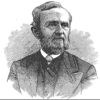
John Leyburn (1814-1893) was born in Lexington, Virginia to John and Jane McDowell Leyburn. The infant’s paternal grandparents were George and Abigail Leyburn who were descended from English ancestors that had relocated to Ireland. He began his professional studies in Washington College in his hometown but completed his program in Princeton College with the class of 1833. Leyburn began his divinity education in Union Theological Seminary in Virginia, 1833-1835, but then completed his work in Columbia Theological Seminary in South Carolina, 1835-1836.
Licensed August 27, 1836 by Lexington Presbytery he supplied the Oak Grove Church in Amelia Courthouse, Virginia, 1836-1837. Leyburn then moved south to Alabama to be ordained and installed in the Gainesville Presbyterian Church on April 4, 1838. The congregation had been organized by presbytery the previous year. Either during or just before Leyburn’s ministry the church building was constructed and it still exists after 180 years.
Leyburn returned to his home state of Virginia to accept a call from the Tabb Street Church in Petersburg in 1840. During his Tabb Street pastorate, John Leyburn made the acquaintance of Louisa Steuart Mercer of Fredericksburg and they were married in 1845.
John Leyburn left Petersburg for Philadelphia in 1848 to become secretary of the Board of Publication for the General Assembly of the Presbyterian Church in the United States of America (PCUSA), Old School. Four years later he became a part owner and an editor of The Presbyterian which was the Old School newspaper. In 1860 he toured the Middle East and wrote accounts of his journeys for The Presbyterian.
When Leyburn returned home the Civil War had started and the Presbyterians residing in the Confederacy had separated from the PCUSA because they would not comply with the Gardiner Spring Resolutions, especially the requirement to affirm allegiance to the Federal Government. Despite raising the ire of his Philadelphia associates, John Leyburn returned to Virginia to minister in the Presbyterian Church in the Confederate States of America (PCCSA). He was the denomination’s secretary of the Committee of Sustenation and then starting in 1863 he became secretary of the Committee of Publication. He also had abundant opportunities for preaching as a pulpit supply in Richmond, and he could be an informal chaplain for the numerous prisoners, casualties, and troops in the city because of the war.
With the end of the war, Leyburn left Virginia and supplied the Associate Reformed Presbyterian Church in Baltimore for a few years until he was installed the pastor beginning in 1870. During Leyburn’s ministry years the independent church was listed in Baltimore city directories under the category of “Presbyterian” as the “Associate Reformed Church” despite its lack of connectional association with any judicatory. Pastor Leyburn continued in a fruitful ministry until October 14, 1885 when he retired from active ministry.
Rev. John Leyburn, D.D., died in the manse of the Presbyterian Church in Waynesboro, Virginia, July 13, 1893. He had been living with his niece, Jeanie Leyburn, who was married to the church’s pastor, Alonso Rice Cocke. Moses D. Hoge preached the funeral for his friend. Leyburn had delivered the sermon for Hoge’s installation in Second Presbyterian Church, Richmond, nearly fifty years earlier. Pastor Leyburn was buried in Green Mount Cemetery in Baltimore.