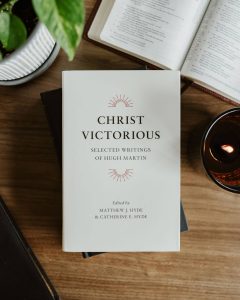
 Hugh Martin, Christ Victorious, Selected Writings of Hugh Martin, eds. Matthew J. Hyde and Catherine E. Hyde (Edinburgh: The Banner of Truth Trust, 2019), 425 pages.
An epileptic seizure occurs when, at its most basic level, neurons in the brain misfire and precipitate pulsating electrical storms that short-circuit normal brain activity. Any Christian afflicted with epilepsy will find great comfort from the words of the Apostle Paul who gives reasons why Christians do not faint under their sufferings in this world (2 Cor. 5:1): “For we know that if our earthly house of this tabernacle were dissolved, we have a building of God, an house not made with hands, eternal in the heavens.” That is to say, all the flaws of the earthly body will pass away and we will, in heaven, not only possess a glorified body but also a glorified and sinless mind free of short-circuits of any kind.
The greatest thing in man is mind. But in a fallen world, the best mind degenerates and is subject to all the vicissitudes and decay inherent to our condition. In the twenty-first century, talk of the mind invariably turns to thought of the brain. And what will the physical brain of man be in heaven and in the new earth? This is one of many interesting questions that receives consideration from Rev. Hugh Martin, in one of his letters included in the compendium “Christ Victorious, Selected Writings of Hugh Martin,” recently published by the Banner of Truth Trust. In the letter on the prophetic office of Christ, Martin asks his daughters:
Here it occurs to me to ask, if ever you have tried to get an answer to the question, “What is that ‘CROWN OF LIFE’ which the Lord hath promised to them that love him? I can only tell you what I think. I think it is ‘A Physical Brain like his own.’ And I think this extremely likely to be the correct answer. When I speak of his ‘physical brain,’ I venture to form no idea concerning it, except that it is that supremely glorious material instrument or engine or organ, by means of which primarily his human soul or spirit communicates with matter, and thereby with the external world generally. In that case, it must be that divinely perfect material instrument through which there is continually outpouring the stream of all his thoughts and emotions, all his sympathy with his people, and all the actings of reason (the human reason of the God-man!) wherein, or in respect of which, he is continually governing his kingdom, which ‘ruleth over all.’ What a prospect — to have a brain like that! A brain which is forever worked by the Holy Spirit — by the Holy Spirit in that character in which Jesus gives his Spirit in a measure to his pupils and people on earth — ‘the Spirit of love, and of power, and of a sound mind.’ Well is Jesus able to give those who are his pupils and his children a brain like his own.1Martin, Christ Victorious, 419-420.
Some evidence suggests Martin may have suffered some mental or physiological disorder of the brain, leading to his early retirement from ministerial work. Whatever the case, it appears Martin derives great comfort from the hope that one day he would have a new brain perfectly fitted and answering to the glory of the new heaven and new earth (Rev. 21:1) where the former storms, upsets, and epilepsies shall not be remembered, nor come into mind (Is. 65:17).
While containing interesting speculations such as just described, in “Christ Victorious” the editors have selected materials whose main focus is Christology, the branch of Christian theology relating to the person, natures, and work of the second person of the holy Trinity. Of all Christ’s works, the most precious to the believer is his atoning work on the cross. It is there that Christ secured his own crushing victory over death, sin, and Satan. And it is there that Christ secured for his own, dearly beloved bride her own triumphant victory and eternal union with Christ. It is on such themes that Martin speaks touchingly to our generation in this volume, comprising 425 US half letter pages, in which are bound together ten sermons, nine essays, and two letters mainly on the theme of the atoning work of Christ.
Hugh Martin was born on August 11, 1821, in Aberdeen, the granite city on the stormy east coast of Scotland. Little is known of his family connections to the Church, but it was said of Martin “that he feared the Lord from his youth.”2Hugh Ferrier, Hugh Martin (Part 2), Free Church Witness (eds. W. Macleod, H.J.T. Woods), January 2002, 14-15. http://www.freechurchcontinuing.co.uk/witness/witnessjan02.pdf (Viewed online 14 March 2020). He studied at Marischal College (now in the University of Aberdeen), beginning his undergraduate course at the tender age of fifteen years, several years earlier than was typical, by virtue of his keen and gifted intellect. He was preceded there by his close friend and colleague, John “Rabbi” Duncan. During his studies, Martin won numerous academic prizes, including the Gray bursary, the highest award in mathematics granted by the College. He graduated MA in April 1839, still a teenager and widely recognized as a mathematical prodigy, in an age of Scottish prodigies. Principal John MacLeod believed Martin to be “one of the foremost home-bred and original mathematicians that Scotland has produced.”3Ferrier, Martin, 14. This is high praise indeed, especially when one considers that he was a contemporary of such geniuses as James Clerk Maxwell, ten years junior to Martin, and later a professor of natural philosophy4natural philosophy – physics at Marischal College.
Although it is not certain that these two men conversed, it is almost certain that Maxwell knew of Hugh Martin’s mathematics, as they both published in the same journals, sometimes being referenced on the same journal page.5For example, Rev. Martin’s paper “On Centres, Faisceaux, and Envelopes of Homology” is mentioned on the same page as Prof. Maxwell’s remarks on “The Construction of Stereograms of Surfaces”. This is found in Proceedings of the London Mathematical Society, Volume 2, 11/1866-11/1869, 57. Martin was elected a member of the London Mathematical Society on February 28, 1867. He regularly contributed to the “Transactions of the Mathematical Society of London” and acted as Examiner in Mathematics to the University of Edinburgh. He also lectured extensively on science in relation to the Biblical doctrine of creation. But he is chiefly remembered today for his theological achievements, including books such as The Atonement and The Shadow of Calvary, in recognition of which Edinburgh University conferred a Doctorate of Divinity on him in 1872.
While Martin’s passion for science and mathematics continued throughout his life, he considered mathematical studies a means to a greater end. Prof. Collins of the Free Church College wrote that “his early conversion was followed by the call to devote himself to the ministry of the Gospel, and his higher studies from the beginning, were directed to that end.”6Ferrier, Martin, 14. After graduating at barely eighteen years old, Martin studied theology at both Marischal College and King’s College in Aberdeen, and was ordained to the ministry at the unusually young age of twenty-three. Martin was licensed to preach on 19th May 1843, the day after the Disruption.7Alisdair Macleod, The Free Church of Scotland 1843—the Kingship of Christ in Doctrine, The Master’s Trumpet (Grange Press), this issue. In 1844 he accepted a call to minister in the Free Church at Panbride, near Carnoustie. In 1858, he was translated to the congregation of Greyfriars Free Church in Edinburgh where he remained until his early retirement from the ministry in 1863, due to ill health, possibly due to mental health issues. After his retirement in 1863, Hugh Martin and his wife moved to Greenhill Cottage, Lasswade, near Edinburgh where he died in 1885 aged 64 years.
His retirement at what would seem to be the peak of his powers — he was only 42 years old — was a blow and a wonder to many of the godly. Dr Begg refers to this as “a mysterious Providence, removing him from the place where he was confidently expected to exert a mighty and extensive influence for good.”8Ferrier, Martin, 15. Although not regularly in the pulpit, the Lord continued to use him for great work. Most of the sermons included in “Christ Victorious” come from the Edinburgh period and after his retirement.
His friends, Principal Cunningham, who had the oversight of the British and Foreign Evangelical Review, and Dr James Begg of Newington, who was editor of The Watchword, engaged Martin to contribute to these periodicals. Over 150 pages in “Christ Victorious” are essays Martin contributed to the British and Foreign Evangelical Review.
The collection is handsomely hardbound in quality materials and is sown together to produce a volume that will bear much page turning. And Martin’s work induces page turning. Prof. John Murray wrote that Martin’s “writings exhibit an unexcelled warmth and fervour. No one could scale greater heights of sanctified eloquence.” His letters in this volume contain several interesting thoughts touching on the nature of space and time, natural inquiries for one of a keen mathematical bent, and combines these thoughts with theology, which is, after all, the queen of sciences. A couple of examples of Martin’s preaching will show how he challenges those in the pews with exquisite views of the person and work of Jesus Christ, in his humanity and in his divinity:
But this child in swaddling [b]ands9Swaddling is the practice of wrapping infants in blankets or similar cloths so that movement of the limbs is tightly restricted. Swaddling bands were often used to further restrict the infant., lying here in the manger — he does not speak to me. His lips do not even move. No sound issues from them. And how can you say then that you hear a voice from the new-born speechless babe?
But I also will ask you one question. As you gaze into the manger of Bethlehem, and listen in vain, as you say, to hear the voice of Jesus — so do I now look up to the right hand of the throne of God, where Jesus now is, and I also may complain as well as you that I listen in vain, that I hear no voice from Jesus. As little sound of words do I hear coming down from the throne of God, as you now hear coming forth from the new-born king. But is Jesus therefore silent unto me? Has he nothing to say to me? And does he take no means of saying it? Am I doomed not to hear the voice of Jesus? Do I really not hear him? Then I am not of his sheep. For his sheep hear his voice. And other sheep he has that are not yet of his fold, them also he will bring, and they shall hear his voice.10Martin, Christ Victorious, 5.
Martin preaches clearly the active work of the Holy Spirit in communicating to sinners the love of God through Jesus Christ, and the union that Christians therefore find with God. Although we are incapable of comprehending the mind of God, the Holy Spirit works to convict his children to believe and follow the truth. It is through union with Christ that believers receive the Holy Spirit, and are said to have the “mind of Christ” (1 Cor. 2:16):
Christ, by his Spirit, lives in them. By his Spirit he quickens them to new and spiritual life; and by his Spirit he takes possession of them as his living temple. As a living temple, he always regards them and acts in them. Their faculties as living men — alive from the dead — he animates and controls. Whatever in their thoughts, affections, purposes, actions, is opposed to his own, he sets himself to suppress; and the faculties themselves he undertakes to sanctify — to form, and mould, and guide into harmony with his own. Nay; their whole character, their very natures, as living men — spiritually living — he works by his Spirit to assimilate unto his own. So far as this work advances, the very thoughts that he thinks they think; the affections he entertains they entertain; the purposes of his mind of theirs also; his work is their work; his nature is theirs. And up to the limit to which this blessed result has in its onward progress been achieved, how can a better, a briefer, a more perfect expression be found for it, than to say that, to this extent, ‘Christ liveth in them’? It is, then, literally, profoundly true that Christ lives in his people. He lives in them by his Spirit which he has given them.11Ibid., 12.
In other sermons, Martin touches on how union with Christ must mean lasting conflict with the world, and how fellowship with Christ must imply, necessarily, fellowship with the brethren, even those whom we may be tempted to disparage because of their imperfections.12Ibid., 103. As Christians are united to Christ, this means, then, that they are also united one to another. This union with Christ, and communion together with him and our brethren must needs imply, writes Martin, revealing the heart of a pastor, that we must love our brethren: “You are not at liberty merely, it is your imperative duty, to cultivate Christian friendship. Concerning each of his friends alternately, Jesus says to all, ‘He that receiveth you, receiveth me.’”13Ibid., 349. The members of the Church are friends together, united in relationship with Christ the victorious. We are his dearly beloved bride waging warfare, with him at our head, against the world, the flesh, and the devil. Our unity with Christ ensures our legitimate and final triumph over all the earth: “The world is ours by birthright. A tyrant hath usurped it and oppressed us. But we look not round in vain for a deliverer, for a Prince to head our rebellion, our revolt, our revolution.”14Ibid., 140.
Martin makes other practical applications, for instance to Christian worship, which he notes is most perfectly expressed by the heavenly scene of the glorified priesthood of the Lord Jesus. Heaven is the literal place, he says, where our great High Priest ministers as the God-man and acts on our behalf, perfecting our worship so that it is acceptable in the beloved. Now we worship and “see through a glass, darkly; but then face to face” (1 Cor. 13:12). Martin makes clear that mere human innovations in worship reflect a mistaken Christology; in innovating, we fail to properly understand the priesthood of our glorified Lord. Heaven is the literal place of our worship under Christ, where we behold him with eyes of faith; but it is also the literal place of worship of the glorified saints in heaven, who, as John Owen put it, visibly see Jesus in his glorified humanity. Because Christian worship is in heaven, it is impossible for humans to contrive any worship worthy of the beatific vision, and as such, “…the tolerating or desiring of such innovations and impurities in the worship of God, always goes hand in hand with false or defective views of the priesthood of Christ.”15Ibid., 127. The sinful human tendency to seek an earthly, ritualistic, outward worship in a merely human priesthood reflects a failure on our part to remember our privileged position, as those “in Christ” for whom:
…the earthly house of prayer — and not heaven — comes to be regarded as the scene and sanctuary of worship; its observances, in default of heavenly and unseen beauty, are decorated with materials of earthly splendour; and inasmuch as it is a principle of reason that the worship of God should be glorious, and priesthood and glory stand intimately related, the priesthood being on earth, the glory sought is an earthly pomp and glory too. The doctrine of Christ’s exclusive and celestial priesthood puts ritualistic worship to flight. And the believing worshipper, seeking in spirit to enter heaven, rejoices to resign every beggarly element of the world, which can only chain down his spirit, too prone to cleave unto the dust, and hinder his entrance within the veil.16Ibid., 12.
If you love to read and think about the atoning work of Christ, and if you want to learn how to more deeply trust and worship him, then this reviewer highly recommends that you take up “Christ Victorious.”
Footnotes
- 1Martin, Christ Victorious, 419-420. ↩︎
- 2Hugh Ferrier, Hugh Martin (Part 2), Free Church Witness (eds. W. Macleod, H.J.T. Woods), January 2002, 14-15. http://www.freechurchcontinuing.co.uk/witness/witnessjan02.pdf (Viewed online 14 March 2020). ↩︎
- 3Ferrier, Martin, 14. ↩︎
- 4natural philosophy – physics ↩︎
- 5For example, Rev. Martin’s paper “On Centres, Faisceaux, and Envelopes of Homology” is mentioned on the same page as Prof. Maxwell’s remarks on “The Construction of Stereograms of Surfaces”. This is found in Proceedings of the London Mathematical Society, Volume 2, 11/1866-11/1869, 57. ↩︎
- 6Ferrier, Martin, 14. ↩︎
- 7Alisdair Macleod, The Free Church of Scotland 1843—the Kingship of Christ in Doctrine, The Master’s Trumpet (Grange Press), this issue. ↩︎
- 8Ferrier, Martin, 15. ↩︎
- 9Swaddling is the practice of wrapping infants in blankets or similar cloths so that movement of the limbs is tightly restricted. Swaddling bands were often used to further restrict the infant. ↩︎
- 10Martin, Christ Victorious, 5. ↩︎
- 11Ibid., 12. ↩︎
- 12Ibid., 103. ↩︎
- 13Ibid., 349. ↩︎
- 14Ibid., 140. ↩︎
- 15Ibid., 127. ↩︎
- 16Ibid., 12. ↩︎