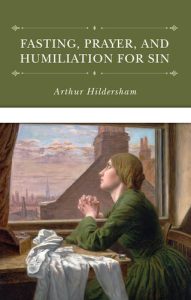
 Arthur Hildersham, Fasting, Prayer, and Humiliation for Sin, Lesley A. Rowe, ed. (Grand Rapids, MI: Soli Deo Gloria Publications, 2017 [1632]), 125 pages.
As a young Christian I struggled to understand how to engage in religious fasting. That it was expected by Christ was undeniable, “…when ye fast…” (Matthew 6:16). However, when was this to happen? How was I to go about it? How could I avoid the errors of the hypocrites Christ mentioned? Doubtlessly, many today encountered similar questions when various days of humiliation were established over the past several months in light of God’s judgment upon our land and world. While excellent sections in several works exist, few book-length treatments can be found to address the topic. Fewer still are worthy of a Christian’s precious time.
There is help to be found from the past. In 2017 Soli Deo Gloria issued Fasting, Prayer, and Humiliation for Sin by Arthur Hildersham, a work originally published in the 1600’s. Hildersham (1563-1632) remains largely unknown today. This stands in contrast to his own day, when he was highly esteemed as a powerful and popular preacher. To illustrate his position in his own day, as the introduction to the book indicates, Hildersham was a leader among the men who wrote to King James in 1603 with the Millenary Petition seeking further reform according to God’s word. This document appealed for corrections in worship, ministry, church livings, and discipline, all craving a “due and godly reformation,” while resisting the tendency of schism. Though ultimately unsuccessful, the Petition indicates Hildersham’s alignment with and leadership of the Reformed and Puritan camp. Also of interest: one of his four children, Samuel, entered the ministry, and, though not an original or frequent attender, he was a member of the Westminster Assembly. After his father died, it was Samuel who prepared these sermons for publication.
Fasting, Prayer, and Humiliation for Sin contains eight sermons preached by Hildersham upon an outbreak of the plague in London during 1625. In July of that year, a call came proclaiming a fast to be observed on each Wednesday throughout the duration of the plague. The sermons were preached on various Wednesdays from August to December of 1625, with the final sermon of this volume being preached in 1626 upon an additional, though lesser, outbreak. In addition to the eight sermons there is a 15-page introduction providing a survey of Hildersham’s life, ministry, and publications, with particular focus upon the context of these sermons. Samuel Hildersham’s original dedication and Arthur’s prayer before his lecture are also included. The book runs 125 pages, with each sermon running roughly 10-20 pages. The text has been edited by Lesley A Rowe, who has also written a biography of Hildersham published by Reformation Heritage Press titled The Life and Times of Arthur Hildersham: Prince among Puritans.
The eight sermons provide the reader with a searching treatment of the nature, purpose, and observance of religious fasting. The first sermon demonstrates that we ought to take to heart the judgments God lays upon others. In the second, Hildersham sets before us the teaching that prayer is the chief duty for us when others are in misery. The third sermon shows the “outward and bodily exercises to be used” in days of humiliation, while the fourth declares “the chief use of a religious fast is to humble and afflict the soul with sorrow and grief…” The substance of this sermon continues through the fifth, sixth, and seventh sermons. In these three, attention is given to the right motives for gracious humiliation (fifth and part of the sixth), the public means for attaining it (sixth), and the private means for attaining it (the seventh). The eighth sermon gives helpful signs for determining whether our humiliation has been true and gracious or false and carnal. Each of the sermons has the typical Puritan balance of doctrinal instruction, practical application, and experimental assessment. To read these sermons is to be exposed to much more than a how-to handbook, though such guidance is certainly provided. It is to be searched, assessed, helped, and fed.
Christians in our day will profit from reading Hildersham. The trials of these times certainly warrant us to humble ourselves. One aspect of God’s truth, unfortunately neglected in our current day, is that each judgment experienced in this world calls us to examination and repentance for it reflects the visible providence of God. Hildersham mentions this in his opening sermon:
Every judgment of God has a voice and is a real sermon of repentance; and the more general and extraordinary the judgment is, by so much the louder and more audible voice it has. And it is therefore a contempt done to God when we regard it not nor hearken unto it. “Hear the rod, and who hath appointed it” (Mic. 6:9).1Ibid, 5.
This first sermon also provides help in assessing God’s judgments and determining cause and the appropriate response. A key point of his may be summarized in his own words:
We know not the meaning of the plague nor make right use of it, unless every one of us enter into his own heart and say, “What have I done?” To this end it will be profitable for us to search the Scriptures and find out what were the special sins which either have brought the pestilence upon God’s people in former times or which the Lord has threatened to punish in this manner and with this judgment.2Ibid, 13-14.
Much of American Christianity has lived for years without knowing what a day of humiliation is or what it would look like. I went the better part of 30 years in the church without experiencing such a day. This represents a serious weakness in our biblical knowledge and practice. Such days were familiar to Hildersham and his age. And yet this did not make it easy for his people. Hildersham acknowledged the difficulty of the spiritual work of examination, “In the stone of kidney or bladder, men need not be persuaded to desire or seek remedy, but in the stone of the heart they do.”3Ibid, 76. So his work does not come to us assuming that we all understand what to do. It provides us instruction and guidance as to the right observance of such days as well as caution and warning against many errors. Among the things to do, he notes that the Scriptures emphasize that public days included the reading and preaching of the word, the singing of psalms, extraordinary prayers, and examination for sins.4Ibid 47-48. If we would begin here in our days of humiliation, we would begin well.
For some, a day of sorrowing over sin may seem a foreign exercise. Many have the erroneous idea of the Christian life that the Christian is always supposed to walk about in a state of electric giddiness. A day of sorrowing over sin may seem unbecoming for a Christian. Hildersham addresses this in a number of ways. To illustrate one, notice how he argues that we ought to sorrow over sin:
…you have by your sin corrupted others, whereof it may be some are in hell already, and some in the way to hell, and you cannot draw them unto repentance. Indeed, if you can truly repent, this shall not hinder your salvation that you have been a means of damning others…Yet must it needs be a heartbreaking to you, whenever you do seriously think of it all the days of your life…5Ibid, 110.
It may be that some think such attention to our sins is unhealthy or even hurtful for our spiritual good. The phrase, “morbid introspection,” has been applied to the Puritans on occasion as descriptive of their concern about examination. In truth, not only does such an assessment of the Puritans misrepresent them, it ultimately veils the fact that examination is a means to great spiritual good. The examination of sins and sorrowing over them is a healthy and beneficial work. Hildersham encountered such thought and addressed it as follows:
To commit sin is dangerous and hurtful to your soul, but to call your sins to remembrance has no danger in it, will do you no hurt at all. To have an enemy or a mortal disease upon you is dangerous and hurtful, but to be aware of them may do you much good.6Ibid, 105.
Another strength of the work is its treatment of prayer. As prayer is a primary duty in such days, he gives some length to the topic. His treatment on intercessory prayer for those under God’s judgment is worthy of its own attention. He calls us to a proper frame:
Beloved, you can never do yourselves or your brethren good by your prayers, unless when you pray you watch and look well to your hearts to keep them from drowsiness and senselessness, from wandering and roving, that when you pray, you may pray with fervency and feeling of your own necessities and of the necessities of them that you do pray for.7Ibid, 36.
This frame is not meant to be a self-confidence, but rather a sense of our own weakness as we take up the cause of our neighbors before the throne of grace. We are to be conscious of our weakness in prayer, because prayer in its essence is an appeal to God who is gracious and mighty to intervene. Memorably, Hildersham notices:
And this is surely another cause why our prayers for our brethren have been so weak and without force with God. We are too strong, too well persuaded of ourselves to do God’s people any good with our prayers.8Ibid, 39.
The work is very accessible for today’s reader. It is relatively brief, and the sermons are representative of the plain style of Puritan preaching. This provides clarity and directness allowing ease of engagement by the contemporary reader. Doubtlessly, the work of the editor has assisted the readability of the work. Such clarity can be illustrated by Hildersham’s call to search out our sins appealing to the example of Achan:
And what hope then can we have to prevail in our fasts, while no care is taken to find out Achan? The idolater is an Achan, and so is the murderer, and so is the adulterer, and so is the blasphemer, and so is the drunkard…Our Achans are not so secretive as that man was. Our Achans do not hide their accursed things as he did…Endeavor every one of you to find them out and suppress them, or else our fasts will be of small force with God.9Ibid, 61.
As the Lord blesses, anyone with the maturity of teenage years upward should be able to read the work with tremendous profit. It is a book worthy of prayerful consideration by young and old alike. It is a book that would help those who are engaged in the spiritual labor of sorrowing over sin. However, it would be far more helpful to have read the work prior to such spiritual exercise.
“This, then, is one part of our duty today – that we should humble our souls for all the abominations that are committed in our country and for our lack of mourning over them.”
– John Owen, Searching Our Hearts in Difficult Times