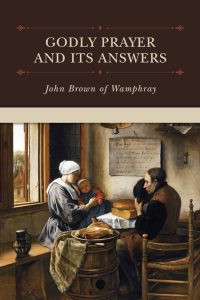
 John Brown of Wamphrey, Godly Prayer and Its Answers (Grand Rapids: Soli Deo Gloria, 2016), 352 pages.
Every Christian’s spiritual life begins and ends with prayer, from the first cry of the renewed soul to the last sigh of the departing saint. Prayer, basic as breathing, simultaneously demands rigor from even the most seasoned warrior.
Given its fundamental place, it is no wonder that modern books on prayer abound. But as many readers can testify: if you have read one, you have read them all. They often echo the same techniques and practical tips on the place, pattern, parts and proper form of prayer.
The contemporary vintage of books on prayer often proves that Christians have grown accustomed to drinking from the wells of the self-improvement gurus. In response, many Christian authors have incorporated those flavors to accommodate the preferred taste of readers. That thirst has transformed our literary diet, making the self-help books nearly indistinguishable from their Christian counterparts.
The whole approach remains tragically wrongheaded because the well is poisoned. And mixing in biblical verbiage will not remove the deadly toxins. The method centers on man, not God. People demand shortcuts. They desire a bag of tricks. They want to enlist God in their service, concentrating his attention on their happiness. Many view God as a means to their personal end. And prayer seems to provide the perfect mechanism for steering God’s focus onto their agenda.
Brown’s book provides a breath of clean, crisp air, wafting in from another spiritual landscape. Over against misguided modern notions, Brown reminds us that true prayer serves to align our desires with God’s will. It begins and ends with God himself.
John Brown of Wamphray (1610-1679) served as a bright light in a galaxy of ministers notable for their gifts and godliness. He lived amidst the substantial, spiritual advances of the seventeenth century Second Reformation. Born in Kirkcudbright, Scotland, he studied at Edinburgh in preparation for the gospel ministry. Rutherford wrote to Brown’s mother, a former member of his congregation in Anwoth, stating that he had “a great love to dear Mr John Brown because I thought I saw Christ in him more than in his brethren.” The growing tide of persecution in Scotland resulted in Brown’s imprisonment followed by exile to Holland in 1663, where he spent the remainder of his ministry, along with other faithful Scots. In Rotterdam, he wrote several important books for the future edification of the Church, some of which are still in print. Godly Prayer and Its Answers is the latest to come back into circulation.
If you are new to reading books from the seventeenth century, please be aware that Brown does not open by riveting your attention and convincing you of the importance of his work. But if you take time to hear and receive his message, it will indeed strengthen you for labor at the mercy seat.
Despite the potentially misleading title, this book does not contain a collection of testimonies of answered prayers from bygone days. Rather, it constitutes a theology of prayer, loaded with biblical content. Though not stated explicitly, Brown’s approach stems from the persuasion that orthodoxy informs orthopraxy – right doctrine molds right practice. Few categories of the Christian life bring together our theology and practice as closely as prayer does.
Brown provides clear and convincing instruction on practical matters: what, where, when and how often to pray. But the most valuable component is his method. He skillfully and repeatedly unveils the root issues in our hearts and minds that shape our prayer life. How we pray (or do not pray) reveals what we believe about God and about ourselves. When we align both of these with the truth of God’s Word, it produces the proper desire, motivation and content of godly prayers.
In addition, he answers many thought-provoking questions: What are the solutions to our obstacles in prayer? If God does not hear the wicked, are unbelievers obligated to pray? Are there substantial solutions to wandering thoughts in prayer? What does it mean to pray in Jesus’ name? How do we pray in the Spirit? What is the relationship of the Bible and prayer? How can God truly guarantee answers to all of our prayers?
While this book does not tantalize with secret tricks to resuscitate your prayer life, it does drive you deep into the Scriptures and into a rich acquaintance with the majesty of the One before whom you plead. Read it slowly and reflectively. View the copious Scripture references not as mere proof-texts but as a valuable resource to tutor you (and saturate you) in biblical truth. It will persuade you of the indispensable role of Christ in your prayers and strengthen your conscious grip on his mediation. It will stir you to pray in the Spirit, training you to lean on his ministry in prayer. It will supply you with guidance on the controlling influence of the Word in framing your petitions. It will leave you in holy amazement over the priceless fellowship with the Triune God in the secret place. You will better grasp both the simplicity and complexity of this spiritual exercise.
Brown’s exposition of praying in Christ’s name would alone justify the cost of the book. He devotes five chapters to this topic and provides incisive insight that plumbs the depths of Christian experience, identifying all the ways in which we unknowingly approach the throne on other grounds, while supplying correctives at each step. We learn that even consulting our inward, spiritual frames can divert us from coming to the Father in the name of the Son.
Another highlight includes his material on our responsibilities after prayer. He obliges the diligent to look for answers to prayer and condemns as sinful the omission of this duty. Brown elucidates what this entails, and he provides poignant direction on implementation.
From beginning to end, he suffuses the entire treatise with a God-centered focus that captivates the hearts of Christians. The book avoids modernity’s missteps that cement self at the center of prayer rather than God himself.
Most Christians love to read about prayer, think about prayer and talk about prayer. The privileges and power of prayer enliven the heart. But after all the chatter, far too few truly pray. And those who do pray, do so haltingly – and sometimes heartlessly. This book has the full potential, with the Lord’s blessing, of actually motivating you to pray – to pray more frequently, fervently and faithfully – because you will come to see that the most beautiful part of prayer is the knowledge, fellowship and worship of God himself.
While this reviewer has read many books on prayer, none have compared to the depth or penetrating insight of Brown of Wamphray. It may not be the first book to read on prayer, but it may well be the last and best book you will ever need on this important subject. It is highly recommended to aspiring warriors who long to wrestle for the divine blessing before the throne of grace.