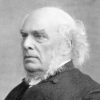
Selected from: Horatius Bonar, Life of the Rev. John Milne of Perth (London, 1869).
Between Mr. Milne and Mr. M’Cheyne there were points of likeness, yet of great unlikeness also. In appearance they were dissimilar. Both, indeed, were short-sighted, and generally wore spectacles; they both walked nimbly and erectly, moving with an agility that spoke of inward joy; but the former was dark, the latter rather fair; the former was under the middle size, the latter considerably above it, which gave him a commanding appearance, especially on one occasion, when not thinking himself high enough to overlook the audience, he mounted the stool which the minister used for kneeling, and on this elevation poured out one of his most energetic sermons to a congregation of some 1200 people. Both had a pleasant smile ; but there was more of severity about the latter than the former, though the laughter of Mr. M’Cheyne was louder and more ringing than that of Mr. Milne. In both there was great plainness of speech, and indifference as to polish and ornament. Illustrations were to them not flowers for the fancy, but arrows for the conscience. In both there was an unearthly elevation of spirit, alike in prayer and preaching, which lifted up the hearer unconsciously along with the speaker. In both there was deep solemnity of voice, though in Mr. Milne there was more of the natural,—we might almost say the conversational,—tone than in Mr. M’Cheyne. Both were vehement in denouncing sin, the latter never pausing to smooth down his words, as if afraid of calling things by too strong names; the former uttering the same denunciations more courteously, and with less liability to be misunderstood or to call up opposition.
Both of them were, at first, long preachers; both, like our Reformers, used homely illustrations; both spoke without manuscript or note before them, easily and plainly, right into their people’s eyes; both thoroughly believed the creed which they had subscribed; and both preached the good news concerning the work finished on the cross in all their unconditional freeness. No man ever mistook their calling, or supposed them to be anything but ambassadors for Christ. In public and in private they were felt to be men of God, on the watch for souls.
Mr. Milne kept back nothing from his people, but spoke freely and boldly of all current events and controversies. He was one of the few who could, without awkwardness or difficulty, introduce any subject into the pulpit, either in prayer or discourse. His first morning prayer in church was always very remarkable for the minute fulness with which it entered into the various cases that had come before him; it might be sickness, or pain, or losses, or bereavements, or anxieties, or spiritual trouble; every one was specially indicated and prayed for. This was one of the tenderest and closest of his pastoral bonds; for thus, while his affections were flowing out towards his flock, theirs were drawn towards each other. In many other ways did his ready sympathies get vent to themselves, far beyond his own people. Wherever he heard of sorrow, thither a note from him found its way, or a call was made; and if the parties could not be seen, his card was sent in with John 14:1, or some such text, pencilled on it, and “love and sympathy” written above or below his name.
Times of Waiting on God
For several years a few brethren in different parts of the country had been in the habit of observing some day in each month (generally, though not always, the first Monday), as a day of special private prayer, that they might seek help and wisdom in “taking heed to themselves and to their ministry.” The practice was suggested and begun by Robert M’Cheyne; and each of us in turn wrote the monthly letter, reminding the brethren of the day, and noting thoughts and subjects that might seem particularly suitable. It was a happy bond; very pleasant to look back on, though many links are now broken, and nearly one half of the original members have left us to be with the Lord.
The following is Mr. Milne’s circular, of date February 29, 1844:—
“My dear Andrew,—I have been requested by Mr. Smeaton to write the circular for this month, putting the brethren in remembrance of our special season of prayer and fasting, on Tuesday the 5th of March. It is said, ‘When the poor and needy seek water, and their tongue faileth for thirst, I the Lord will hear, I the God of Jacob will not forsake them.’ I do not think we have yet been brought to this. Let us therefore next Tuesday meditate on the terribleness of a barren ministry, till our hearts are wrung and broken. See how Jeremiah speaks (Lam. 3:49) of his feelings during the withdrawal of God’s power and favour. ‘Mine eye trickleth down and ceaseth not.’ And again, ‘Mine eye affecteth mine heart.’ Oh, is it not affecting to see the people flocking to ordinances, and waiting so earnestly on the word, and yet so little of the power being present to heal them! I think I feel it beginning to humble me. The apostles gave themselves to prayer, and to the ministry of the word, and that continually. Is it so with us? Let us examine if there is anything wanting in our prayers for the blessing. Are we frequent, constant, fervent, importunate, special, believing, humble in prayer? Is there anything defective in our ministry of the word? Do we seek the conversion of souls? Do we seek messages from God? Do we speak with authority, in the name and through the power of God? Do we set forth tremblingly, yet affectionately, the awful condition of unbelieving, unregenerate men? Do we in Christ’s stead beseech them, ‘Be ye reconciled to God’?”
A Ministry of the Spirit
When brought face to face with human evil, we feel our helplessness. It is too great for us. Outward remedies do not reach the seat of the disease. Laws restrain it; walls hide it; prisons silence it; civilisation refines it; education teaches it to keep within bounds. But there it is, notwithstanding all these appliances, its real nature untouched by either magistrate or minister. We are helpless before the evil of “this present evil world.”
Be it so. We fall back on God. We ask Him to energize the word; to clothe the speaker of it with superhuman power; to do the work which He alone can do, and for the doing of which He will be entreated of us. Sword and spear and armour may have been in vain. We have still the sling and the stone.
What Mr. Milne felt so strongly, both at this time and afterwards, was the need of the Holy Spirit for the ministry and the minister, and the certain failure of all work in the Church without Him; the uselessness of the best ecclesiastical organizations or congregational machinery, or even pastoral work, apart from the direct divine energy of that mighty Spirit that wrought wonders at Pentecost, and is ready still to work wonders as great in these latter days. “Wells without water” will furnish no refreshment; and lamps without oil will give out no light. The Church’s danger ever has been to substitute a ministry of the intellect for a ministry of the Spirit; to confide in the human instead of the superhuman; and the indication that she is entangled in this snare is the feeling, conscious or unconscious, that she can do with less prayer now than formerly, on account of the progress of the age,—an age which is supposed not to require the supernatural helps that other ages did.
Thus Mr. Milne wrote to a friend some years after:—“I suspect that much of the religion you will meet with has more of the flesh than of the spirit; more of self than of Christ; more of the world than of the closet; more of working than what is more humbling—meek, patient, waiting on the Lord.” And at another time he says: “Perhaps working is more dangerous than waiting, though both have their snares.”
He undertook nothing without prayer. He never went out or came in without prayer. Whatever he spoke or wrote, it was with prayer. He felt that the greatest favour he could do for a friend was to pray for him. His desire was to stir up the Church of God to prayer. He understood more than most of us these words of the prophet (Hosea 12:3–4)—“He had power with God! Yea, he had power over the angel; yea, he prevailed, he wept and made supplication unto Him.”
The following letter, written in his later years, will show how he maintained the same spirit of intercession throughout his ministry; that as he had begun, so he went on; going constantly, and exhorting others to go with him to the one fountainhead of blessing, the one source of ministerial strength. It is dated, “Free St. Leonard’s Manse, Perth, 22d Feb. 1863.” It was printed and circulated largely:—
“My dear friend,—We are arranging, God willing, for a short series of evangelistic meetings in the City Hall here, from Sabbath 8th to Tuesday 17th February inclusive, that is, ten successive nights. We expect to have some of those with us whom God has used and honoured in this kind of work. But our hope is in the Lord Himself, who alone can give the increase, and who, we have reason to believe from several indications, is at this time very near at hand. We earnestly solicit your prayers, both before the meetings and during their continuance. Pray that those employed may be endued with power from on high, that they may forget themselves, and care only for the things of Christ. Pray that there may be a wide, deep interest excited, and that many may at this time pass into the kingdom of God. Pray that our town may at this season be blessed, and that, through it, the blessing may spread all around. Look at Ezek. 34:26. Take hold of the Lord and constrain Him. You know that He loves holy, filial boldness and importunity, and complains of the want of it. Think of the preciousness of souls, their imminent danger, the Lord’s joy when poor, heavy laden ones come to Him. Think of the influence it would have on the whole year, if there were at this time a very marked, decided work of God; and as you think, let your heart burn, let your desires be stirred, and so let fervent, effectual supplication flow forth.—Believe me very affectionately yours,—J.M.”
It was power that he sought; power with God for the sake of men. He desired influence; but it was influence with God, and, as the result of that, influence with the souls of men. Other power and other influence he cared nothing for. “I think,” he says, “I feel the want of power to speak to men as sinners, to convince them of their lost estate. O my Lord, let not my ministry be a useless, ineffectual one! Let me not be the dumb dog that cannot bark.” And again: “I see that useful power in dealing with souls can only be through the Holy Ghost operating upon them. O Peace of our peace, Life of our life, Light of our light, be with me!” It was thus that these men, in that critical time, waited on God for His Spirit.
I find, some years after this, the following prayer in one of Mr. Milne’s diaries:—
“I pray for a far more energetic thankfulness; to be a whole and a continual burnt-offering. Let all false fire die; but let the flame of love, through the Holy Ghost, keep me spending and being spent. Renew my spiritual strength, O Lord. I see some whose heart seems to be right with God, and yet they do not receive much blessing on their work. Perhaps they are not seeking themselves; but are they honouring the Lord by faith? The soul that is lifted up is not upright; it is cleaving to self instead of God; it is trying to rise by building a Babel instead of taking hold of the Almighty. But there is a dishonouring of the Lord by the want of a large, joyful, practical expectation that goes on in His strength, and surely prevails. Moses had not this at the commencement of his enterprise, but got it afterwards. Many seem never to get it, and to drudge on in an unprofitable routine.”
It may not be out of place to mention here that it was by this waiting on God that both Mr. Burns and Mr. Milne became what they were. Up till the memorable Kilsyth Communion in 1839, Mr. Burns had not been remarkable as a preacher. But those who knew him can tell how, like the disciples before Pentecost, he continued in prayer; and so he “received the power” which was afterwards so striking in his ministry; the power described by a contemporary writer as possessed by old Henry Venn when “men fell before him like slaked lime.” So was it with Mr. Milne. His first sermons showed nothing remarkable. But when the great work began in 1839, he himself was brought under its power; he rose up to another level both in life and service. From that time he started on a new course, in which he held on to the last. Other ministers at such times have been stirred, and then gone back. He never from that day looked back. His whole after life took its tone from the first months of his ministry.
Generosity
“June 21 [1853].—Tuesday morning.—I see some difficulty before me in money matters. I have been too unheedful of my matters. But, Lord, Thou knowest that I have done this in simplicity; and if there is a net here, in which I am caught, I feel sure that Thou wilt bring me out. My eyes are ever toward Thee, and Thou wilt bring my feet out of the net.”
Such an entry as the above is quite characteristic, and just what we should have expected. Both in Perth and in Calcutta he showed great heedlessness in money matters. It would not be wise to give details; but the instances of his liberality, his generosity, his putting away money when it came to him, of his refusing to be rich, would, if we were at liberty to give them, make some, who think themselves liberal, ashamed of their covetousness.
It is now nearly thirty years ago that a friend was making inquiries about Robert M’Cheyne, of whom he had heard somewhat, but whom he had not seen. “They tell me,” he said, “that he is immensely generous; that he cares nothing for money, but gives away all he has.” It was a true report, and it added not a little to the influence exercised by that man of God during his brief course among us, that he was known to be so open-handed in all things; for nothing so destroys ministerial weight, either in the pulpit or out of it, as covetousness or penuriousness. Mr. Milne was no less known for his liberality than his early friend. His hand was always open; and it was to him “more blessed to give than to receive.”
Love Not the World
As he had himself come out from the world, so did he seek with all earnestness to draw others out. Like Noah, he “condemned the world” (Heb. 11:7).
Robert M’Cheyne’s life and ministry formed a very decided testimony against the world and worldly pleasures. In his private conversations, in his dealings with young people, in his sermons, in his “fencing the tables,” in his after-communion addresses, he spoke out with decision; and some of the most vehement things we ever heard from his lips were in condemnation of the “lovers of pleasure.” He spoke out against the theatre, the ball-room, the card-table, “sparing no arrows.” In his younger days he had tasted the world’s pleasures, but found them poor. In the beginning of 1838 he had some striking sermons on 1 Pet. 1:14–19, the notes of which are now before us. Thus he spoke, and thus he speaks still: “My dear friends, if you wish to obey the word of God here laid before you, flee from all circumstances, from all places or companies, where you know you may be tempted to sin. Are there not some of you who appear to be awakened and to rejoice in Christ, who yet go, with a bold and daring countenance, into idle companies and places where you know you will meet with temptation? Is this fearing to sin? ‘Do you wish us to be hermits?’ you will say. No such thing. But do you know a company where holy things are slighted, where things are spoken that should not be named, where late, unholy hours are kept, where you have already been tempted to sin? Then, child of God, I charge you not to cross that threshold again, no, not once. I charge you, flee temptation; pass the time of your sojourning here in fear. And here I cannot but allude to an awful provocation of God, which, I have reason to fear, is carried on amongst us. I mean young persons, after the holiest exercises, plunging into the unholiest companies; praying in the house of God, or in a class for religious instruction one hour, and entering into ungodly company the very next. I beseech the unconverted among you to leave off this practice, if you would not have God send some sore judgment on your soul. I charge the children of God among you to leave off this practice, now and for ever. Ah, fear to sin! Flee the world! Flee company! Pass the time of your sojourning here in fear.”
There were few things that Mr. M’Cheyne more dreaded than “worldly amusements” in the families of professing Christians, especially of ministers. Let those who think that he was narrow-minded and too rigid, test his views by our Lord’s words concerning the world, or by the epistles of His apostles afterwards, especially those of the beloved disciple. “The extent to which novel-reading, dancing parties, private theatricals, card-playing, luxurious feasting and dressing, loose, frivolous, and profane song-singing, with other exhibitions of utter worldliness, prevail even in professedly Christian families, with the sanction and under the eye of office-bearers in the Church, would hardly be believed. Can we wonder at so many of the children of apparently good men turning out ill, when we know that ‘Love not the world’ was no maxim in their training?” Such is the statement of one who knew something about the ways of “Christian families.” It was no Puritan who called the world “an infinite masquerade.”
Of the same spirit was John Milne. Of the same tone was his ministry. And “love not the world” came well from his lips; for he lived what he preached. No man could suspect him of loving the world, or caring for its pleasures, or its gold, or its literature, or its company.
It is by being filled with the love of God, and admiration of “the world to come,” that we are made impervious to this world and its attractions. Nothing else will do. Hence the folly of asceticism. It is only before heavenly love and beauty that earthly love and beauty will give way. The world’s pleasures: can they co-exist with the love of the Father? The world’s religion: is it not poorer even than its pleasures? The world’s polish: is it not tinsel, if not rust? Yet an effort is being made by some to reconcile the two worlds and their two masters; nay, to make the religion of Christ in part consist of an enjoyment of the pleasures of life. The construction of a worldly religion, and the enjoyment of religious worldliness, are marked features of the age.
Both these men of God understood “the world,” and recognised in it the adversary of God and His Church, alike in its persecutions and its blandishments. It was not to them a thing of the first century, but of the nineteenth as truly. The theology that teaches men not “to come out and be separate,” but to enjoy the world and its pleasures, did not fit in to their system. Worldliness, however refined, was still worldliness in their eyes, because inconsistent with the love of the Father. “If any man love the world, the love of the Father is not in him” (1 John 2:15). Religious worldliness, or worldly religiousness, seemed to them of all things most opposed to the spirit of Christ.
God and the world cannot find room in the same heart now, any more than in former ages. The “reproach of Christ” (Heb. 11:26) is now much the same in England as it was in Egypt once; and “without the camp” (Heb. 13:13) cannot mean “within.” The attempt to efface the line that separates “within” from “without” can only succeed by the creation of a new Christianity, from which some of the great features of the old are struck out. The world and the Church have been found at times not unwilling to patronize each other. The world has undertaken to be religious, provided the Church will consent to be worldly. The basis of the proposed compromise is the mutual understanding that a man may be worldly, and yet a good man; that a man may be a Christian, and yet not a very bad man after all.
There was nothing of this compromise in the preaching or the lives of these two men of God. Separation from the world was what they taught and lived. No amount of supposed progress, or refinement, or elevation could make the world less the world, or remove its hatred of Christ (John 15:18), or produce the love of holiness, or supersede the necessity of cleansing by the blood, or regeneration from above. Certain modern philosophers and poets, in evolving what they have called the human side of Christianity, proceed upon the defence or consecration of “worldliness.” They also assume that old Christianity, whether of the first or the seventeenth century, is not suited to an age of progress and intellect like ours:
“Your creeds are dead, your rites are dead,
Your social order, too;
Where tarries He, the power who said,
‘See, I make all things new?’
The millions suffer still and grieve;
And what can helpers heal?
With old-world cures men half believe
For woes they wholly feel.”
The ministry of these two men showed that they had not so learned Christ. They believed that what man needed was salvation; that the gospel for humanity in all ages is that gospel which is “the power of God unto salvation”; and that this salvation comes not through philosophy, or science, or sacramental grace, or connection with a church, but through the cross of Christ and the Spirit of the living God. Thus they preached, and thus multitudes believed.
Making Opportunities of Doing Good
Mr. Milne’s consistency was as marked as his separation from the world. His conformity to “the world to come” was as decided as his non-conformity to “this present evil world.” His relish for it had long passed away, ever since he had tasted the love that passeth knowledge, and known the grace of God in truth. And this disrelish for lower things, and relish for the higher, is our great preservative against worldly conformity. Place Mr. Milne anywhere, in any company, his unworldliness showed itself. Place him next a worldly man in a room, in a railway carriage, on the highway, in the course of two minutes’ conversation his character came out. It could not be hid. Exceedingly well-informed, gifted with great powers of conversation, and with a most versatile mind, he could take up any topic; and, ere his neighbour was aware, he would imperceptibly give the conversation a higher turn, and, in the gentlest of words and tones, introduce the great question of personal relationship to God. He might meet a mourner in the street; he would go up and speak words of consolation. He might see a sickly person passing; he would go and offer his arm, for the purpose of bringing to him the glad tidings. He could hardly pass any one without making use of the opportunity of speaking a word, or giving a leaflet or book. In season and out of season he preached, and spoke, and acted. The full heart could not but flow out; and, strange to say, almost invariably without offence being taken, so courteous, so gentlemanly, so kind, so unobtrusive was his manner.
No one could mistake him at any time, or not discover in the course of five minutes “whose he was and whom he served.” Some of us, when thrown into unpleasant company, prefer remaining silent rather than risk unpleasant collision. Not so Mr. Milne. He did not fear being affronted. He did not hesitate to speak, and he had always a word in season,—a mild word too; no sharpness, no dogmatism, no resentment. He seemed incapable of being provoked or ruffled by any amount of opposition; and the “My friend,” or “My dear friend,” with which he prefaced each reply, disarmed and won the opposer.
Some are more ready at missing than at making opportunities of doing good. Seldom did Mr. Milne let slip an opportunity; often did he make it. He seemed constantly on the watch for some one on whom to let fall a word of wisdom or love. Of the Master it was said, “This man receiveth (is on the outlook, lies in wait for, προσδέξεται) sinners”: Luke 15:2. So was it with the servant in the present case. Before he went out he prayed, in going along he prayed, on coming home he prayed. In answer to these prayers, opportunities, often of the most unexpected kind, were given him.
Avoiding Religious Bustle
He was afraid of too much religious work, too many religious engagements, too much religious bustle. Societies, committees, “social meetings,” Bible-readings, are good things, but they may be unduly multiplied. “I should like to get nearer the Lord,” he says. “I feel the danger of becoming absorbed by religious as well as worldly work. Nothing can make up for the withdrawal of God’s gracious presence. His favour is life. How kind is it of the Lord to restore us from time to time! Without this we should go down altogether. I am quite sure that it is indispensable to spiritual health to maintain a thankful, hopeful, cheerful spirit in all circumstances.” And again, “I should like to shut the eyes of sense, and to cut the sinews of carnal feeling, and try to be wholly the Lord’s. Why do we allow anything to vex us that would not vex Him, or to please us that would not please Him?”
“Be more concerned to be really good than to do great things. It is the greatest of mercies when our house on the sand topples down, and we escape, naked, bruised, covered with shame, from its ruins. The Lord sometimes sensibly delivers men up to the devil for a season, that they may grow in grace. He did it to Job; He sent His people into captivity that they might know the difference between His kingdom and the yoke of the enemy. I have long felt the duty of laying aside every weight, of cutting off the right hand; but I have delayed and procrastinated. But now the Lord has done it for me. May I get grace to see God’s loving, wise hand in this, and embrace the opportunity of entering on a new and higher life. Clear the way, and let me start fair; let me run for the crown; let me wrestle, watch, labour; and let none come between me and the crown. Let me never forget for a moment how unstable I am, or how strong is the hold of the power of darkness. Pride and self-will are like the law; they drive on without mercy, and give no help nor support. Christ leads gently, and supports.
“There is a fulness of time and ripeness in all God’s ways; and happy are they who patiently wait for it. But this is very hard. We are doing nothing; perhaps see no progress; and our heart sinks. Soldiers find it the hardest part of the battle just to stand still and do nothing. Our hasty soul cries, ‘What shall I do?’ and the answer is, ‘Be quiet and wait.’ This is the trial of trials. Abraham knew it; Christ knew it. But look to the Lord; expect from Him; search the promises; in due time they will speak, and not tarry.”