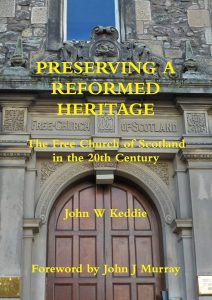
 John W. Keddie, Preserving a Reformed Heritage: The Free Church of Scotland in the 20th Century (Scottish Reformed Heritage Publications, 2017), 377 pages.
Who cares about the Free Church of Scotland? To the disinterested observer it is merely a small Presbyterian denomination in a wide, wide world. In 1843, a minority revolted against compromise in the national Church of Scotland over the issue of the interference of the State in church matters. The small band reconstituted as ‘The Church of Scotland, Free’. It received scorn and mockery as, “The Free Kirk, the wee kirk the kirk without the steeple.”1Moffat, Alistair, Good riddance to the Wee Frees (New Statesman Scotland, 31 January 2000), https:// www.newstatesman.com/node/193323 (accessed 26 December 2018). At the time the Church of Scotland was, in a vital sense, Scotland. The Disruption was a national catharsis, exciting an interest almost unimaginable in our times of spiritual lethargy. When Thomas Chalmers – a Disruption leader – walked out of the State Church, “the throng at his last service was so great that the police were overpowered and the military had to be called in.”2Barbour, G.F., The Great Disruption, The Spectator, 14 May 1943, 8.
Much diminished in worldly glory but much revived in spiritual vitality, the Free Church of Scotland marched from 1843 with lively vigour and missionary zeal. However, spiritual storm clouds gathered. Later in the century the glens thundered when battles ensued over numerous issues including higher criticism, purity of worship, the establishment principle, confessional subscription and even Arminianism. The storm broke with the unutterable calamity of 1900, when the majority abandoned reformation principles of “old school orthodoxy”3Keddie, Preserving a Reformed Heritage, 15. in doctrine and practice to unite with the United Presbyterian Church. The faithful minority continued as the Free Church of Scotland. The minority General Assembly pleaded with the people:
You are doubtless aware that a large number of the Members of the Assembly have withdrawn themselves from the Free Church, and have formed a new Church on a new basis, and under a new name. Such abandonment of an historic Church we deeply deplore, and cannot imitate. At all costs we are prepared to adhere to the Westminster Confession of Faith and the other Standards of the Church of 1843 as heretofore understood. And we affectionately appeal to you to join with us in our endeavour to maintain the ideal of the Church as the pillar and ground of the truth, the whole truth, as revealed by God in the Holy Scripture, and of which so admirable a compend is exhibited in the Standards of our Church.4Ibid., 99.
It was to no avail. Free Church communicant membership crashed to such lows that they became known by the pejorative moniker “Wee Frees”; numbers fell from a little under 300,000 in 1899 to just over 4,000 in 1900,5Siobhan McAndrew, Presbyterian Communicants, 1840–1970 (xlsx), British Religion in Numbers, University of Manchester, 2010, http://www.brin.ac.uk/wp-content/uploads/2016/06/Presbyterian-Communicants-1840-1970.xlsx (accessed 4 July 2016). with total adherents estimated at 18,000.6Keddie, Preserving a Reformed Heritage, 93. In 1901, the General Assembly of the Free Church numbered merely twenty-five ministers and about sixty-three congregations, the majority in the Highland Gaelic-speaking districts of Scotland.
Thus begins Part 1 of Preserving a Reformed Heritage: The Free Church of Scotland in the 20th Century, by John Keddie, a minister ordained by the Wee Frees in the 1980s. Keddie lays out the history of the Free Church in the 20th Century in three parts and an epilogue: “The Nineteenth Century Scottish Church Scene and the Church Union of 1900”; “Recovery and Rebuilding”; and finally, “Maintaining the Faith in a Changing World.”
In Part 2 – Recovery and Rebuilding – Keddie describes how the Wee Free Kirk regrouped after the Union of 1900. Not only reduced in number, the small minority also faced cruel persecution; in cases where their minister joined the union, many congregations found themselves literally abandoned in the cold, dark winter, without a church meeting house or manse. The United Free Church claimed the property of the Free Church minority, and civil authorities upheld the majority claims. Aside from the disparaging label “Wee Free”, men of the Free Church had also to endure other vicious, scornful, and spiteful characterizations. Critics said they were animated by a wicked “spirit of rebellion,”7Ibid., 120. mere actors “playing at Free Church,”8Ibid. and that opposition to union was a “political, rather than a religious movement.”9William Cunningham, Some Differences between Scotch and English Christianity, The National Review, Volume 45 (Ballantyne and Co., 1905), 689.
Into this milieu, God’s providence fell like a thunderbolt from heaven to shatter expectations. In 1904, a stunned nation shuddered when the House of Lords ruled that all the forfeited properties and funds in the hands of the United Free Church were legitimately those of the Free Church of Scotland. Although happily vindicated, the small minority, comprising less than two percent of the original strength of the church, found itself in the problematic position of having legal right to a massive trust of property and funds but faced with intransigence from the United Free Church majority, who had them in their possession. Bitter rivals called the ruling “the triumph of obscurantism”10Cunningham, Some Differences, 691. and did what they could to prevent the lawful possessors from reclaiming their own. Soon the British government intervened in the wrangling, and a subsequent Parliamentary Act of 1905 appointed a Commission to redistribute the properties and funds more ‘equitably’ between the United Free Church and the Free Church of Scotland. Some characterized this decision as “unjust”.11Keddie, Preserving a Reformed Heritage, 115. It mugged the Free Church not only at home but also robbed them of what was more precious, of what Alexander Duff called the “Chief End of the Christian Church”12Ibid., 225. – every one of her overseas Mission Stations.
It appears that many Scots had second thoughts about the Union. By 1905, the continuing Free Church experienced rapid growth and claimed over 65,000 members and adherents. The small, determined minority found vindication in their adherence to the heritage of the Scottish Reformed Church, the church of John Knox and Thomas Chalmers. They set to work to shore up the battered and ancient landmarks of the church. In 1905, and again in 1910, the Free Church powerfully reasserted the reformed understanding of public worship:
The General Assembly reaffirm the Disruption position of 1843 in respect of doctrine, worship, discipline and government, and enjoin all their congregations to adhere to purity of worship, as that was understood and practiced at that period.13Ibid., 124.
When several congregations failed to practice acapella Psalm singing, the General Assembly instructed presbyteries to enforce the law regarding ‘purity of worship’ in every case. This arguably contributed to some losses of ministers who, though opposed to union, were theologically in-tune with the ‘broad’ Church approach which valued diversity in doctrine and worship as a feature rather than a failure of faithfulness.
For the most part, the Church recognized the necessity to concentrate on matters most precious in the sight of God. In 1910, The Monthly Record, the denominational magazine, advocated revival, insisting that:
preaching is the divinely-appointed means for the recovery of the Church. ‘The only hope, humanly speaking, for this land is a religious revival, and the human instrumentality in such revival has invariably been a faithful Gospel ministry.’14Ibid., 185.
Over the succeeding decades the Free Church strove to prevent, however imperfectly, subordinating her mission to “the socialist vision of a secularised society” and “abandonment of Christian morality.”15Ibid., 310.
In Part 3 – Maintaining the Faith in a Changing World – Keddie considers the most recent decades in the life of the Free Church, including the tragic split at the end of the twentieth century. The twentieth century is, of course, the bloodiest century in the history of mankind in which man’s barbarity to man found full expression countless times. The established Church of Scotland presented no challenge to the world but rather accommodated its spirit by astounding betrayals, compromise, cowardice, division, and treachery. The history of the Free Church of Scotland proves what strange and half-sighted creatures we are, for once again, in latter decades, the Church struggled with many of the same issues for which it had sacrificed so much a century earlier. Sadly, at the end of the twentieth century, the Free Church found herself engaged in skirmishes wherein she found her distinctives again challenged as obscurantist and unsuited for a modern world.
Parallels in tone at the end of the millennium echoed eerily familiar tunes from a century before. Issues boiled over regarding the failure of the Church to apply proper disciplinary procedures against infidelities alleged against a theology professor. The heat rose at the 1999 General Assembly when the actions of protest by some disaffected Church members received vituperation from Rev. Iain D. Campbell, as “gross scandal” akin to “incest, adultery, trilapses into fornication, murder, atheism, idolatry, witchcraft.”16Ian H. Murray and Murdoch Murchison, When Justice Failed in Church and State (London, 2001), 60. A few months later, Campbell wrote in the Monthly Record that it was time to halt protests, “to grasp this thorn in our flesh” and “to cast out the bondwoman and her son.”17Murray and Murchison, When Justice Failed, 68. It was as if the horrors of 1900 had risen again from the grave.
Matters climaxed on 20 January 2000, when 30 ministers, including 22 who were suspended, claimed that the majority had departed the Free Church of Scotland and that the reconstituted minority adhering to the constitution were the true Free Church of Scotland (Continuing). And so the Free Church entered the new millennium as two contending parties.
Keddie considers the future of the Church in the Epilogue. Broad, mainline Scottish churches continue to hemorrhage members. They push through liberalizing gimmicks, simpering seductions by which they hope their appeal may broaden to a worldly-wise demographic. They progressively reject Biblical authority in favour of cultural cachet. The synthesis of Christianity with hastily assembled worldly dogmas, with their worship of fleeting fashions, says nothing unique among the secular mysticisms that surround us. When the church accommodates the world, the world absorbs the church.
Since the split of 2000, every indication demonstrates that the Free Church majority flirts further with disaster, similar to what engulfs the mainline church, including changes as significant as in ordination vows. Keddie offers examples from 2010 when the majority rejected their constitutional position on purity of worship. He mentions a minister, later elected as General Assembly Moderator, publicly welcoming the Pope of Rome to Scotland, as “a fellow Christian.”18Keddie, Preserving a Reformed Heritage, 304. In this context the future appears bleak.
The minority added the word ‘Continuing’ to their name to stress that they saw themselves as maintaining their roots. The Free Church of Scotland (Continuing):
holds unequivocally to the whole doctrine contained in the Confession of Faith as its subordinate standard and to the doctrine, worship, government and discipline of the Scottish Reformed Church, particularly as expressed in the historical standards of the Free Church of Scotland. It maintains the practice of purity of worship, believing that only unaccompanied inspired materials of praise have Scripture warrant for use in public worship. It affirms the doctrines of grace…. As a gospel church it is ‘evangelical’ in maintaining the free gospel call to repent and believe in Christ…. holds to the Headship of Christ in Church and State….19Ibid., 312.
History will judge who are the rightful “heirs” of the historic Free Church and its testimony.
Thomas Chalmers said, “Who cares about the Free Church compared with the Christian good of the people of Scotland? Who cares for any Church, but as an instrument of Christian good?”20Barbour, The Great Disruption. In short, if a church forgets or betrays its mission, it will die. It will deserve to die. Keddie’s book is therefore sad to read, for the Free Church of Scotland has failed to fulfil her promise of 1843. Mavericks and mavens with fingers feeling the wind will not save her. Keddie remains optimistic, if not in man, then certainly in the Son of Man. Jesus does not flinch at the weakness and small number of those steadfastly adhering to Him. He encourages His little flock to persevere: “Casting all your care upon him; for he careth for you” (1 Pet 5:7).
Footnotes
- 1Moffat, Alistair, Good riddance to the Wee Frees (New Statesman Scotland, 31 January 2000), https:// www.newstatesman.com/node/193323 (accessed 26 December 2018). ↩︎
- 2Barbour, G.F., The Great Disruption, The Spectator, 14 May 1943, 8. ↩︎
- 3Keddie, Preserving a Reformed Heritage, 15. ↩︎
- 4Ibid., 99. ↩︎
- 5Siobhan McAndrew, Presbyterian Communicants, 1840–1970 (xlsx), British Religion in Numbers, University of Manchester, 2010, http://www.brin.ac.uk/wp-content/uploads/2016/06/Presbyterian-Communicants-1840-1970.xlsx (accessed 4 July 2016). ↩︎
- 6Keddie, Preserving a Reformed Heritage, 93. ↩︎
- 7Ibid., 120. ↩︎
- 8Ibid. ↩︎
- 9William Cunningham, Some Differences between Scotch and English Christianity, The National Review, Volume 45 (Ballantyne and Co., 1905), 689. ↩︎
- 10Cunningham, Some Differences, 691. ↩︎
- 11Keddie, Preserving a Reformed Heritage, 115. ↩︎
- 12Ibid., 225. ↩︎
- 13Ibid., 124. ↩︎
- 14Ibid., 185. ↩︎
- 15Ibid., 310. ↩︎
- 16Ian H. Murray and Murdoch Murchison, When Justice Failed in Church and State (London, 2001), 60. ↩︎
- 17Murray and Murchison, When Justice Failed, 68. ↩︎
- 18Keddie, Preserving a Reformed Heritage, 304. ↩︎
- 19Ibid., 312. ↩︎
- 20Barbour, The Great Disruption. ↩︎