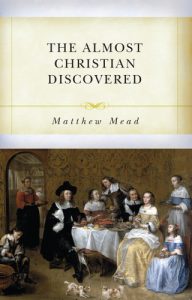
 Matthew Mead, The Almost Christian Discovered (Soli Deo Gloria Publications: Grand Rapids, 2019), xx + 166 pages.
The soul is priceless. “What shall a man give in exchange for his soul?” (Mark 8:37). One need only consider the rich man’s words while in hell, “I am tormented in this flame” (Luke 16:24), to realize how highly we should esteem our soul’s salvation. Yet, however highly we ought to concern ourselves about our soul, God’s Word is clear in indicating that many will be deceived regarding their salvation until the final day: “And then will I profess unto them, I never knew you: depart from me, ye that work iniquity” (Matt. 7:23). What help is available to the one wanting to know whether he is deceived regarding his own soul and salvation?
Drawing from Agrippa’s testimony to Paul, “Almost thou persuadest me to be a Christian” (Acts 26:28), Matthew Mead (c. 1630-1699) published The Almost Christian Discovered in which he raises the doctrine, “There are very many in the world that are almost, and yet, but almost Christians” The book provides an excellent example of simple but searching analysis of common errors which have deceived many souls to their eternal undoing. In the end, the work assists today’s reader to examine himself to see if he rightly confident of his salvation or not.
The Almost Christian was originally published in 1661 and has been in print by Soli Deo Gloria since 1989, running various editions and printings. As with all of Soli Deo Gloria’s publications, this work’s spelling, grammar, and format have been moderately edited, making it more accessible to today’s reader. This most recent edition was issued in early 2019 and is printed as a softcover.
Mead may not be as well-known as other Puritans of his day. If known, it is likely because of this book. He was an English Independent, associated with the names of John Owen and Joseph Caryl. He was not as prolific an author as either, but his works demonstrate an acute awareness of sin and the danger of temptation, while exhorting Christians to walk wisely in this world. He was ejected in 1662 and was forced to spend time in Holland on at least two separate occasions. He returned to England in 1687 and labored until his death in 1699, at 70 years old.
The book itself is not a comprehensive work on the marks of grace. It does not provide full counsel to awakened sinners as to how to find peace with God. While it touches on both topics, it focuses primarily on one matter: helping us to see how much an unconverted person may resemble someone who is converted. It is aimed at awakening deceived souls. The book itself presents five questions, after which Mead concludes with several uses: of application, examination, caution, and exhortation. The questions are:
- How far may a man go in the way to heaven and yet be but almost a Christian?
- Why is it that many men go so far that they come to be almost a Christian?
- What difference is there between a natural conscience and a renewed conscience?
- Why is it that many are but almost Christians when they have gone thus far?
- What is the reason that many go no further in the profession of religion than to be almost Christians?
His first question receives the longest treatment, running almost half of the book, and presenting twenty ways of how much one may resemble a converted believer. Among these are: “He may do much against sin,” “He may tremble at the word,” “He may be a member of the church of Christ,” “He may be much in prayer,” “He may have some kind of faith,” “He may love the people of God,” and “He may be, in some sense, sanctified.” Mead’s method of treating each of these is very helpful and lends itself to clarity. He begins each assessment with a Scriptural example of one who was deceived by the false mark. He follows the example by raising an objection to his point, typically stating that the given characteristic is elsewhere described in Scripture as a mark of grace. He then proceeds to answer the objection by distinguishing the difference between gracious and natural experiences. For example, when showing that a man may have a type of faith but not be converted, he writes:
Though it is true what our Lord Christ said, that “he that believes shall be saved”, yet it is true that many believe that shall never be saved. Simon Magus believed. Yea, James said, “The devils believe and tremble.” Now, none will say these shall be saved…There is a saving faith. This is called “faith of the operation of God.” It is a work of God’s own Spirit in the soul. It is such a faith as rests and casts the soul wholly upon Christ for grace and glory, pardon and peace, sanctification and salvation…There is a common faith which is not saving, a fading and temporary faith.
Mead then provides further characteristics of this common, non-saving faith, explaining what it is and why it is insufficient. Though he is not exhaustive in what could be said, he is clear and Scriptural. It is a method that provides the reader with the ability to assess himself in light of the truth presented.
The four remaining questions are answered in less space, but with equal clarity and help. By the end of the work, the reader is left with a work by which he can assess himself. He will have been forced to assess his own actions, affections, motives, conscience, and confidence. Furthermore, he will have encountered faithful warnings and exhortations giving practical advice regarding his soul.
It is good to remember that any attempt to examine and demonstrate how far someone may go in religion without being converted presents a temptation to weak believers. Mead is aware of this and states that the design of his book:
… is not to break the bruised reed, nor to quench the smoking flax; not to discourage the weakest believer, but to awaken formal professors. I would not sadden the hearts of any whom God would not have made sad; though I know it is hard to expose the dangerous state and condition of a professing hypocrite, but that the weak Christian will think himself concerned in the discovery.
Throughout his book, Mead is careful to distinguish between what is and is not a mark of grace. He also shows the difference between weak and strong faith. It is important for all to remember that, as Mead notes, “The least measure of true grace is as saving as the greatest. It saves as surely, though not as comfortably. The least grace gives a full interest in the blood of Christ whereby we are thoroughly purged, and it gives a full interest in the strength and power of Christ whereby we shall be certainly preserved.” When examining ourselves, we ought to avoid both the error of mistaking nature for grace, and the error of mistaking grace for nature. While this book focuses on the disastrous error of mistaking nature for grace, it also provides help and encouragement to those who are prone to overlook grace in their lives.
Without the slightest exaggeration, here is a book to be recommended to every professing Christian. In a generation of Evangelicals mistaking church membership or profession of faith with certain conversion, such a book is needed. Moreover, as in Mead’s day, Reformed congregations are not immune to this deception. The pages before us were originally sermons preached to his congregation. Additionally, it is rather simple to read. Young and old alike would benefit from the examination encouraged by this book. The true believer may be chastened and refined, but he will return thanks for the experience. Though there is a real temptation for weak believers to be shaken unnecessarily, the greater danger is for false believers to live confidently. It provides a sober word to a confused and deceived world. May the Lord bless it to the awakening of sinners to their need, ultimately drawing them to Christ Jesus, to be altogether Christians.