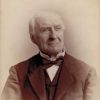
Selected from: “Sermon preached at the opening of the Synod of New Jersey, October, 1858,” Home, the School, and the Church, or the Presbyterian Education Repository, edited by C. Van Rensselaer (Philadelphia, 1859).
“Lest that by any means, when I have preached to others, I myself should be a castaway.” 1 Corinthians 9:27.
The most immediate, and to this audience, the most impressive suggestion conveyed in this half sentence is, that a preacher of the Divine Law and Christian Gospel may be a castaway.
Nay, when we remember who was the “I myself ” that wrote these lines, we perceive that even an Apostle, an inspired preacher, was not, on that account, beyond the peril. We have the still more positive confirmation of fact; for an older Apostle than Paul, one of the original twelve, called and endowed with power by Christ himself, fell by transgression from “this ministry and apostleship,” perished by suicide in the field he had purchased with the reward of iniquity, and went from Aceldama to what was, in a more fearful sense, “his own place,” a castaway.
Every chapter of church history, down to the records of our own Synods and Presbyteries, makes the admonitory revelation, that like the Wandering Jew of the old legend, the Iscariot has made his footprints in every place where the Church has stood. Preachers of the Gospel have become heretics, blasphemers, infidels: they have died on the gibbet, not as martyrs, but as felons; they have been visited with “scourgings, bonds, and imprisonment,” not for their faith, but for their crimes.
Besides what comes to the light in these ways, we know that the Scriptures must be in the course of fulfilment, which declare that there shall be false men in the ministry, speaking lies in their hypocrisy; many Antichrists, besides the emphatic Man of Sin; deceivers sitting in the temple of God; vessels in the great house to dishonour; men teaching for filthy lucre’s sake, and for that price things which they ought not, going in the way of Cain, running greedily after the error of Balaam for reward, and perishing in the gainsaying of Korah; false apostles, deceitful workers, transforming themselves into the Apostles of Christ.
But ah! my brethren, why need I cite these painful predictions, and historical instances; why need I use the mysterious phrases of whose definite meaning the Church is uncertain, when we have our own consciousness to appeal to, our individual experience to testify within us? How easy it is for a preacher to become a castaway! Let us not judge one another; but looking at our common nature, the unfinished work of the sanctifying Spirit, the abounding temptations, the peculiar self-delusions to which we are professionally subject, does it not often come into our minds that if we are not already reprobate, we could easily become such? that we deserve to be such? Has not our very preaching, the very act of preaching, sometimes suggested this?
We may admit the allowances implied in the proverb, that no minister is as good as his sermons or his prayers; we may properly insist that imperfect men must not, through a consciousness of their own imperfection, in example and experience, hold back in their preaching the most complete representation of the Divine standard of Christian character; yet, while this is due to the third party with which we are connected, the very stress of the obligation we are under to present that fulness of our message, is adapted to bring it home to our souls with the irresistible logic of the epistle, “Behold, thou makest thy boast of God, and knowest his will, and approvest the things that are more excellent, being instructed out of the law, and art confident that thou thyself art a guide of the blind, a light of them which are in darkness, an instructor of the foolish, a teacher of babes, which hast the form of knowledge and of the truth in the law: thou, therefore, which teachest another, teachest thou not thyself?” Thou that sayest, out of the Scripture, that one should do and not do, that he should believe and reject, that he should feel and be; dost thou, O preacher, dishonour God and his word and thine own sermons, and thine own sacraments, by saying and doing not? Oh, that is a preacher’s reprobation which is set forth in the language of the Lord and Master himself, “Many will say to me in that day, Lord, Lord, have we not prophesied in thy name, and in thy name have cast out devils, and in thy name done many wonderful works? And then I will profess unto them I never knew you; depart from me, ye that work iniquity.” It is not “whosoever shall teach,” but “ whosoever shall do and teach,” that shall be called great in the kingdom of heaven.
Indeed it is remarkable how jealously our Lord trained the twelve for their ministry with a view to their peculiar spiritual perils. It looks as if his benevolent but faithful mind, whenever he turned towards these simple men, was affected by the secret perception of their weaknesses, their ignorance, their exposures, their coming trials, all so unsuspected by themselves, and to be learned mostly by surprising experience, and as if almost everything he said had at least a secondary aim at their special instruction and admonition. It is a great study of itself to follow the course of the Lord Jesus with this view. No system of pastoral theology taught in the schools can compare with the lessons of that daily walk of Christ with his “children.” John 21:5.
What a superhuman insight did the Lord show in not allowing himself to be deceived by the present amiableness, the zeal, the docility, the solemn assurances and gratuitous vows of these men! How often he took occasion to forewarn them of their unseen and unbelieved jeopardy; sometimes permitting them to discover it for themselves by letting them go a while without his prevenient and protecting grace! He held before them, not merely the disrepute, the ungracefulness, or the ingratitude of apostolic inconsistency, but the danger of apostasy and reprobation. “Simon! Simon! Satan hath desired to sift thee as wheat.” To that same Simon he said: “Get thee behind me, Satan!” and surely he was nearer being a castaway than we know of Paul’s ever being, after their respective conversions, when he cursed and swore, and protested three times that he knew not the man who was standing before Caiaphas. It was directly to the twelve, when he detected their latent envy, their ambition, their secular views, or it was in their hearing, in his more general discourses, that he spoke the parables of unfaithful stewards, indolent servants, dishonest agents, rapacious husbandmen.
I need not presume here to expound the exact meaning of the castaway of our version. You will remember that the same word is only so translated in this place, and that in the seven other places of the New Testament, it is once rendered “rejected,” and six times “reprobate.”
The image is, therefore, the familiar one of that which is cast aside because it does not come up to the quality or service required in the test of it. As reprobate or castaway metal is that which, being tried by the proper tests, is found to be either altogether spurious, or below the proper standard required for use, and as structures are tried, and abandoned, if they do not pass the appropriate test of their strength and capacity, so one is reprobate who, if tried by the evangelical standard, is rejected as deficient in the marks which designate the Christian. A castaway preacher, in like manner, is one who, if judged by the tests appropriate to his official, superadded to his personal Christian character, should have to be stigmatized as not such a one as Christ acknowledges.
If we ask what are these peculiar tests, Church tradition will answer in one way; Scripture tradition will answer in another way. The one dwells most on imposition of hands, and of certain hands, the other on the spiritual character. The former is to be pursued in a series of voluminous controversies, the latter is not the subject of controversy at all, because the New Testament is at so little pains to treat of it as ecclesiologists would like to make it out. The New Testament shows the Divine Founder of Gospel institutions breaking up the old ideas of holy tribes and ecclesiastical genealogies, by taking for the first ministers of the Christian Church, no priest, no Levite, no official of the temple or synagogue, but men found in his common walks, then instructing them in doctrine, and especially disciplining their hearts, and laying so little stress on ceremonials, that he rather seemed to discountenance the whole idea when, in reference to a scruple of this very sort, suggested by the Apostles, he gave them the aphorism, “for he that is not against us is on our part.” Oh, how the rebukes which our Lord gave so often to the Jewish Apostles, when they were reverting to the bondage of the old ceremonials, apply to us, in our more enlightened condition, when we turn day after day to the journals of his life, and find how little he said or did, or at least required to be put on the record, as to the points which disunite the Church and feed the perpetual flame of sectarianism!
Then the Acts and Epistles continue the Scripture tradition to the same effect. The tests of the ministry that stand out there in overshadowing prominence, are soundness of doctrine and purity of heart. So unsacramentarian is the chief of the Apostles, that he declares that Christ sent him not to baptize but to preach the Gospel; and so unassuming of prerogative or station, that he declares the highest honour of Christ’s preachers is to be ministers’ servants, by whom men believe. And so, when he writes still more immediately, and, as it were, officially, to ministers as such, the charge he commits to them, as involving the point of their standing or falling, is their holding faith and a good conscience; their being blameless, vigilant, sober, just, holy, temperate; not self-willed; of good behaviour; taking heed to themselves; reading and meditating for their profiting; giving themselves wholly to these things; not covetous, or entangling themselves with the affairs of this life, but fleeing the worldly pursuits which had already caused some to err from the faith; to follow after righteousness, godliness, faith, love, patience, meekness; to fight the good fight of faith; not striving about words to the subverting rather than the converting of their hearers; not entering on questions (theological though they be) that gender strifes more than they edify; not novices, lest they be proud; having a good report of the world as to their moral standing; examples of believers, patterns of good works. The Church quarrels whether Timothy was bishop of Ephesus, or Titus of Crete, because Paul was more careful to let Timothy and Titus know how they ought to behave in the house of God, than to place beyond dispute how, and in what relations they were brought into the house. “If thou put the brethren in remembrance of these things”—things conscientious and spiritual—“thou shalt be a good minister of Jesus Christ,” whether the hands of the Presbytery were of one or of many, whether the charge be a parish or a diocese.
Such is the test of the minister. The castaway is the minister who does not abide the test; who is so far opposite to, and different from, the standard thus established—whose faith, spirit, life—whose personal religion and official fidelity, are so wanting in these characteristic traits of a good minister, that, in the eye of Christ, he cannot be identified by the description. I say the eye of Christ, for human trial, and ecclesiastical inspection fail here, as in every other experiment of trying the heart. The inferior qualifications may be determined by a prescribed criterion, but it is only the omniscient sight that reaches to the root and foundation. “The fining-pot is for silver, and the furnace for gold, but the Lord trieth the hearts.” They are the eyes that are as a flame of fire, and the countenance that is as the sun shineth in his strength, that behold and penetrate, while the infallible voice declares to the angel of each church: “I know thy works; I know thy works.” That this is the purport of this inspection, that this is the standard, is as plain as the ten commandments. If, therefore, like our predecessors in apostolic conference with their Master at the table, we are disposed to say, “Lord, is it I? is it I?” the test is easily applied. According to that example, it is best applied by a direct, individual appeal to the Chief Shepherd himself. By an humble, contrite, approach to his feet, in opportunities of utter separation from the misleading influences of one’s public ministrations, can the minister best come to an impartial discovery of that point of points for his research,—his own actual standing in the sight of Christ.
The signs of a castaway preacher, so far as they are distinct from those of the trials of other Christians, will appear to be such as these: he has no cordial or practical belief in what his function compels him to preach; he feels an intellectual pride, and enjoys an ambitious gratification in preaching, but has no heart in it as the means of glorifying God and restoring man; with him the ministry is no more than a profession; preaching is his livelihood. If he labour for success, it is for the sake of maintaining his professional position; he is actuated, as men are in their secular vocations; he seeks for promotion; his choice of place and occupation, and his charges, are determined by the preponderance of personal advantages; he will not forego domestic comfort for the sake of ministering in obscurity to the least provided; he finds ready excuses for retiring from labour, or for indulging indolence; he counts his life too dear to run risks; he is always looking for material reward, even for his prayers and consolations; he resorts to tempting adventures, not merely from necessity, or while the necessity continues, but from the love of gain and the pleasure of accumulation; he hoards penuriously while he preaches liberality; he loves general literature more than theology, the society of the world more than the society of the Church; he preaches and prays, visits and writes for fame and notoriety; the pleasure and excitement of the act of preaching are the effect, not of zeal, but of self-complacency; and the gratification or disappointment which he experiences, does not relate to the souls of the people, but to his own vanity; he looks on his fellow-ministers as competitors and rivals; he is envious and jealous; mortified at being overlooked, and ever suspicious of slights.
But this is only a random sketch of particulars. Perhaps all may be comprehended in the phrase of the text by saying, that the character described is only a preacher to others. He may have the gifts of prophecy and knowledge, may speak in the tongue of angels, but he is not in himself such a preacher as Christ requires; his unction is not from the Holy One, and so he is disowned, rejected, castaway.
Or the first part of the whole sentence may be taken as giving a comprehensive sign of the castaway preacher in the declaration which introduces the “lest that by any means” of the text. “I keep under my body, and bring it into subjection, lest that by any means when I have preached to others, I myself should be a castaway.” It is the predominance of the body, bodily consideration, the body as the symbol of whatever is secular, sensual, personal, selfish, the mortal in distinction from the spiritual,—it is this which, unsubdued, and not kept under subjection, makes men castaways, although they have preached to others, and perhaps saved others from the very abyss in which they themselves fall.
The perils of the ministry from this quarter are increased with the worldliness of the nominal church, or of church-supporters. The world gain much to their side by encouraging in preachers such views or habits as assimilate their teachers to themselves. In proportion as their flattery or liberality, their flexible principles and loose opinions make an impression on the yielding minister, their own course is more free, and the dangers of the pastor are multiplied. Their influences will appear in the most specious connections. Display, extravagance, luxury, pride are not confined to private habits; the simplicity that is in Christ may be violated in the most evangelical guise. A Bible Society may build a palace; a Sunday School Institution may be as financial as a bank; an ecclesiastical Board may have as much policy as a cabinet; a church may be as fashionable as a theatre. The preacher is in all these, and he must keep his body under, as to some of the subtlest insinuations of the social state which surrounds him, if he would not run uncertainly, or beat the air. Many a Demas has forsaken Paul, having loved this present world, and it is Paul who calls on the Church to mark them and avoid them, whosoever they be, that serve not our Lord Jesus Christ, but their own carnality, even while by good words and fair speeches, it may be from pulpit, platform or press, they deceive the hearts of the simple.
What are the consequences of the rejection so declared in the text? That rejection may be considered either personally, as it relates to the man, or officially, as it relates to the preacher. The personal disowning would ensue upon his being found wanting when weighed in the balance which determines whether one is or is not a Christian. He cannot plead the laying on of hands, the sprinkling of baptism, the partaking of the Lord’s table, the works of the pulpit, the study, the judicatory; he cannot plead his popularity, his titles, his success: he must, like the lowliest of his flock, be judged by the eternal test, which, as in every other case, will be applied both to heart and works. No minister will be castaway because he was less conspicuous, less celebrated, than others; but if such should by any means be the fate of any, after having preached to others, it will be because they were unconverted men; because they entered the ministry, not at the call of God, but under a professional attraction, or as a last resource, or under stress of persuasion, or offer of reward, or recent excitement, or transient enthusiasm; and, perhaps, more than all other causes, because when, after preaching to others, they found reason to conclude that they were themselves unbelievers, they did not then so take to heart their own preaching as to be converted and healed, but continued, through shame, or fear, or habit, or dread of temporal consequences, to act wilfully as false apostles, with the evidences of reprobation constantly before their eyes in their own manuscripts, uttered by their own arguments, testified to God and their consciences by their own prayers, witnessed against themselves every time they dipped their hand into the font, or broke the mystical bread.
If, again, the rejection be considered specifically as that of the preacher, it is the decision of the Divine Head that the individual is not a true representative of his kingdom—that he is not an accredited ambassador. Whatever he may have said or done in the name of Christ, the sentence which disowns him is its own justification, “I never knew you.” His title, his licensure, his ordination, his instalment, have no more power to give him sanctity in the Divine view, than does the colour of his clothing. Are his ministerial acts valid? What is validity? No acts on the part of man, not even on the part of the Church, give of themselves either validity or invalidity before God, to what is said or done on earth. In human consideration, and as to their effect on the human mind, the official acts of a minister, standing fairly in the visible Church, though in the Divine judgment reprobate, may have all the effect of what is genuine. The children he baptizes are duly initiated; the communicants who, by their faith, receive the Lord’s bread and wine, are blessed in their devotion; the words of Bible truth he preaches may instruct, awaken, convert, and edify; the men upon whom he places his ordaining hand are truly set apart to their sacred office. All this is provided for the orderly convenience and the comfort of the Christian society.
But God acts independently of what is done or left undone by any of his ministers, the genuine or the spurious. None of their acts, and the acts of none, can be said to bind Him. No such unqualified claim as that can be pretended on the warrant of “whatsoever ye shall bind on earth, shall be bound in heaven.” The best of ministers, by ignorance, by mistake, by indiscretion, do things and say things, even in the name of Christ, which pass as inoperative as their breath. A hypocrite may deceive the holiest session, and die in the confidence of the purest church, but the act of his admission to the Church, and his continued fellowship with true saints, had no “validity” in the Divine sanction to seal his redemption. If this be the construction of validity, his baptisms and communions were not valid. They availed him nothing. They were wasted upon him. That which is highly esteemed among men for some fancied intrinsic virtue, may not be preserved by its religious name from becoming, in particular instances, abomination in the sight of God; and one of the saddest subjects we can contemplate is, how many sacred acts and formal observances must be always taking place in the Church, which, like the multitude of sacrifices, the Sabbaths, the calling of assemblies, the solemn meetings, the multiplication of prayers, in the first chapter of Isaiah, are of no purpose to God, at best are vain oblations, and it may be, rise to the enormity of an abomination, a trouble, and a weariness to him! If the services of a false minister are followed by good effects, they are the result, not of the Divine sanction, either of the personal or official character of the preacher, but of the Divine sanction of the truth and of its symbols. The result gives no seal to his credentials. A Jew or infidel may print the New Testament for the profit of the publication, and such copies of the word may be as much blessed to the kingdom of heaven, as those issued by the Church itself. So the words, the arguments, the eloquence, the talents, of a preacher may be the means of benefit to souls, and a means of reputation to himself both living and dead, yet it may be, that as an official messenger he could never describe himself, with the writer to the Galatians, “an apostle, not of men, neither by man, but by Jesus Christ and God the Father.”
If the nature and the causes of this sad condemnation have been fairly stated, it is unnecessary to look further for the remedy. The Apostle gives as well the direction as the warning, in his words: “I keep under my body, and bring it into subjection, lest . . . myself should be a castaway.” We have his own exposition of, and commentary on what is meant by the body and its subjection, when he says, “all things are lawful for me, but I will not be brought under the power of any”; “let not sin reign in your mortal body, that ye should obey it in the lusts thereof, . . . but yield yourselves unto God, as those that are alive from the dead”; they that “are in Christ Jesus walk not after the flesh, but after the Spirit”; “they that are after the Spirit, mind the things of the Spirit”; “now if any man have not the Spirit of Christ, he is none of his.” I need not prove to this assembly that the terms body and flesh comprise the lusts of the mind and of the heart, in all their vanities, self-conceits, ambitions, enmities, bigotries, uncharitableness, covetousness, as well as the more corporeal that tempt to ease, indolence, luxury, intemperance, or immoderation.
The self-denial which one preaches, he should not only exemplify in his own private life, as visible to observers, but should practise upon his own soul in regard to his individual characteristics and circumstances. He must not spare his own eye, or foot, or right hand, when they tempt him to offend. If the preacher is in special peril of becoming a castaway, from neglecting to bring his body into subjection to his own doctrines, if, with all his knowledge, his theoretical soundness, his efficiency in serving others, his own soul is in jeopardy, then he is called to exercise a watchfulness and self-denial peculiar to himself, to his own position, a branch of the common duty which it is the more incumbent on him to perform than to preach, inasmuch as he is the one to whom, in his distinctive character, the precepts are addressed. The presumptuous sins of a preacher must be the most aggravated of all that come under that inspired designation; and it must be the highest grade of presumption for an expounder and teacher of religion to trust either in his office or his theology, to shield him from the application of such a test as this. The creed will never exculpate, will never screen any transgressor. Election, predestination, perseverance, as mere doctrines, though held with Antinomian confidence, will not avert the reprobation of the preacher who, trusting in them, neglects to keep under his body and bring it into subjection. Subjection is the word; the same figure applied to the power of grace, as is applied to the power of sin. His servants ye are whom ye obey, whether of sin or of obedience. Sin reigns in the mortal body. Those who are made free from sin become the servants of righteousness. The bondage of Satan becomes the yoke of Christ. The preacher is not to bind burdens on others, which he discards from himself. No subjection of the flesh is to be his text; it is to be his practice. Alas! alas! how many that were thought, and thought themselves, to be standing, have fallen, just because they would not take heed to the reflex application of this principle! “Then spake Jesus to the multitude and to his disciples, saying, The Scribes and Pharisees sit in Moses’ seat; all, therefore, whatsoever they bid you observe, that observe and do; but do not ye after their works; for they say and do not.”
There is, then, no preventive, no remedy, but the spiritual mind. The revival we need is the revival of the piety of ministers. And as the main cause of its depression is the superincumbency of the world and of the flesh, as the cares of other things entering in choke the word, even in the heart of the sower, so life must begin with the putting away of that which is smothering it. “Take away the dross from the silver, and there shall come forth a vessel for the refiner.” If, through the charming of a serpent as subtle as the beguiler in Eden, our minds have been corrupted, in any form, to any extent, from the simplicity that is in Christ, there must be a conversion in that particular before we are strengthened. Is it not one of the great perils in which we stand this day, that the outward strength of our Church is becoming the arm of flesh, in which we misplace our confidence? May we not hear too much of names, money, schemes, policy? May we not speak too much of power, of numbers, of denominational triumphs, as though the dominion were ours, and we the masters, rather than the ministers? If personal considerations then fail to awaken us to the necessity of cultivating the spiritual mind, let us reflect that a church may be castaway, and recollect that history records that those were not vain alarms that have been sounded in times past, and are still echoed from the seven trumpets of the Apocalypse: “I will come unto thee quickly, and will remove thy candlestick out of his place except thou repent. I will spew thee out of my mouth.”
Spare thy people, O Lord, and give not thine heritage to reproach!