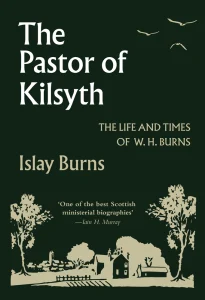
 Islay Burns, The Pastor of Kilsyth; or, Memorials of the Life and Times of The Rev. W. H. Burns DD (Edinburgh: The Banner of Truth Trust, 2019), 312 pages.
Biographies provide a distinct benefit to the Christian. Doctrinal books instruct our minds, practical books guide our actions, but biographies do both by holding a model before us, often fleshing out the influences of sound doctrine and the habits of wholesome practice in ways only they can. Scotland has been privileged to provide the scene of many subjects for wholesome and edifying Christian biography. The lives of Halyburton, M’Cheyne, Bonar, and Macrae are books that will always be cherished by those who want to know what it is to walk with God. Never do they provide a picture of a perfect Christian, but they always impress upon us a sound form of faithfulness.
Few will be familiar with the subject of this biography, William Hamilton Burns (1779–1859). More will be familiar with his sons, William Chalmers Burns and Islay Burns. The father stands less known, not because less faithful, but likely because more ordinary. While less prominent than his sons Islay and, certainly, William Chalmers, he was devoted, godly, and earnest for over fifty years of steadfast labor to God’s glory. But as this brief biography demonstrates, it was not merely his duration but the quality of his labor that warrants our attention.
W. H. Burns was born in 1779, the fifth of eight sons alongside four sisters. In this large family, God’s grace was prized and cultivated. Burns would learn early lessons of grace and piety surrounded by a godly family. His youth was lived during the interesting age of moderates and evangelicals, even witnessing the famous plea in 1796 by John Erskine for evangelical missions, “Moderator, rax1rax – to reach, stretch (Ed.) me that Bible.”2Burns, The Pastor of Kilsyth, 27. These privileged scenes would be blessed of God both to his conversion and his preparation for the Gospel ministry. Entering the ministry in 1800, he would serve for over fifty years in only two congregations. His first charge was in a small country parish of Dun, roughly thirty miles northeast of Dundee. It is here he would spend twenty-one years of regular and attentive pastoral labor. His second and final charge would find him in Kilsyth, near Glasgow. Though not large by today’s standards, the new scene stood in stark contrast to the small pastoral scene he knew in Dun. He would serve here for the remainder of his life, from 1821 to 1859. During these years he would witness and participate in an outpouring of God’s Spirit and the Disruption of the Church from the Establishment, all the while laboring faithfully year by year, caring for the souls of his charge.
It is worth noting that the book is not a comprehensive study of Rev. W. H. Burns’s life and ministry. It is, as the subtitle notes, a collection of “memorials” from his life and ministry. Today we might call it a sketch, however, it is not a haphazard survey of unconnected anecdotes. The sketch covers his life, raising up monuments along the way for reflection. The book briefly covers his early life, focusing the majority of our attention upon his two pastorates. Far from detracting from the value of this work, the brevity of this biography serves to capture something of the liveliness of the subject.
The book is composed of twelve chapters spanning his life. Chapters one and two set the scene by surveying the state of things in the nation and church. Chapter three provides insight regarding the time of his first pastorate (1800–21), while chapter four covers the same timeframe but with an eye to the changing culture of his day. Chapters five through ten focus on his second pastorate, from the early labors and homelife in Kilsyth (chapters five and six), to the times of revival (chapters seven through nine), and the season of the Disruption through his final years (chapter ten). The final two chapters focus on his last days and death. Following the final chapter, the reader is provided with additional “illustrative remains.” These inclusions aid in providing another insight into the life and ministry of W. H. Burns. The lengthiest of them is his “Lecture on the Mode of Conducting a Revival: Errors and Evils to be Avoided.” Far from the ungrounded views of revivalism today, this address shares scriptural and sound insights regarding Godsent revival. He notes various principles associated with true outpourings of the Spirit and warns against several and serious errors. Throughout he demonstrates a simple reliance upon Scripture and a helpful ability to illustrate with historical references. The other remains are four sermons, one of which is by his son, William Chalmers Burns, at the outset of the outpouring—all of which are instructive and edifying.
Throughout the book we become acquainted with one who led, as the biographer called it, a “quiet, but busy and useful life.”3Ibid., 52. On a Saturday during the early part of his first pastorate, he records, “This day important as preparatory for the solemn work of tomorrow. May my thoughts be well regulated, my affections devout, memory retentive. This day should preach to myself, that tomorrow I may be prepared to preach to others.”4Ibid., 52-53. This conscientious attention seemingly abided with him throughout his life, doubtlessly a means of the usefulness for which he was known. Each week he was visiting members throughout his parish, tending to the poor, and instructing the children, all while overseeing his own soul and preparing for his Sabbath labors. He was full of steady activity giving constant attention to the care of souls.
Yet this pastorate of twenty-one years was not full of the kind of fruit we might imagine. Islay inserts his own assessment:
A short time ago I too found my way to that quiet and solitary churchyard. The old church, superseded by a modern structure at some distance, had been turned into a tomb, but all around remained unchanged as in other days. But the congregation of the old pastor was beneath my feet. A solitary loiterer was standing near, who, to my inquiry, replied “that he remembered the name of a Mr. Burns; that one of that name, he believed, had once been minister there.” Such is the scanty record on earth of so many years of faithful service, of so many prayers and unwearied ministrations of love!5Ibid., 65.
Such a reflection provides great instructions to all who labor a long time for the cause of Christ. Such labor is not always crowned with the long-hoped-for harvest. It does not always bring with it the kind of influence and transformation earnestly sought. As Paul commanded Timothy (2 Tim. 4:2), “Preach the word; be instant in season, out of season; reprove, rebuke, exhort with all long suffering and doctrine,” so is the minister to press on. Surely the Lord knows and is well pleased with his faithful servants.
Upon his change to Kilsyth, he experienced a number of changes. Islay notes, “The transition from the quiet rural scene he had just left was a great one. It was altogether a busier, noisier, livelier scene, in which he now found himself.”6Ibid., 74. But beyond the change of scenery and culture, there was a change of the religious makeup of the people.
In a religious point of view, the prospect, as it first struck him, was at once discouraging and hopeful. There was at once more evil and more good in his new parish than in his former sphere…There was less profession, or rather, we might say, conformity to religious customs and observances, but more life. In the one case, the whole population were church-goers, while scarcely any were more; in the latter, a comparatively small proportion attended church, but among these a goodly number of decided and shining disciples, who were indeed lights of the world, and the salt of the earth. Instead, in short, of a uniform colour of decent mediocrity, the scene which now presented itself to him was that of a bright centre of living piety, surrounded by a dark shadow of open ungodliness and sin, stretching out on every side.7Ibid., 75.
It was this scene of contrast that would serve as the location of the great days of revival. He entered upon his labors with the same steady and deliberate purpose of faithfulness he had exercised in Dun. Day by day passed into week by week and ultimately year by year, all witnessing the devoted care of “a workman that needeth not to be ashamed, rightly dividing the word of truth.”
The city of Kilsyth will be known to some as the scene of revival along with Cambuslang during the years of 1742 and 1743. Burns began interesting himself in this work and took conscious efforts to call attention to these previous works of the Lord. After years of faithful ministry and earnest seeking of the Lord for a favorable outpouring, the Lord was pleased to provide a season of refreshing in 1838 and 1839. The lengthiest chapter of this book records those treasured seasons and provides a great encouragement to us to long for such days ourselves, revealing that such longings, if sincere, will provoke us to earnest labor.
The book includes a helpful perspective on the trials associated with the Disruption. Our souls soar with a sense of honor to the King of kings when we read those stirring speeches, sermons, and essays asserting the crown rights of Christ Jesus in other volumes. Our hearts are stirred by the scene of David Welsh and Thomas Chalmers marching with thousands thronging them as they move to constitute the first general assembly of the Church of Scotland, Free. Yet, it is hard for us to imagine the individual difficulties faced by most ministers who sacrificed for Christ’s cause. We gain a glimpse as we read:
It was not at Canonmills, amid that enthusiastic and applauding assembly, but at the closed manse door and the church-yard stile, that the true sacrifice of faith and patience was made,—there that those brave hearts that had forsaken all for Christ received their sharpest and deepest wound. How many a parochial and domestic tragedy of deepest pathos was, during those few succeeding days, enacted far away among the valleys and hills, that will never find a record on earth, but which, if recorded, would form a history more thrilling far than that even of solemn convocations and enthusiastic assemblies, “the day” alone will declare.8Ibid., 155.
The closing chapters provide a glimpse of the personal struggles Burns faced, and yet the steady drumbeat of his faithfulness continued. The moving scene of his closing days come before us and we conclude the story of one whose very ordinary ministry was marked by extraordinary faithfulness.
The book is highly recommended for pastors. It corrects the false view many students and pastors have of the ministry, a view of public notoriety, fame, and large influence. The Pastor of Kilsyth reminds us that the minister is called to exercise his labors in faithfulness, regardless of circumstances, trials, disappointments, or encouragements. Whether a small country parish or a busy town center, the Lord calls his pastors to shepherd diligently and faithfully. Here is a realistic picture of that life.
However, this is not a book reserved for pastors alone—all Christians will benefit from this brief study in multiple ways. All will be encouraged by the portrait of godliness presented to us in these pages. We gain a glimpse of one who spent much time in the conscious presence of the Lord. Perhaps an unexpected benefit will be a realistic picture of a pastor’s life. Most, understandably and necessarily, will be unaware of the unseen labor a faithful minister provides. While most will know that the minister does more than prepare sermons, preach, and catechize, it is almost impossible for a congregation or individual Christian to know the hidden efforts of a pastor. While every minister will have unique schedules and daily habits, The Pastor of Kilsyth provides an excellent portrait of the daily, weekly, and yearly labor of a faithful undershepherd. It will do much to build Christian and loving sympathy for one’s own pastor to consider what the often-unseen concerns, struggles, and labors of a pastor are. Though a quick survey and faint glimpse, yet true and faithful is the portrait presented. Surely the Christian who reads such a work as this will be led to give thanks for faithful pastors and to pray that the Lord would make them more faithful still.
Perhaps the greatest help The Pastor of Kilsyth provides us is how it directs us to consider our King and Savior, Jesus Christ. Burns’s life models for us a life lived in fellowship with Christ, ever seeking the glory of Christ. His life well illustrates what is recorded in the last sermon found in the volume. May his words lead us to a deeper love of Christ Jesus, just as surely as his recorded life does:
We are built upon the foundation of the apostles and prophets, but Jesus Christ himself is the chief corner-stone. It is he that holds up and connects all. Apostles and prophets, and all depend upon him, and derive all from him. But for him they would have no existence, no commission—their righteousness, their strength, are nothing without him. On him all their doctrines hang, in him they all terminate, and from him they all derive their efficacy. Take away this cornerstone, and instantly the saints in heaven fall from their thrones, and the saints on earth, that are gradually rising in heaven, sink for ever.…But this cannot be. The foundation of God standeth sure. The chief corner-stone of the Church can never be moved out of its place.9Ibid., 285-286.