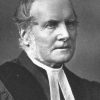
Selected from: Alexander Moody Stuart, Capernaum (London, 1863).
“And a certain Woman, which had an issue of blood twelve years, and had suffered many things of many physicians, and had spent all that she had, and was nothing bettered, but rather grew worse, when she had heard of Jesus, came in the press behind, and touched his garment; for she said, If I may touch but his clothes, I shall be made whole. And straightway the fountain of her blood was dried up; and she felt in her body that she was healed of that plague. And Jesus, immediately knowing in himself that virtue had gone out of him, turned him about in the press, and said, Who touched my clothes? And his disciples said unto him, Thou seest the multitude thronging thee, and sayest thou, Who touched me? And he looked round about to see her that had done this thing. But the woman, fearing and trembling, knowing what was done in her, came and fell down before him, and told him all the truth. And he said unto her, Daughter, thy faith hath made thee whole; go in peace, and be whole of thy plague.” Mark 5:25–34. See Matt. 9:20–22; Luke 8:43–48.
On the way to the ruler’s house, where Jesus raised the dead Maiden to life, an unusual interruption occurred. This tried the anxious father’s spirit by his child’s death during the delay. We have now to take up the case of the Sufferer whose urgency occasioned it.
But first of all it is to be observed, that the interruption itself is of a most remarkable character; there being nothing similar to it in the New Testament. Jesus, though hindered, was not stopped by the crowd, nor by an importunate petitioner that would not be denied, but simply by the change that passed on his own spirit. Virtue has gone out of him; a portion of the Spirit within him has entered into some one else. He has undertaken a great work which he goes to perform, and there is a pressing throng around him; but he instantly marks the alteration that has occurred within himself, and will not proceed till it is accounted for; although he possesses the Spirit without measure, and that is not lost by him which is gained by another.
Jesus has thus left us an example, of watchfulness over our own spirits from morning till night; of possessing our souls in patience, even in the midst of work and hurry. Recollectedness throughout the day saves the hard labour of recovering what we lose by forgetfulness. It is recorded of a holy man in former times, who was greatly prospered in his earthly calling; that if his spirit departed from God, in the course of the day, he immediately repaired to his closet till his soul was restored. Such a plan would seem most likely to break the business of life in pieces; but in a soul so watchful the wanderings would be, for the most part, both few and brief. Jesus, in the heart of pressing business, marks the sinless change in his own spirit, and suffers himself to be interrupted by it. We cannot, indeed, be always expressly looking to Christ; in doing with our might what our hand findeth to do, such an exercise is often impossible. But when occupied with reading or working by night, we look not at the candle but at the work before us; yet if the light be obscured, we note the difference as quickly as if we were expressly watching it. Let us strive so to walk under the light of God’s countenance all the day, that if a cloud passes between the Light of Life and our souls, it may be instantly perceived and its removal diligently sought.
In this miraculous cure we have one touching among many pressing on Jesus, her case the worst in all the crowd, and her immediate healing.
I. One Touching Out of Many Pressing on Jesus
There was love, power, and nearness enough for all the crowd, yet one alone touched Christ for healing.
There was love enough for all in the heart of Jesus. It was in this same Capernaum, and to these very people that he announced, Him that cometh unto me I will in no wise cast out. True, there might be none sick in the crowd except herself. But she came for her soul’s health, as well as for the outward cure, because her sickness shut her out from the sanctuary of God; and she found the salvation of the soul, along with the healing of her plague. When she is healed Jesus announces to her: Go in peace, thy faith hath made thee whole, or thy faith hath saved thee. It is either, it is both; for the words are the very same as those addressed by Jesus to the weeping penitent who washed his feet, and whose only plague was the sickness of sin. There were others in the crowd, who needed this health quite as much as she; it was as free for them as for her; but they sought not the grace of the Saviour, and were therefore given over to judgment more intolerable than the doom of Sodom.
There was power enough in Christ to heal them every one; ample virtue to go forth for the salvation of them all. A single Sufferer comes to him today and is healed; but a whole crowd of sick with diverse diseases had come one Sabbath evening, and all were healed. The one is healed, because the one cometh; and many were healed, when many came. A hundred are as welcome to Jesus as one; and the healing of a hundred, as easy with him and as certain as the healing of one. He casts out in no wise; he casts none out for any evil in the applicant, and he casts none out because the applicants are too many. If all the world from east, and west, and north, and south should come, not one would be cast out; for there is love enough in Jesus for all, and virtue enough for all.
Further, there was nearness enough to Christ to draw the virtue out of him, if they had desired it. But they thronged him and pressed him, yet they touched him not; touched him not in sense of want, with any urgent desire, any object to be gained, or any faith to find it. ‘Who touched me?’ Jesus asks; and all deny. All the saints deny touching, and all the sinners deny. Peter denies, James and John deny; all the apostles, and all the disciples deny. They were conscious of no healing in themselves; of no virtue entering into them out of Jesus. They were conscious of no touching on their part for the sake of health; of no hand stretched out by them in that moment for any salvation. One only denies not, yet neither does she confess, but withdraws. She was farthest off; had come nearest and obtained life; and now she is hid again in the crowd. But she has taken Christ with her, and health and salvation along with Christ.
How similar is the case of many an assembly in the house of God. Jesus is in the midst of it according to his promise; nearer to each, than each is to his neighbour; in the midst of all, and thronged by the people. Yet how true may it be that not one touches him, out of many crowding around him. There is health for all, and none need go unsaved; yet most must deny that any virtue enters into them.
In every meeting in the name of Jesus, a vast amount of sickness and of death is gathered together; there are many lepers, many blind, many lame, many dead in trespasses and sins. The assembly may be little else, than an hospital of souls that are sick; a graveyard of souls that are dead. Yet there is more health in the house than disease, more life than death, infinitely more; health enough to cure all the sickness, life to quicken all the death. Christ is in the midst, full of grace and truth; Christ in the midst, the Resurrection and the Life. There is a fountain of life and health in him, seeking any outlet; and if the fountain is sealed up, it is only because none will drink the living waters. He is pressed and straitened with the overflowing abundance of life, that is pent up within him; because no heart is open to receive it, no empty vessel brought to be filled.
This poor Woman touches; touches not himself, but the hem of his garment; and Christ is so full of life, that she is filled with life in a moment. Through that narrow and distant outlet, that slightest touch of the outer hem of the clothing, the full flood of life enters body and soul at once. It pervades her whole being with the lively consciousness of health; fills the body from head to foot with vigour; fills the soul with salvation, cleanses all the conscience, renews all the heart. If I may but touch his garment, I shall be whole: Jesus Christ is the same to me as to her; the same yesterday, today, and for ever; the same in the midst of us now, as in the midst of them of old; as near as loving, as full of virtue for all that touch him.
Nearer even than in the house of God many often are, yet without touching Jesus. At the sacramental table, how near have you often been; seeing, handling, tasting; yet not by faith touching Jesus. The bread is eaten, but Christ is by unbelief shut out from it and never touched; the wine is drunk, yet unbelief refuses Christ and touches him not. At such a table, how many are thronging and pressing on the Saviour; yet like many in that Galilean crowd, with their backs toward him, and no hand of faith stretched forth. The proof of having touched is virtue issuing out of Christ into your soul; and if no healing power has penetrated your heart, you may have thronged and pressed, but the hand of faith has never touched the Healer.
But some sadly mistake in this matter; and reverse the order of the Gospel to their own loss and sorrow. Because the virtue from Christ entering the soul is the proof of health given; they conceive, that it is likewise the warrant for touching Christ to obtain health; and they will not draw nigh to touch, till they have first been healed. But it is the sick that need the Physician, and that are invited to him for saving health. The warrant for coming to Jesus is his word, Come unto me; and the souls warranted to come are such as he is sent to redeem, when he came into the world to save sinners and the chief of them.
II. Her Case Is the Worst of All
1. She is the weakest in all the crowd, yet she presses through till she reaches Jesus. It is not easy for the weak to stand a crowd at all; and hard for them indeed, to press through to its very center. Christ’s brethren sought to find him in the midst of a crowd, young men in the fulness of their strength; but they were baffled in the attempt; and had to content themselves with sending a message through many mouths, that they desired to speak with him. Yet this Woman, worn out with disease and perhaps also weakened by want, finds her way to Jesus in the center of all this throng.
Where there is a will, there is a way. Every saved one has indeed learned, that it is not of him that willeth, nor of him that runneth, but of God that showeth mercy. The weakness of our will to all good, our inability even to will what is right, is a humbling but most needful lesson for us all. Yet our invitation is, Whosoever will, let him come and take the water of life freely; and our reproof, Ye will not come unto me that ye might have life. It is amazing what a man will do for that which his heart is set upon; and how he will not stagger at what seems impossible to another. And so by grace it is, in the awakened sinner’s pressing to enter in at the strait gate. The weakest with a determined will is far more than equal to the strongest who is but half-hearted. This woman’s case had become desperate; quite desperate, except for the one bright hope that now dawns upon her in Jesus Christ. She said, It will be enough if I may but touch his garment; that is, not if I be allowed to touch, but if by any means I do but touch. Therefore at any cost she must touch it, and she does. Despair of every other resource, with faith in this One, makes it impossible for any crowd to keep her back. She is indeed stronger than them all; for she has in that hour the strongest will and the liveliest faith.
There is always a crowd between you and Christ, inquiring soul: a crowd of past sins oppressing your conscience, a crowd of earthly lusts stifling better desires, a crowd of worldly friends opposing your progress, a crowd of evil spirits wrestling against you; all between you and Christ. But there is not only welcome for you in Christ’s bosom, but help for you in his arm; more far to help, than all that can hinder; and the moment you touch the border of his garment, you are healed. Strive on, press through, yield not but wrestle forward; and by his own grace you will reach Him, and all will be well for ever.
2. She is the vilest of all, the most unfit to touch the Holy One, for her very touch defiles. Being herself ceremonially unclean and shut out from the sanctuary, her hand pollutes for that day all whom it touches. Yet she believes, that her vileness will not defile the Holy One; but that his purifying holiness will cleanse her. Her disease is quite incurable by herself, or by any earthly means; yet she is confident, that the slightest touch of Christ will heal her altogether. For twelve sad years, she has proved how deeply seated the plague is within her, and how far beyond all human remedy; yet she believes, that there is power in Jesus in one instant to remove it for ever. This poor defiled one, shut out from all the holy; and this Holy One, undefiled and separate from sinners: stand to each other in most complete contrast. But it is their contrast that makes their mutual fitness; the outcast needing the Saviour, and the Saviour all-sufficient for the outcast.
Sinful soul, there is ever a contrast between you and Jesus; for there is nothing unholy in him, and nothing holy in you; nothing common to both. Yet the High and Holy One, becoming flesh for men, was numbered with sinners for their salvation. You need him, he receives you, and his blood cleanses you from all sin. Fear not therefore to draw nigh to Him because you are so contrary, since it is the contrast between you that makes you meet for each other. He is health for the sick, cleaning for the vile, clothing for the naked, and life for the dead.
3. Her coming is the worst timed of all applications; no accosting of Christ could have been more unseasonable. He is in the very midst of another case; a case which he has undertaken, and in which he is engaged; a case of life and death, in which every moment I precious. The Ruler’s daughter is at the very point of dying; but this woman’s disease is chronic, and an hour or a day will make no difference. She has been ill for twelve long years, ever since the maiden drew the first breadth of life; yet she arrests Jesus in the very crisis of life and death to the girl; and while she delays him, the child is dead. She might surely at least have waited half an hour, till he had finished this pressing call.
It seems as if earnestness for her own case left her thought for another; and she comes to Jesus for immediate cure, more unseasonably than any other ever came. But Jesus said, Him that cometh I will in no wise cast out; and a coming so ill-timed he does not at all refuse. Nay, he encourages and seeks such a coming; he heals her at once; and so heals her that the other sustains no injury, but only receives greater good. Through her intervention the father, instead of a sick daughter restored to health again, receives a dead daughter raised again to life.
Come at any time to Christ, only come; come the very first opportunity, make an opportunity and come, come in the absence of opportunity, come now. Say not that it is out of season, for he will instantly receive you; embrace the time and make no tarrying, but come.
4. Her coming seems to be in the very worst way; none other appears to have come so ill. Nicodemus comes to Jesus by night; but this Woman comes to Jesus by stealth. If any comer had ever been rejected, surely she must have been that outcast. But Christ said, that he would not cast the comer out in any wise; however ill the time of coming, and however wrong the way, he promises that he will not cast the comer out. The truth is, that as there can be no wrong time of coming to Christ, so there can be no wrong way of coming; for Christ has come into the world, for the very purpose of putting right all that is wrong. If there could be wrong coming, such would hers have certainly been. But Christ is redemption out of all evil, recovery out of all error, rectification of all wrong; and if we come to Him, all is right. Many are so afraid of coming wrong, that they refrain from coming at all; whereas if we only come, all is well. Jesus does not declare, that he will not cast out the man that cometh in the right time, or in the right manner; but pledges himself, that him that cometh in any way He will in no wise cast out. If the sinner only come at all, Christ does not acknowledge, and man need not apprehend any ground of rejection.
III. Her Immediate Healing
1. Her coming to be healed is late, and yet immediate: late in reference to the past, immediate in the haste of this afternoon. ‘When she heard of Jesus she came’: yet this evening could not well be the first time he had heard of Jesus; because not only had all the Town been already filled with the praise of his works, but all Galilee and Judea. But the name of Jesus struck her ear and her heart now for the first time, as having any interest or hope for her. So it constantly is when a sinner feels himself lost; he is ready to give up all; but the tidings of salvation sound in his ear for the first time, as having anything to do with himself, and come to him full of promise and life. Long before this the whole City had brought their sick to Christ, and he had healed all that were brought. But she was not dying, that kind friends might carry her to the good Physician; and it never occurred to herself, that her case was one for his help. But hearing now that Jesus passes through the street, from the feast in Matthew’s house to the sick-room of the Ruler’s daughter, she loses no time in trying to overtake him.
The act of her coming is good, but the reason is humbling: she comes hastily to Jesus now, but it is because she has spent her all. She has not thought Christ first, but last. Physician after physician she has tried; but the thought of Jesus never occurs, as of one able to relieve her. One advice she asks and follows, till it runs its course and leaves her no better; then she tries another and another, with the like result; hewing for herself cisterns, which when hewn can hold no water. Fee after fee she pays, giving her money for that which is not bread; while her patrimonial treasure dwindles steadily away, till at last she finds herself a pauper, ‘all her living spent.’ She has not half a shekel of silver remaining to fee another physician, else she had not thought of Jesus; seemingly not a few pence left to buy bread, with no strength to work for it. Yesterday she had spent her last; today she has nothing, and it draws toward evening. And now she begins to think that Jesus can help her. What an honour to pay to him! He will charge her nothing for advice and aid, for present health and eternal salvation.
This is exactly what every sinner does: no son of man comes to Christ first, but always last and after every other refuge has failed. He stands with his back to the living waters, laboriously hewing cistern after cistern; and only when he finds them all dry, does he turn and stoop to drink of the free and flowing fountain. The prodigal son has no thought of his father’s house, till he is perishing for hunger; when the choice is between his father and death, he counts death still worse than his father’s house and he will now go home. Death is worst of all; his father’s roof only second worst. And this is all the honour, that any of us at first render to God and to Christ and to heaven. Earth, self, fancied righteousness, the pleasures of sin, the creature above the Creator: these are our own heart’s choice. At length, when we come to see nothing before us but death, judgment, woe, we flee to Christ as less terrible than death, and we think of heaven as not so intolerable as hell.
But though it begins thus, it never ends there. The want of bread drives the prodigal to think of home: but his thoughts once returning thither, there is found in him by grace the true heart of a son; there springs up within him a sincere longing, repenting, yearning, toward his offended Father. So in this impoverished Patient, though Christ has been her latest thought, he is highly exalted now; he is first, greatest, all. She desires no counsel now from vain physicians; if she had thousands of gold and silver, she would leave all for Jesus; the hem of his garment is more to her, than all the physicians and all the medicines in the world. To her believing Christ is precious; not because she has touched and been healed; but before she touches, and because she believes him full of health for every coming sufferer. Poor dying soul, Jesus is the same yesterday, today, and for ever; and as he was then to her, so is he now for you.
2. Her cure is immediate, complete, conscious: straightway the fountain of her blood was dried up, and she felt in her body that she was healed of that plague. The root of the disease is reached, and instantly removed; in a moment the spring of health and youth rises fresh within the inner depths of her frame; she is healed, and she feels and knows that she is well. She needs no experience to prove it; no trial, if she can walk erect and with elastic step; no bread set before her to test her appetite; no work to show her strength. Others will look to those evidences; and they will come to herself in due time, and be highly prized as daily proofs that she was the subject of no delusion. But meanwhile, independently of all the future, she knows for herself, because she feels within herself, that she is well: not dying now but living, not weak but strong; and not with any mere outward cleansing, but with a true healing in the inner springs of life.
Even thus is it with the immortal soul. The heart believes in Jesus Christ unto salvation; the conscience in that hour is cleansed and has peace with God; the soul is healed, is new-born, liveth and is strong with everlasting youth and health. Eternal life has begun within the man; the life lost in Adam, and corrupted from the womb, is more than restored; it is renewed unto life more abundant in Christ Jesus. And the man feels it, and knows it. Others will wait for the fruit of holiness; and he will himself carefully cultivate that fruit, both as precious in itself unto God, and as a constant and essential evidence of the reality of the change. But already he recognizes and feels the root of life within him: a life which he knows to be everlasting; which he knows to be of God; which cannot but live, and grow, and be fruitful for ever. Into Christ Jesus the great root of all, the living and life-giving tree, he is now engrafted as a living and fruit-bearing branch.
Did this poor Woman feel within herself that she was cured of her bodily plague; and will the renewed man be all unconscious of his spiritual health and cure? Did her soul know the change that had taken place in the dull unconscious body; and will not our soul much more know and feel the immediate and everlasting change, which by grace has taken place within itself?
3. But she cannot depart in health without confessing Christ the Healer. Public confession has been her great cross; the fear of it had nearly become a great snare; and a little more might have kept her back altogether. Yet ashamed, timid, and retiring as she was, she faced a crowd for deliverance and she found it; not for the body alone, but still more for the soul. Go in peace, thy faith hath made thee whole, thy faith hath saved thee, is a double deliverance; health spiritual and bodily, temporal and eternal. But the Healer must be publicly acknowledged, and the need of health openly confessed.
Her coming unseasonably Jesus not only allows, but commends; in the parable of the Friend at midnight, he encourages and enforces it. Her coming stealthily he allows and pardons, but corrects. He has not refused her on that account, because he casts out none that cometh in any wise; and he will therefore let her come in this way, or in any other way that any may choose to take. But having let her come thus, he will not thus let her go. If she is to go in peace, with everlasting health for the soul, and with a root of health for the body that will spring up again from the grave, she must go not ashamed of Christ and not ashamed of her need of Christ. With the heart man believeth unto righteousness, and with the mouth confession is made unto salvation: the heart-belief there has been in her, and her mouth must now make confession.
It is a much more public and detailed confession now, than it might have been had she come owning her sickness at the first. She might thus have obtained health, with perhaps no more publicity than in other cases of which we have no special record; passing as one amongst many. But now she is singled out by herself, and has to detail all her history before all the people. In coming to Christ at all, there is often the taking up of the cross: and in her case a heavy cross it would have been to come openly. But Jesus said not, he that cometh unto me must take up his cross, but him that cometh I will in no wise cast out. But then he proclaims, If any will come after me, let him take up his cross and follow me. The comer need not, he may or he may not; but every follower must bear the cross of Christ. So with her: Jesus puts not the cross upon her before she comes, but he lays it on her expressly before she departs; for without it she cannot follow him, and no one can. We must all bear the cross now, if we would wear the crown hereafter.
Yet the cross is far lighter to bear afterward, than it would have been before. She was burdened beneath a heavy weight, that crushed her to the earth; and Jesus would not lay an added load of public shame upon the back so unequal to bearing it. But now she is relieved; her soul is forgiven, accepted, renewed; her bodily frame strong and well. Full of joy and health, she can lift the cross that she had shunned; it is now the only load she has to carry; and his yoke which is easy, with his burden light, Jesus gently lays upon her. For the moment she trembles and is ashamed, in narrating all her long and hopeless malady; yet even then, fallen on the ground, she can declare before all how the plague is gone, and how sound and whole she has become. Even already her cross becomes her crown: herself a healed one, rejoicing in the Lord’s great goodness; and remembering her sorrow no more, for joy in the great salvation and in God her Saviour.
Her soul hath mingled with the spirits of the just made perfect; and her body hath mingled with the dust of the earth till the resurrection. But one of the everlasting memorials in heaven, of the Lord’s works on earth, will be in the resurrection unto life of this Woman; who had suffered in vain so many things from many physicians; and was healed in a moment by the good Physician, through the believing touch of the hem of his garment. May we be partakers of her living faith, that we may share with her in that blessed rising from the dead; when this mortal shall have put on immortality, and this corruptible have put on incorruption, and death shall have been swallowed up of life. Amen.