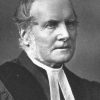
Selected from: Alexander Moody Stuart, The Spiritual Condition of the Ministry in Its Influence on the People (Edinburgh, 1865). The following was read at a private conference of ministers on the 20th of February 1865.
In selecting this subject for consideration this evening, I wish to be understood as regarding it simply in itself, and not in comparison with ministerial learning or activity, or other qualifications; and if I should seem to overlook these, it is not at all in the way of disparaging them, but only of stating the paramount claims of this one qualification for ministerial usefulness.
It is almost overwhelming for a minister to consider the likeness of the people to the priest, to see his own image reflected on them for good or for evil, himself multiplied a hundredfold. No doubt the absence of this likeness is often very observable. You may see a member, an elder, a deacon, a precentor or doorkeeper in a church, sittting for twenty years under a ministry of a very marked character, without a single feature transferred from the pulpit to the pew; and over many of his hearers, the most faithful pastor must often complain, “I have laboured in vain, and spent my strength for nought.” But on the other hand, the minister is very commonly reflected in many of his people, and his cast of thought is frequently exaggerated in its reappearance among them.
For example, in Brainerd’s converts among the Red Indians, his doctrines and his own experience were brought out in a depth of humiliation, such as in saying that they were willing to be condemned, beyond what he had himself preached, yet the natural fruit of his preaching, and still more of his spiritual experience. The work of the Spirit was both evident and great in their own individual conversion; yet it seemed, in almost every case, to take the type of their spiritual teacher and father. This was, doubtless, the embodiment in them of his intense and singular earnestness. But there is no reason to doubt that a similar process is taking place, to a greater or less extent, in all our congregations, and that our people are imbibing both our doctrine and our spirit, our earnestness, our humility, our love, our faith, our repentance, our joy, our prayerfulness, or our sloth, our self-sufficiency, our narrow-mindedness, our worldliness; our heavenliness, our lively hope, our spiritual insight, or our blindness to the unseen and the future, to God, to Christ, to heaven, to hell, and the value of the souls of men.
Independently of preaching, and even of personal intercourse, our spiritual state tells continually upon our people. Their impressibleness on the Sabbath depends much on prayer through the week; and their praying for us and for themselves depends much on our praying for them. And then on the Sabbath how much hangs, not merely on the words that are spoken, but on the spirit in which we speak, in which we preach and pray. Especially in extemporary prayer, we are in constant danger of sinking into a formality perhaps more lifeless than if we were using a form; a formality which we must all have detected in ourselves, by falling into the groove of the same words for want of fresh life within. Or if in such a state we make an effort at the moment toward real prayer, the prayer is constrained and laboured, instead of the spontaneous utterance of our thoughts. When the mouth speaks out of the abundance of the heart, out of spiritual desire, spiritual sorrow, or spiritual joy, what conciseness, what tenderness, what power is in the supplication, taking the people along with us in all our petitions, or else making them to feel their own lack of the spirit of grace. This one ordinance in our church, of public prayer without a form of words, shuts us all up to a very peculiar necessity of becoming and continuing to be men of prayer; shuts us up under the pressure of a severe penalty, resting on ourselves and on our people week by week, as the sure consequence of our failure. Then in our preaching it is often what is within us, in the hidden thought of our own hearts, that influences our hearers more than the mere words that are flowing from our lips.
But to be more specific, it is freshness of spirit that tells more on people than any other mental condition. Freshness of desire, of faith, of hope, of repentance, of love, seems to have far greater moving power than the amount of actual spiritual attainment. A minister’s attainment appears to produce no effect on his people in comparison with his progress. It may indeed with new hearers, or in another pulpit, because it has there the effect of freshness, but not with his own congregation. The greatest of all effects has sometimes been produced by a preacher awakened and inquiring, and carrying his people along with him step by step; directing his people toward a Saviour still only sought for by himself, and at length finding Him along with them. Reality in the ministry, as everywhere else, carries with it immense power. We must of necessity declare the whole counsel of God, irrespectively of our present attitude toward any part of that counsel; but provided we keep nothing back that is profitable to our hearers, we shall always speak with most power when we describe the truth from our own point of view. In that fervent eulogy of the Lord Jesus Christ in the Song of Solomon, in which the bride sets Him forth to others as the “chief among ten thousand, and altogether lovely,” it is not Christ present to herself that she describes, but Christ absent from her, and intensely longed for by her. More lovingly and more gloriously than anywhere else, she there delineates to the daughters of Jerusalem her great Bridegroom in all his attractions. The picture is as full as if He were most brightly revealed at the moment; yet confessedly He is not seen by her, but only vividly remembered and ardently desired by one who “sought him, but could not find him, and called him, but he gave her no answer.” Freshness or reality is, as we have said, that which is most of all influential for good in the ministry, [and] hence, therefore, one great and constant element of success in a young minister endowed with any measure of spiritual life, even when that life is largely supplemented by the merely natural fervour of youth. Hence, likewise, almost the whole power that has been found recently in lay preaching. Laymen, for the most part, as soon as they lose this one element of influence, lose everything. But as long as they retain it, this alone gives them far more power for good than all the rest without it; for as in the days of Solomon so now, “the living dog is better than the dead lion.”
Immediately connected with freshness of spirit or the “dew of youth,” there is another spiritual element of incalculable power in preaching, that is faith. There is no gift more valuable for the ministry, than faith in God that He will not let his word return to him void. When the minister’s soul, however, relapses into death, faith of necessity dies. “Dead faith” is as weak as everything else that is lifeless, and lively faith is never separate from freshness of spirit, either as its root or its offshoot. But besides that faith in the promise of God which we are so apt to let go, and should all cherish habitually in preaching the Gospel, there is another development of faith of a subtler and rarer character, yet undoubtedly the mightiest element of all in the success of the Word. This faith is most rare and precious, hard to find, not easy to retain, and difficult to describe; yet wonderfully simple to the soul to which it is given, and marvelously communicative in its effect on the souls of others. No doubt it is a peculiar gift of God, and sovereignly bestowed for a special end, but it is not uncommon under any powerful work of the Spirit in a neighbourhood. At such a time it is often habitual or abiding in the heart; and the man who is thus “full of faith and of the Holy Ghost” seems to be enabled to carry this faith with him to other places, where there had been no work of the Lord, and to be used to kindle the fire of Divine love where all was dark and frozen before.
This faith is not the same as trust for personal salvation, and does not necessarily flow from it; possibly it may be supernaturally given even in the absence of saving faith altogether. It is not natural confidence, nor is it spiritual expectation in a general way; both of which a minister may possess, along with far lower power and less abundant fruit than may be found in others who are weak and burdened and even depressed. This faith itself may be accompanied with great depth of weakness; for Paul surely possessed it at Corinth, where many were turned to the Lord, when he knew nothing but Christ and Him crucified; yet it was in weakness, and in fear, and in much trembling. I have conversed about it with some of the most thoughtful and successful Irish ministers after their great revival was past. They said that during that whole period, as compared with the previous years of their ministry, the chief and most characteristic difference, both in the state of their own souls and in their preaching, consisted in faith; a faith which they had never known before, and which they could not command or recall afterwards, but which was then simple and abiding in their own hearts, and in their daily ministrations to the souls of others, individually or in public. They believed, and therefore spoke; they spoke and believed that God would own their words, and that their preaching would by the Spirit work conviction, enlightening, and salvation; and they were not disappointed. Daily believing thus, daily they were not put to shame, for the Lord himself confirmed the Word daily with signs following. That was a sovereign gift in a peculiar season. Yet such men as Whitefield almost seem to have been habitually endowed with a faith nearly akin to this; and in coveting earnestly the best gifts, we should all earnestly pray, “Lord, increase our faith.”
But apart from this more special faith, freshness of spirit appears to be the chief element in spiritual influence, and this has its origin and daily maintenance only in personal intercourse with the living God, the Father of the spirits of all flesh. “My covenant was with him of life and peace; he walked with me in peace and equity, and did turn many away from iniquity. If they had stood in my council, and had caused my people to hear my words, then they should have turned them from their evil way, and from the evil of their doings.” (Mal. 2:5–6; Jer. 23:22.) To stand in Jehovah’s secret conclave or council, to “hear and mark his words,” to get them there fresh for ourselves, and so to carry them fresh to the people, is the great condition of ministerial success. Other things we may have, or lacking them we may be losers by the want; but this is essential to life, and for it everything else must give place. Whatever time it takes, we must have this intercourse with our Master. “Behold, I am against the prophets, saith the Lord, that steal my words every one from his neighbour. I have not sent these prophets, yet they ran; I sent them not, nor commanded them, therefore they shall not profit this people at all.” (Jer. 23:21, 30, 32.) No doubt this prompt running seems to save time and labour. We have not found God, Christ, the Spirit, for ourselves; but we have the words of the Lord, and we may run with these at once to the people, especially when by going first to Himself we could not get other words after all. But our Lord brands these as “stolen” words, even when they are His own, but heard only at second-hand by us; and denounces the hasty self-sent messenger as wholly profitless to the people.
Our warfare is maintained in an enemy’s country, and our first essential for safety, not to speak of victory, is to keep the line of our communication clear with home; with the base of our operations, with the source on which alone we depend for all our supplies, for our bread and water, for our shields and armour of defence, for our arrows and arms of assault. If we are surrounded and cut off from our only source of supply, we are inevitably defeated; and in that event we must first of all fight our way back to Him who sent us, we must retreat into our refuge and fort and rock of defence. This we must do at whatever cost of time and effort, at whatever loss of other operations however urgent, otherwise we are ourselves lost.
Now, surely in us and in every believer the soul can be kept in some right attitude toward God, unless we fall into culpable neglect. We cannot prevent temptation or the harassing of Satan; but through grace we may strive against it, and faithful conflict with the enemy is as pleasing to the Captain of our salvation as victory itself. We can neither destroy the old man nor arrest his working; but the cry, “O, wretched man, who shall deliver me from the body of this death?” is a state of health and fidelity as well as the shout of triumph, “Thanks be to God, through Jesus Christ.” We cannot prevent the hiding of our Heavenly Father’s face, nor is it safe to affirm that such hiding is always in proportion to our provocations; but in the darkest hour the attitude, “I wait for the Lord as they that watch for the morning,” finds the cheering promise, “He that walketh in darkness and hath no light, let him stay himself upon his God.” The soul of every child of the kingdom and of every minister of the Gospel ought always to be in some right state toward God; if not of joy for his presence, yet of grief for his absence; if not of victory, yet of true conflict; if not of spiritual vigour, yet of humiliation for weakness; if not of cleaving to the Lord with purpose of heart, yet of distress for cleaving to the dust. Our hearts ought to be always right toward God; and if we are not culpably slothful, they may be always right in this wide, yet true sense of the term. They may be, habitually and permanently, not drawing back from the Lord, not sleeping as do others, not divided and double-minded, not shut up in things seen and temporal.
Adequate time given to the Word of God and prayer will usually suffice for the righting of the heart. It may not soon effect its restoration, but it will commonly obtain at least this blessed issue, “My desire is toward thee, and to the remembrance of thy holiness.” A passing desire will not suffice, for the sluggard desireth and hath not; a brief effort may bring only a transient amendment; the ordinary exercise of devotion may end and leave the spirit as lifeless as when they began. In that case we cannot always resolve with Robert M’Cheyne, on a particular occasion, “I cannot begin my work; for I have not yet seen the face of my God”; for the work may be such that we must enter upon it, however ill prepared. But we may often follow this example; our work may often lie over till we have seen the face of our God, and be both faster and better done through the holy delay and the Divine help; and to a spirit resolved to “seek first His kingdom and righteousness” the delay occasioned by the search will commonly be very brief. Especially before laying ourselves down to rest after the labours of the day, we may refuse to take sleep to our eyes or slumber to our eyelids without some fresh apprehension of the promise attached to the Word of Life when held fast by the soul, “When thou goest it shall lead thee, when thou sleepest it shall keep thee, and when thou walkest it shall talk with thee.” There will be little sleep lost by such a resolution, while that which is given will be the sleep of the Lord’s beloved. But in a minister’s daily walk with God one unwatchful hour may involve grave loss to himself, which, if not soon repaired, may entail a serious injury to his people.
But along with spiritual freshness, through abiding nearness or continual returning to God, there must for a long ministry be also its sure fruit in spiritual growth, and therefore spiritual variety. If there is the same man in the pulpit with the same people in the pews for many years, there is a great risk of his rehearsing the same thoughts to unimpressed listeners. Now, while reading and study and other means are necessary to variety, and largely conducive to it, there is nothing so helpful as personal spiritual growth, because there is no such sameness as the sameness of death. Life is variety, death is sameness. Waking, either bodily or spiritual, is in the midst of an ever-varying scene: but in outward or inward sleep, one time is the same as another; darkness and light, winter and summer, spring and harvest are the same. If the state of the pastor’s soul varies, not by fickleness but by healthy growth, the Word of God is unto him stored with varied fulness. In its treasures there are the milk and the strong meat, the honey, the oil, the wine, and the finest of the wheat; and the barley bread, the bitter herbs and the vinegar. And if there be health and growth in his soul, he will taste for himself the goodness of God in all these, and be helped in a wise stewardship to give meat to the household in due season.
But we note finally, that a minister should seek indefatigably to be an example to his people, and ought therefore to aim at being the holiest man in his congregation, the meekest, the lowliest, the kindest, the most joyful, most watchful, most prayerful, the strongest in faith, the liveliest in hope, the highest above self, the nearest to God and to heaven, the purest or the least spotted image of our Lord Jesus Christ. Our falling almost infinitely short of this standard, is no reason why it should not be our earnest, constant, and determined aim. The sight of many members of our flock before us will not therefore fill us with grief, but with joy; yet we ought to grieve deeply for our own lagging behind them in the race. Perhaps ministers, while far from being the least, are not commonly the most spiritual in their churches. Now, certainly, on every account a minister ought to be the holiest man in his congregation. His spiritual life is of ten times more importance than that of any other member in his church; and his calling and position are far more favourable to holiness than any other vocation. There is in all these things the exercise of a high sovereignty, and the base things and the weak, and the things that are not, are evermore exalted by Him who chooseth the poor in this world rich in faith, that no flesh may glory in His presence. Yet as no other place in the flock requires grace like the pastor’s, so none is so favourable to grace. His calling shuts him up, more than any other, to the daily and weekly need of Divine help, and grace is promised and given according to need; given, that is, to faith apprehending both the need and the promise. He is tempted by Satan as no other member of his church is tempted, and stronger temptation, if resisted, ensures more abundant grace; he is prayed for by his people as no other member is prayed for; and above all, He who walks amid the golden candlesticks holds him more than any other as a star in his own right hand.
Our very helps we do indeed transform into hindrances, when instead of rising to the level of our sacred calling, and being sustained by it there, we drag it down to the level, and therefore far below the level of any other calling; ministering in things holy as if they were common things, instead of walking as a holy priesthood unto God. But the truth remains, that ministers ought to be the highest Christians; and blessed be God, the fact remains that the highest specimens of saints have been ministers of the Gospel in all ages of the Church, and the accompanying fact that it was their being great among the saints that rendered them great in the ministry. Such has been the case not in one age nor in one class of ministers, but in every age and in every character of the sacred calling. Moses and Elijah, John and Paul, were quite as eminent among the saints of God as among the ministers of his Word. But so amongst intellectual and studious men were Augustine, Owen, Edwards, and hundreds of others, higher as saints in the kingdom than as preachers of the Gospel; and probably nearer to God and liker to Christ than any of their hearers. So likewise with working pastors of parishes, with Newtons and Venns in England, with Calders in the Highlands and Bostons in the Lowlands of Scotland, and with men like M’Cheyne in our own day; they were eminent in the ministry, chiefly because they were eminent in grace, and they could, with Paul, say truly to their people, “Be ye followers of me, even as I also am of Christ.”
Clearly this is not the exceptional, but the normal state of the Gospel ministry; because, other things being equal, men with most grace should give themselves most readily to the ministry; and in the ministry most grace is provided for them, because they have most need of it and most use for it. Yet we seem to be too often contented with a sadly lower state. We have all to mourn a hundred deficiencies in other respects; and there are other defects which bulk much more largely with our people, and often more largely with ourselves. Yet there can be no doubt, both from the Word of God and from the dying testimony of faithful men, that when it comes to death and judgment, and the giving in our account, the words, “Without me ye can do nothing,” will stand out in all their simple and awful magnitude; that things great and many done without Christ, though in his name, will go for nothing, while the least word spoken or act done in His strength will abide for ever. “Herein is my father glorified, that ye bear much fruit,” is to every one of us a great call and stimulus to manifold and unceasing exertion; but there is light never to be neglected, thrown on the nature of the fruit, and the manner of the fruitbearing, by the accompanying words, “He that abideth in me, and I in him, the same bringeth forth much fruit.”