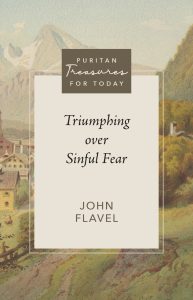
 John Flavel, Triumphing Over Sinful Fear (Grand Rapids, MI: Reformation Heritage Books, 2011), 124 pages.
John Flavel was well-acquainted with the things that most men fear. His first wife died in childbirth, along with their child. He was ejected from his pulpit in Dartmouth, England, in 1662 by the Act of Uniformity. Over the following decade he ministered secretly to his parishioners, under danger of arrest, in the woods and at Salstone Rock, an island in the Salcombe Estuary that is submerged at high tide, where the people would “linger in devout assembly till the rising tide drove them to their boats.”1Joel Beeke and Randall Pederson, Meet the Puritans, With a Guide to Modern Reprints (Grand Rapids, MI: Reformation Heritage Books, 2006), 247. During this same period his father, also ejected for nonconformity, died in prison.2Ibid., p. 245. Flavel was once burned in effigy by a mob, and was widowed a total of three times.3Ibid., p. 248. Toward the end of his sixty-three years of life, he said, “We have long borne the burden and heat of the day; we are veteran soldiers almost worn out.”4Ibid., 248.
“In order to subdue your slavish fear,” this veteran soldier wrote, “you must strive to imitate the encouraging examples of those who have trod the path of suffering before you.”5John Flavel, Triumphing Over Sinful Fear (Grand Rapids, MI: Reformation Heritage Books, 2011), 89. He spoke of the sufferers who have gone before as “excellent persons who have broken the ice,” and said that “the first sufferers had the hardest task, for they lacked the helps that they have left for us.”6Ibid., p. 90. Today’s Christians can look upon Flavel himself as one of these encouraging examples, and upon his Practical Treatise on Fear as a help that he left for us. This treatise, found in volume three of Flavel’s works, has been republished under the title Triumphing Over Sinful Fear. The new edition, totaling 124 pages, features modernized language (while retaining Scripture quotations from the Authorized Version) and an affordable price tag.
Flavel’s treatise is based upon Isaiah 8:12-14, which contains the Lord’s caution to Isaiah and his disciples against sinful fear: “neither fear ye their fear, nor be afraid. Sanctify the Lord of hosts himself; and let him be your fear, and let him be your dread.” The passage follows Isaiah’s encounter with a terrified king Ahaz, whose “heart was moved, and the heart of his people, as the trees of the wood are moved with the wind” (Isaiah 7:2). Under the threatened national disaster of Ahaz’s day, Flavel says, the people “are so terrified at the approaching danger that all their counsels, thoughts, and studies are occupied with preventing it.”7Flavel, Sinful Fear, p. 4. Do we not have reason to lament that, under the recent shakings of our own land, professing Christians have been too much given to such manifestations of sinful fear? Is it not a good time to sit of the feet of Christ’s servant John Flavel and learn that “the fear of God will swallow up the fear of man. A reverential awe and dread of God will extinguish the creature’s slavish fear, as the rain puts out the fire.”8Ibid., p. 5.
Flavel helps the reader by distinguishing between natural fear, sinful fear, and religious fear. Natural fear is “the trouble and agitation of mind that arises when we perceive approaching evil or impending danger. It is not always sinful, but it is always the fruit and consequence of sin.”9Ibid., p. 8. Sinful fear, on the other hand, arises from unbelief, is excessive in degree, unfits us for duty, and tempts us to use unlawful means to escape danger. The remedy lies in “a holy and laudable fear, which is our treasure, not our torment,” and is “the chief ornament of the soul.”10Ibid., p. 19.
The chapters on the causes of sinful fear and the effects of sinful fear help the reader to sharpen his self-examination and deepen his conviction. For instance, Flavel faithfully warns the reader that “Carnal fear is the very root of apostacy.”11Ibid., p. 56. The book’s lengthiest chapter contains twelve remedies for sinful fear. The first remedy is to study the covenant of grace, since “in the covenant, God has graciously considered our fears, doubts, and weaknesses” and “places Himself under the most solemn ties and obligations,” chiefly in that he promises to be God to his people. The fifth remedy may strike home to many hearts, telling us that “in order to get rid of your fear and distraction, you must mortify your affections to the world, and to the inordinate and immoderate love of every enjoyment in the world.”12Ibid., p. 85. The twelfth remedy, which sums up all the others, is to exalt the fear of God in our hearts.
Throughout this book, Flavel employs many Scripture verses, and numerous brief and memorable word pictures. Many of Flavel’s word pictures are themselves allusions to Scripture, such as when Flavel says that the fear of God will swallow up sinful fears like Aaron’s rod swallowed up the rods of the Egyptian magicians. Another strength of this book is the wealth of illustrations gleaned from church history, particularly from the early church and the first Reformation. When the governor Eusebius threatened to tear out Basil’s liver, Flavel notes he replied, “Truly, you would do me a great favor to take out my bad liver, which inflames and diseases my whole body.”13Ibid., p. 91.
This book is a voice from the Puritan past. When Flavel tells us that we should fear God and that losing the world and life itself are small things, he is sounding a note that is not commonly heard today. Flavel’s paragraph on acquainting our mind beforehand with sufferings exemplifies both why his book is a hard sell in today’s general church climate, and why his book is so greatly needed:
I know our minds are naturally reluctant to think upon such harsh and unpleasant subjects. It is difficult to bring our thoughts to them in good earnest. It is difficult to dwell upon them as long as is necessary to achieve this end. We would rather take a pleasant prospect of future contentment and prosperity in this world, of multiplying our days, of dying quietly in our nest. Our thoughts run nimbly upon such pleasant fancies, like oiled wheels. However, when our minds enter the deep and dirty ways of suffering, they have great difficulty. They are like Pharaoh’s chariots without wheels. That which is most pleasant is not always useful and necessary. Our Lord was well acquainted with grief. He often thought and spoke of His suffering, and of the bloody baptism with which He was to be baptized (Luke 12:50). When He perceived the fond imaginations and vain fancies of some who professed to follow Him, deluding themselves with expectations of earthly rest and prosperity, He turned their thoughts to this less pleasing subject – the things they would suffer for His name. Instead of answering a foolish and groundless question concerning who would sit on His right and left hand, He rebuked their folly and asked them a less pleasing question: “Ye know not what ye ask. Are ye able to drink of the cup that I shall drink of, and to be baptized with the baptism that I am baptized with?” (Matt. 20:22)14Ibid., p. 76-77.
O, that we may know this Christ and be strengthened to follow him to the end, and, having the promises, that we may cleanse ourselves, perfecting holiness in the fear of God!
Footnotes
- 1Joel Beeke and Randall Pederson, Meet the Puritans, With a Guide to Modern Reprints (Grand Rapids, MI: Reformation Heritage Books, 2006), 247. ↩︎
- 2Ibid., p. 245. ↩︎
- 3Ibid., p. 248. ↩︎
- 4Ibid., 248. ↩︎
- 5John Flavel, Triumphing Over Sinful Fear (Grand Rapids, MI: Reformation Heritage Books, 2011), 89. ↩︎
- 6Ibid., p. 90. ↩︎
- 7Flavel, Sinful Fear, p. 4. ↩︎
- 8Ibid., p. 5. ↩︎
- 9Ibid., p. 8. ↩︎
- 10Ibid., p. 19. ↩︎
- 11Ibid., p. 56. ↩︎
- 12Ibid., p. 85. ↩︎
- 13Ibid., p. 91. ↩︎
- 14Ibid., p. 76-77. ↩︎