Selected from: The Sunday at Home: A Family Magazine for Sabbath Reading, Vol. 7 (London: Religious Tract Society, 1860), 326-328.
In the year 1644, a very interesting book was imprinted by Robert Bryson, and sold at his shop, at the sign of Iona, in Edinburgh, entitled, A Historie of the Church of Scotland. This book records a curious incident which occurred “a little before the death of George Wischard” (Wishart), the martyr. We give this incident as contrasting the shrewdness of a Scottish farmer with the duplicity of a Romish preacher who came selling relics1The modern reader will recognize in this depiction the “snake oil salesman” ― someone who deceives people in order to get money from them. for physical and spiritual healing.
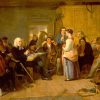
On a certain holiday, a number of the inhabitants of a village near Haddington were gathered around a man, whose sun-browned countenance and peculiar garb indicated that he had been a traveler in some foreign land. The man had been to Rome, and had brought home with him “very many holy reliques2relic ― an object surviving from an earlier time; in this case, of religious interest and new things of great virtue, as he gave out; but the things were not to bee had, nor any benefit by the sight or touching of them, without moneys.” Around this “Romish Peddler” stood the greater part of the villagers, listening with the greatest attention, and with astonishment and admiration plainly depicted on their countenances although here and there an expression of doubt might have been detected.
Among the marvellous things which were presented to the admiration of the simple villagers, there was a bell, which the relic-monger eulogized3eulogize ― to praise as possessing the most extraordinary virtues, especially this, that it was an infallible detector of falsehood or perjury. “For,” said the man, elevating his voice as he spoke, “thus shall it be made known whether what a man sweareth be false, or whether it be the truth which he sweareth. When anyone sweareth laying his hand on this bell, if he swear true, he shall, after the oath sworn, remove his hand easily from the bell without any change to the bell; but if he that sweareth, having his hand upon the bell, sweareth falsely, his hand will stick to the bell, and the bell will rive4rive ― to cut apart with great force asunder And look you, my masters,” continued he, pointing with one of his fingers to a small crack in the bell, “here is a rift which was made when one did falsely make oath, having his hand upon this bell.”
This statement of the peddler made, as might be expected, no small impression upon his auditory.5auditory ― a group of listeners But while the peddler was in the height of his triumph, a plain but thoughtful-looking man, a farmer of the neighbourhood, stepped forward, and laying his hand upon the peddler’s arm, asked him to let him have the bell in his hand to look at it more nearly. The man glanced a little uneasily at the farmer’s face, and then at the faces which looked intently at him, and probably concluding that the farmer was a man of some local influence, he with an air of triumph, which yet hardly concealed a shade of anxiety, placed the bell in his hand. The farmer took the bell, and examined it with the greatest attention.
“Truly,” said he, “this is a marvellous bell—a bell of rare virtue. And how sayest thou, that if any man shall swear falsely upon this bell, it will rend? Truly ‘tis a wonderful bell. And now I bethink me I have a matter, a very weighty business which lieth heavily upon my mind. Wilt thou, my good master,” said he, turning suddenly with a searching look towards the man, who was intently watching him, though apparently well pleased with the farmer’s eulogy of the bell, “wilt thou suffer me to make oath on this weighty matter which troubles me, in the presence of these people, having my hand on this bell that so it may be made clear that I swear truly?”
“Yea,” said the man, with some little hesitation, for he could not well refuse, and yet did not much like the trial.
“Then, good people all,” said the farmer, speaking with a bold, strong voice, “ye see, before I swear, the rift that is already in the bell, and how big it is, and that I have nothing upon my fingers to make them stick to the bell.” So saying, he showed them his open hand, and then laying it upon the bell, he continued, in a clear, solemn tone, “I swear, in the presence of the living God, and before these good people, that the Pope of Rome is antichrist, and that all the rabble of his clergy, cardinals, archbishops, bishops, priests, monks, with the rest of the crew, are locusts come from hell to delude the people and to withdraw them from God. Moreover, I promise they will return to hell.” Then lifting up his hand, he exclaimed, “See friends, I have lifted up my hand freely from the bell; and look unto the rift in the bell, it is one and the same without change. This showeth, according to the saying of this merchant, that I have sworn truth.” The discomfited merchant, who had tried to interrupt the farmer in his harangue, but in vain, stood for a moment or two irresolute. “Villain! Heretic!” He muttered through his closed teeth; but a glance at the altered countenances around him (for the farmer’s speech had thoroughly accomplished its object) convinced him it would be prudent to bridle his wrath; so, hastily gathering up his wonderful bell and other curious articles and relics, lest in their revulsion of feeling the people should seize upon and destroy them, the relic-monger, with lowered head and scowling brow, strode away as rapidly as possible. “Then,” says the old history, “this poor fellow went away, and never more was seen in Scotland, nor any other of his kinde who brought reliques or other like toyes from Rome.”
The farmer stood for a few minutes with folded arms, gazing after the “Romish peddler,” and then, turning to the people said: “Beware, friends, of the man of sin; turn away your eyes from beholding the lying vanities of papistry; and read ye and reverence ye God’s holy word, and may it guide ye all in the way of life.” And having said this, without waiting to listen to the congratulations of his friends, the farmer hastened to his home.
Footnotes
- 1The modern reader will recognize in this depiction the “snake oil salesman” ― someone who deceives people in order to get money from them. ↩︎
- 2relic ― an object surviving from an earlier time; in this case, of religious interest ↩︎
- 3eulogize ― to praise ↩︎
- 4rive ― to cut apart with great force ↩︎
- 5auditory ― a group of listeners ↩︎