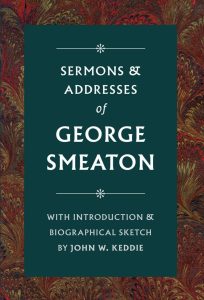
 George Smeaton, Sermons and Addresses of George Smeaton, John W. Keddie, ed. (Carlisle, PA: Banner of Truth, 2022), 280 pages + bibliography of Smeaton’s works.
Rev. George Smeaton (1814-1889) was a man of rare gifts and profound learning. He served as a Free Church Minister from 1843-1853 and then as a professor of divinity at the Free Church College of Aberdeen (1853-1857) and the New College, Edinburgh (1857-1889). The Dictionary of Scottish Church History and Theology begins its entry on him with the simple accolade, “eminent FC Scholar.” He is best known for his work The Doctrine of the Holy Spirit1See Rev. Beers’ review in Volume 10 of The Master’s Trumpet. and The Doctrine of the Atonement. Rev. John Keddie described those works as “the finest orthodox conservative exegetical works to be produced in the nineteenth century.”2Smeaton, vii.
Banner of Truth’s recent publication of his Sermons and Addresses affords readers the opportunity of a brief, accessible introduction to this worthy man of God. After a brief biographical sketch by Rev. John Keddie, the book contains thirteen sermons or addresses by Rev. Smeaton. This review will identify three leading features of the book.
First, Rev. Smeaton’s writing is simple and accessible. He once commended his recently departed friend, Rev. Alex D. Davidson, for living by the rule “that a man did not know what he could not express, and that he only knew what he could utter.”3Ibid., 189. The same could be said of Smeaton’s writings, which express profound truths in clear, vivid language. A few examples illustrate the point. In chapter 1, entitled Immanuel, he described the necessity of the mediator being both God and man:
A mediator between God and man must be competent to effect a reconciliation. He must both vindicate the claims of God, and execute the duties of our race. He must have a divine knowledge of our amount of disobedience, and a nature fit to expiate it. He must both take hold of the nature that was injured, and yet be of a nature to obey and suffer. In a Word, he must be God and man. God could not obey his own law, nor die for sin – a mere man could not obey for millions – a God-man savior could do both.4Ibid., 5-6.
In Chapter 8, entitled Faith, he harmonized saving faith as an act of obedience without giving any credence to the notion that we are justified by obedience:
But while the Gospel is a gift, there is a divine injunction to embrace it (1 John 3:22), involving in one and the same act the reception of a gift and the compliance with a divine command. While faith saves then, not as it contains an obediential element, but simply as it is receptive, there is an obedience of faith even in receiving the gift of righteousness.5Ibid., 114.
One final specimen of his simplicity will suffice. When arguing for church establishments against voluntarism, he quipped that the ideal ruler in a voluntary society must be “a bad man – a man denuded of the fear of God, for whom all religions are alike, and none are worthy of encouragement.”6Ibid., 226.
Second, Rev. Smeaton’s writing is sound. Not long after the disruption of 1843, the Free Church was embroiled in various doctrinal controversies. The doctrinal slide was cemented in 1900, when a majority in the Free Church united with the United Presbyterian Church to become the United Free Church. Rev. Smeaton was one of many ministers seeking to walk in the old paths, where the good way is (Jer. 6:16).
Several chapters bear the marks of his committed orthodoxy, but none clearer than chapter 3, entitled The Necessary Harmony of Doctrine and Spiritual Life. In a lecture given to students entering the study of Divinity, Smeaton warned them against isolating theological dogmas and spiritual life. When men do this, “That which God has joined together, as by a conjugal tie, is violently put asunder.”7Ibid., 67. He further warned them to beware of the demand for progress in doctrinal opinion8Ibid., 69., the disparagement of doctrine in favor of spiritual life, and the destructive criticism of doctrine9Ibid., 74..
A second example of the author’s soundness can be found in chapter 5, entitled The Real Presence of Christ in the Midst of His People. Arguing that Christ fills his appointed ordinances with divine power and glory, Smeaton warned against all adaptations to please the tastes of men. He particularly mentioned the tendencies to revive ancient forms10Ibid., 113., to declare the pulpit outdated11Ibid., 114., to promote novel doctrine12Ibid., 116., and to incorporate the arts into worship13Ibid., 117.. Though that address was delivered in 1856, our generation would do well to heed the same warnings. There is nothing new under the sun.
A final example of his steadfast commitment to sound doctrine is in chapter 9, entitled The True Preacher. In the context of doctrinal downgrade, it is tempting to become driven by the issues. Smeaton understood that doctrinal slide is often the result of sliding back from Christ, so he charged his students to preach the grand truths of the Gospel boldly. Anything less, he warned, would result in an unfruitful ministry:
My object in adducing this is to show that the preacher, who acts upon a system of reserve, inevitably forfeits ministerial success in the highest sense, and especially when he fails to seize the central doctrines of Christianity, and to make them bear on man’s relation to the judge of all.14Ibid., 157.
Third and last, Rev. Smeaton’s writing is searching. This the most pervasive feature of his writing. Every chapter addresses the heart of man. What he said of his departed friend was equally true of himself, “He acted on the principle at all times, that the heart can be touched only through the intellect. But the enlightenment of the understanding was not regarded by him as a finality.”15Ibid., 189. Smeaton’s aim was ever upon the heart. His sermons and addresses were designed to move the man with divine power.
In chapter two, entitled The Lord’s Jealousy against Backsliders Consistent with His Unchanging Love, he described the subtilty and deceit of sin in language eerily familiar to all who know their own hearts:
The sin that dwells in us comes on with noiseless step, disarming all suspicion, it may be under the guise of weariness, or suggesting delay in spiritual service, and it is little suspected, nay, spiritual slumber is accounted sweet.16Ibid., 28.
In Chapter one, entitled Immanuel, he charged his hearers to love the Son of God in light of his glorious incarnation:
To this (Christ’s coming), there were obstacles all but insurmountable opposed: our obstinate neglect, our haughty independence, and our resolute rebellion. Above them all, his grace arose and swelled ‘lo, I come [Heb. 10:7], proclaimed that sin was now condemned, and yet the sinner saved. That the Son of God should come at all, – that he should come over every obstacle and insult – disappoints at once our preconceived ideas of his nature. It is, however, that overpowering condescension in which he will forever be admired in all them that believe. He came to save a fallen world. He came to save the guiltiest transgressor.17Ibid., 18.
Smeaton’s love for souls was evident in his three sermons to congregations of departed ministers (chapters 10, 12, and 13). He closed each sermon with a hearty invitation to the unconverted, as well as a warning against remaining in unbelief. When addressing the church of the departed Rev. James Begg, he assured the unconverted that they had sat under a faithful ministry, but if they did not come to Christ, the numerous sermons, appeals, and invitations would only be recalled in eternity to their woe and agony18Ibid., 280..
In sum, the content of this book is simple, sound, and searching. It offers something for every class of reader. All will profit from the brief but insightful biographical sketch. The young will be helped by the simple writing style, modest size, and self-contained chapters, while the mature will find theological depth on a variety of topics. Pastors will be challenged by several chapters addressing faithfulness in ministry. Principal Macleod said of Smeaton in 1939, “his work as a theologian still awaits a worthy appraisement.”19Ibid., vii. Perhaps this publication will instill an appetite for Smeaton’s larger works and bring about a worthy appraisement of them. Let us pray to that end.
Footnotes
- 1See Rev. Beers’ review in Volume 10 of The Master’s Trumpet. ↩︎
- 2Smeaton, vii. ↩︎
- 3Ibid., 189. ↩︎
- 4Ibid., 5-6. ↩︎
- 5Ibid., 114. ↩︎
- 6Ibid., 226. ↩︎
- 7Ibid., 67. ↩︎
- 8Ibid., 69. ↩︎
- 9Ibid., 74. ↩︎
- 10Ibid., 113. ↩︎
- 11Ibid., 114. ↩︎
- 12Ibid., 116. ↩︎
- 13Ibid., 117. ↩︎
- 14Ibid., 157. ↩︎
- 15Ibid., 189. ↩︎
- 16Ibid., 28. ↩︎
- 17Ibid., 18. ↩︎
- 18Ibid., 280. ↩︎
- 19Ibid., vii. ↩︎