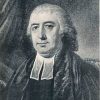
Selected from: Ashbel Green, The Life of Ashbel Green, V.D.M., ed. Joseph H. Jones (New York, 1849).
My eldest son, Robert Stockton Green, died the very close of this year 1813. He died at Boston, on Tuesday the 28th of September, and the next day his corpse was deposited in Mr. Dexter’s cemetery;—the very day of our annual commencement, eight years after taking his degree in this College. He was born July 30th, 1787; and was, of course, twenty-six years and two months of age when he died, wanting two days. He had been exhausted by the heat of the city of Philadelphia, and by his business as a lawyer; and came out of the city to recover his health. He was with me on the 31st of July and the 1st of August. He was emaciated and pallid, but not sick. He left me on the morning of the 2nd of August, on a visit to his brother Jacob at Albany, and intending to spend a short time at the Ballston Springs. He wrote to me from Albany, which he reached in a few days, and was as well as usual. He went to the Springs, and there met with a particular friend, Mr. William Appleton.
The two agreed to visit the military stations on Lake Ontario, and to go to the falls of Niagara. This they accomplished; and were in an attack made on Fort George by the British troops. From Buffalo, after visiting the falls of Niagara, my son wrote me a particular account of his journey and adventures—the last letter that he wrote me with his own hand. He returned to Albany apparently in health, and spent a day or two with his brother. He and Mr. Appleton then set out for Boston. Between Pittsfield and Northampton he was wet by rain in traveling. The next day he was taken ill of what appeared to be a rheumatic complaint to which he was subject, accompanied with some fever. By stopping one day he was somewhat recruited, and traveled the day following. Again he lay by for a day, and then was able to reach Boston, where he went to bed and sent for a physician. E. Rockwood, Esq., a lawyer of eminence, who married Miss Hayward (a former parishioner of mine, and intimate friend of my son) took Robert to his house. Here he received every possible attention which friendship and medical skill could supply.
For about ten days he was not thought to be dangerously ill, either by friends or physician, although I rather suspect that he considered himself in danger, for during this period (using the hand of his friend Appleton) he dictated a letter to me of such a kind as he never wrote before. It was tender and affectionate in a high degree, recognising his dependence on God, and expressing a strong desire to see me. He was apparently recovering till the night but one before his death, when he was taken with a profuse discharge of blood from the bowels, under which he sunk rapidly, and died on Friday morning. He died without a struggle, groan, or the motion of a muscle, and declared repeatedly the day before his death that he had not experienced a single pain from the time he entered Mr. Rockwood’s family. He had his senses fully till within a few hours of his dissolution; and I was glad to learn that his nurse observed him frequently engaged, as she supposed, in earnest devotion—his hands clasped, and his lips moving.
Doubtless I have the partiality of a parent; and affection awakened by the death of a favourite child is apt to magnify his amiable qualities. This notwithstanding, I believe I may say with truth that few parents could lose as much in a child as I have lost in mine. He was tall and well made, had a most impressive and pleasing countenance, with an eye intelligent and benignant in a very high degree. He had also an amenity of temper and a gracefulness and elegance of manners very rarely seen. He was frank, candid, facetious, hospitable and kind. He had more knowledge, and of more various kinds, than any one of his age that I ever personally knew, though not so much as some I have read of. His eminence as a lawyer, of his own standing, both as to distinction and prospects, was without a rival. He was also a handsome and eloquent speaker.
He had a full belief in divine revelation; not the effect merely of education (for he had at one time been on the brink of infidelity), but the result of close and profound examination, terminating in a thorough and unwavering conviction. He had examined and was a complete master of the deistical controversy in all its parts and bearings, and could sooner and more fully put an infidel to silence than any other man I have ever known. He was orthodox in the great outlines of his religious creed. Talking to a friend a short time before his death, about the Unitarian system, he said, “Take from the gospel the divinity and atonement of Christ, and you have little of importance behind.” He was free from vice, and a constant and reverential attendant on public worship. His seriousness was growing, and had manifestly increased in the last year of his life. Whether it had reached to vital practical piety is known to God, in whose hands I leave him. It certainly would now give me more comfort if he had been unequivocally and eminently pious, than that he should have possessed all the brilliant talents and attainments by which he was undoubtedly distinguished.
In this dispensation I recognize my unspeakable indebtedness to God in the following particulars:
1. That during all the illness of my son, I felt more engagedness in praying that it might be sanctified to him, than that he might survive it.
2. That my will was in a degree very remarkably and unusually for me, swallowed up in the divine will, as to what should be the issue, when I knew that his life was in danger.
3. That for the forty eight hours during which I had to wait for letters which would probably inform me of my son’s death, I was not greatly agitated nor anxious, and that I was so prepared for the mournful news of his death, that when I received it, I was not disappointed.
4. For remarkable composure, submission and resignation, for me, under the severe bereavement, so that I lost little or no sleep, was able to attend to all ordinary concerns as usual, and had in general great quietness of spirit. One day, indeed, I was permitted to see that but for the preventing and supporting grace of God, I should be ready to murmur, repine, and be overwhelmed with dejection and distress. But here was the mercy, I did but see it, and I trust was preserved from it, and was made to partake of these consolations, and to follow the advice which on similar occasions I have endeavoured so often to suggest to others—to God be all the praise.
The improvement I would strive to make of this dispensation, is—
1. To impress on my mind more deeply and sensibly than has ever yet been done, that both I and all my family are absolutely in the hand of God, to take any of us, or all of us, out of life, when, how, or where he pleases, and that in so doing, he will not do us wrong, or deal hardly with us. Yea, that I ought to rejoice in this, and be satisfied that in every privation I meet with, my covenant God chooses better for me than I could choose for myself.
2. To trust in God to sustain, support and comfort me, under all his dispensations. He has done so under this, which is one of the most grievous. But let me remember that in order to this, I must really depend on and trust in Him and not on myself. Left to myself, I shall be crushed before the moth.
3. To think less than I have done of the attainments of science and of intellectual distinction, when not connected with religion. Avaricious men are apt to desire unduly that their children may be rich. If I know myself, this has not been my prevailing transgression. But a degree of the same kind of sin, I do believe I have been very prone to, that is, in having my heart unduly set on my children being what my eldest was in intellectual wealth, without considering in the degree that I ought, that this also is vanity unless sanctified by divine grace. I hope and trust that I have supremely desired for them all, that they should be truly the Lord’s: and I think that for two or three years past, I had more of this than before. Yet I have certainly been in a degree an idolater of science. God has taken my idol. Let me renounce for ever my sin in this respect.
4. To be more earnest than I have ever yet been for the saving conversion of my children. As already stated, I hope I have increased in this earnestness within a few years past, and on this partly is founded the hope which I have, that my deceased son had received sanctifying grace before his death; especially, as he showed for more than a year a growing seriousness and attachment to religious duties: but yet I have never been as earnest on this subject as I ought to be. Let me then hear and regard the solemn call which I have had to more fervency of prayer for the salvation of my offspring; and let me not suffer to pass without improvement any opportunity I may have to say or do something, and every thing, that may tend to engage them to attend to the one thing needful. I have hoped that God may sanctify to them the death of their brother. O, most merciful God! grant this most desirable event for the sake of Christ my Saviour. I trust that he did sanctify it to my son Jacob. For, about two years after his brother’s decease he made a public profession of religion at Princeton; and in conversing with him on that occasion, if I rightly remember, he told me that his first serious attention to the state of his soul was produced by Robert’s death. He afterwards commenced the study of theology.
5. To be more engaged for the conversion of young people in general, especially of my dear pupils. I have long felt peculiarly interested for the young, but not enough so. I have not been as deeply sensible as I ought to be, how soon all these opportunities and privileges might be terminated by death. I am now at the head of an institution devoted to the instruction of ingenuous youth, who are destined to teach others, and to have a great influence on society. Their religious instruction is especially committed to me. O, may I feel the importance and responsibility of my situation; and may this event in providence stir me up to the greatest engagedness, watchfulness, diligence and tenderness in endeavouring to promote by every means I can devise, and by every exertion I can make, the eternal salvation of the precious youth of whom I have the charge—Lord, direct, assist, and bless me in this.
6. Finally my son’s death is to be improved to impress my mind more deeply with the emptiness of the world, and the importance of being constantly prepared for death and eternity. How very uncertain, unsatisfying, and delusive are our dearest earthly enjoyments; how deceitful and sorely disappointing are often our fondest hopes and most flattering prospects. Let my heart be less set than it has been on any thing so unworthy of its best affections. Let these affections be more set on things above, where Christ Jesus sitteth at the right hand of God. My son died suddenly—so may I also. Let me live constantly with my lamp trimmed and burning. O God! enable me so to live that I may at last be found of thee in peace.