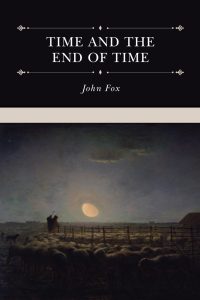
 John Fox, Time and the End of Time: Discourses on Redeeming the Time and Considering Our Later End (Grand Rapids: Reformation Heritage Books, 2016), 156 pages.
A common engraving on seventeenth century gravestones depicts an hourglass with wings. The image conveys a clear message to even the illiterate bystander: time flies. Outside of cemeteries, a barrage of subtle reminders pelt men with the truth that “time is short and eternity is long.” The natural propensity of men, however, tends to suppress and ignore this inescapable reality. Men invert the truth, portraying time as guaranteed and eternity as inconsequential. “Go to now, ye that say, Today or tomorrow we will go into such a city, and continue there a year, and buy and sell, and get gain: Whereas ye know not what shall be on the morrow. For what is your life? It is even a vapour, that appeareth for a little time, and then vanisheth away” (Jas. 4:13-14; cf., Isa. 56:12).
The gospel turns right side up what men have flung upside down. The sinner coming to faith in Christ encounters eternity looming large and casting its immense shadow over the brevity of life. Death, which previously seemed to be lightyears away, now stands at the door, reducing life’s hourglass to a few grains of sand. Orienting time against the backdrop of eternity exposes the fleeting nature of even the longest lifetime. Scripture portrays life as a dissipating vapor (Jas. 4:12-14), a wind (Job 7:7), a dream (Job 20:8), a shadow (Ps. 102:11; Eccl. 8:13), a hand-breath (Ps. 39:5), and blades of grass cut down in a day (Ps. 90:5-6; 103:15-16).
The scarcity of time enhances the value of this indispensable asset. Time is worth far more than money. Money can be lost and regained, even multiplied. Whereas every passing second slips irrecoverably into the permanence of the past. The godly, therefore, sing: “teach us to number our days, that we may apply our hearts unto wisdom” (Ps. 90:12). God answers this petition by providing in the Scriptures the instruction we seek. Time and the End of Time, expounds and applies this biblical teaching for the edification of God’s people.
The book consists of two parts, based on Eph. 5:16, “Redeeming the time, because the days are evil”, and Deut. 32:29, “O that they were wise, that they understood this, that they would consider their latter end!” John Fox, an English Puritan (not to be mistaken with the 16th c. author of Foxe’s Book of Martyrs), served as a minister of the gospel during a tumultuous period of British history, one affected by the ravages of civil war, the bubonic plague, devastating fires and the persecution of Reformed churches. He saw the fragility of empires and the lives of those who comprised them. But above and beyond all else, he saw eternity and the God of eternity.
In Part 1, this God-centeredness provides rich depth to his applications of the truth. Indeed, this book furnishes the reader with the best kind of practical instruction, the kind that dives below the surface into a penetrating, searching treatment of Christian experience. Yes, he provides needed help in answering questions about what to do and how to do it. But he goes further. The biggest challenge often lies in the arena of motivation to carry out known duties. Fox addresses why we are to redeem time and the motives that carry the Christian from nodding at theory to implementing sustained change by the grace of God and the ministry of the Spirit.
Part 2 moves from redeeming time to considering our latter end. To see time accurately, it must be viewed in light of eternity. Few people allot time for the concentrated consideration of the end of life – the absolute certainties of death, judgement, heaven, hell, and most of all, the Lord himself. They are preoccupied with the present or near future. But understanding our end influences more than anything else how we see the present. Life vanishes quickly; yet what we do during this momentary span fixes forever our eternal destiny. Christ’s question demands an answer: “For what shall it profit a man, if he shall gain the whole world, and lose his own soul? Or what shall a man give in exchange for his soul?” (Mark 8:36, 37). What hangs in the balance is either the full enjoyment of God for eternity or subjection to his righteous indignation. The believer aspires to lay up a maximal amount of eternal treasure for the glory of God.
Time and the End of Time stands in stark contrast to the time-saving preoccupation of modernity. In the contemporary world, self sits at the center. Men crave more time, free time for the gratification of transient pleasures. And they have called for an arsenal to achieve these pursuits. The publication of self-help books on time management filled with trendy techniques and the proliferation of time-saving devices have formed a small cottage industry. But after all the fanfare, the solutions have proved worse than the problem. Modern technology, for example, consumes more time in many peoples’ day, including professing Christians, than either sleep or work. We live in a wasteland of wasted time. And techniques and gadgets have worsened the dearth. The whole approach is tragically wrong-headed because God is not at the center and eternity is nowhere in sight.
John Fox’s book provides spiritual nourishment to those hungry for biblical wisdom. Unlike some Puritan writings, readers will find this book highly accessible, savory, and easy to read. Many may find it difficult to put down. The edifying insights – both into Scripture and the human heart – will bring readers back to its pages again and again.
Make time to read this timeless book. If you read it prayerfully and meditatively, while aiming at being a doer and not just hearer of the Word, it could be life changing. Every minute spent in digesting these truths can reward you with rich dividends – eternal profit gleaned from redeemed time. More sand has fallen through your hourglass while reading this review. Make haste for the glory of Christ and the good of your soul.