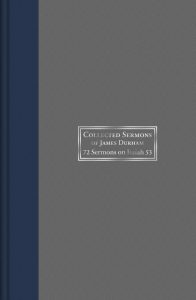
 James Durham, Collected Sermons of James Durham: Christ Crucified: or, The Marrow of the Gospel in Seventy-Two Sermons on the Fifty-Third Chapter of Isaiah, Vol. 2, edited by Chris Coldwell (Dallas, TX, and Grand Rapids, MI: Naphtali Press and Reformation Heritage Books, 2017), 808 pages.
“Read Durham on the 53rd of Isaiah at my request,” said John Duncan. “He has much repetition and you may be disgusted with that. But it’s repetition of a very fine thing—the eating of Christ’s flesh and drinking of his blood. Well, that’s what we must be repeating, in fact, all our life long.” Those who desire to take “Rabbi” Duncan’s advice can now avail themselves of a meticulously-edited new edition of these sermons.
James Durham was converted after being pressed by his mother-in-law to attend a Saturday communion season service, where he heard a very serious sermon that deeply affected him. The following day he heard a sermon on 1 Peter 2:7, “Unto you therefore which believe he is precious,” closed with Christ, and went to the Lord’s Table.1John Howie, The Scots Worthies (Edmonton, AB: Still Waters Revival Books, n.d.), 220. Durham was solemnly charged to devote himself to the ministry by David Dickson, who had stopped and alighted from his horse after overhearing Durham praying.2Howie, The Scots Worthies, 222. He was minister in the Inner-kirk of Glasgow from 1657 until his death in 1658. He completed his sermons on Isaiah 53, it would seem, within a year of his death at the age of thirty-six.3Durham, Christ Crucified, 46n.
Besides his great laboriousness in the ministry, Durham was blessed of the Lord with a humble and moderate spirit. One Sabbath, while Durham was walking with Andrew Gray, the two men saw a greater crowd entering the place where the approximately twenty-year-old Gray was to preach, than the number that were coming to hear Durham. Durham turned back Gray’s protest at this, saying, “I am content to be any thing or nothing, so that Christ may be all in all.”4Joel Beeke and Randall Pederson, Meet the Puritans, With a Guide to Modern Reprints (Grand Rapids, MI: Reformation Heritage Books, 2006), 675. Durham labored to heal the sad division between the Protesters and Resolutioners, and once, when the two sides were meeting separately in Glasgow, both elected him as moderator.
Durham proceeds in the sermons on Isaiah 53 by taking each verse, making brief initial observations upon it, and then stating what the doctrines are. Each doctrine in turn is proved, explained, and defended, and then the uses or applications of each doctrine are opened up. For instance, Durham says that there are four great things contained in the first part of verse 1, “Who hath believed our report?” Again, for instance, the fourth of these things is that ministers’ great complaint is that so few believe the gospel. Durham handles this fourth heading by giving four doctrines that explain it (Sermon 9), giving reasons why people do not believe the gospel (Sermon 10), giving reasons why people do not seriously try whether or not they have faith (Sermon 11), and exhorting his hearers to make faith sure (Sermon 12). Even where the reader does not remember the ins and outs of Durham’s multi-level outlines (which he occasionally modified as he went along), the doctrinal and experimental thoroughness achieved herein by the grace of God is most helpful.
A theme that runs throughout the sermons on Isaiah 53 is the covenant of redemption, a doctrine that Durham also promoted through his co-authorship of The Sum of Saving Knowledge. The covenant of redemption is revealed most explicitly when we come to the final verse of Isaiah 53, where Jehovah’s promise of reward unto his Servant for his obedient fulfillment of the work of redemption is spelled out. Yet, in expounding this chapter which builds up toward its final verse, Durham constantly explains the cross-work of Christ in terms of the eternal covenant between the Father and the Son, saying that:
There has been a compendious sum of the covenant of redemption delivered by the prophet in this chapter, wherein what is required as the price for elect sinners from the Mediator is held forth on the one side in a large description of His sufferings. And what is proposed as the fruit that should follow and as the satisfaction that the Mediator should have for his sufferings, is on the other side laid down.5Durham, Christ Crucified, 716.
As an example of Durham’s use of the doctrine of the covenant of redemption, consider the words of Isaiah 53:5, “and the pleasure of the Lord shall prosper in his hand.” From these words, taken in their context, he draws the doctrine that “Christ’s having and obtaining of a seed, His getting of souls to believe in Him, is a thing most welcome and acceptable, both to Jehovah that makes the promise and to the Mediator to whom it is promised.”6Ibid., 505. The preacher drives this home by inviting and pressing sinners to come to Christ, telling them amongst other things that this doctrine “serves to banish away that unworthy apprehension that is in the minds of too many, that there is greater rigidity and austerity in God the Father towards poor sinners than there is in the Mediator.”7Ibid., 506. At another point, Durham answers the one who complains he can do nothing for himself, by saying that,
The covenant [of redemption] is not transacted between God and you, but between God and the Mediator; and the ground of your peace as to the procuring cause depends on the Mediator’s performing His part of the covenant in your name. And further, as for your believing, it is a piece of the Father’s engagement to the Mediator.8Ibid., 317.
There is much in this volume that is savory to the soul. Sermons 52 to 63 treat the doctrine of justification most helpfully. In these sermons, the Papist error is thoroughly overthrown, while the Antinomian error, as elsewhere in the volume, is also exposed. The final seven sermons, which develop the doctrine of Christ’s intercession, show how we fail to make use of it, and how we ought to do so. Whether we have felt liberty in prayer or whether we can hardly utter anything, our prayers must pass, as it were, through Christ’s censer. “It flows from this, that our prayers are heard, though there be much infirmity in them, and that they are not cast back in our faces as dung, but are made savory to God, it is through the efficacy of His intercession.”9Ibid., 759.
Would-be readers may initially be put off by the length of this volume (808 pages), and no doubt determination will be needed to read it through. However, it should be noted that these sermons, first taken down “by one of his ordinary hearers,”10Ibid., 26. average about ten pages in length. Thus, each sermon can be read in one sitting, giving the reader much to meditate upon as he comes away, and leaving him with a desire to come back again to the volume for more. Those who have a lunch break at their workplace might choose to make this hefty but attractive volume their break room companion over a period of months. Others might create the time for this soul-enriching book by clawing back precious minutes and hours from the billion-dollar attention merchants who stand behind our time-siphoning electronic devices.11Catherine Price, How to Break Up with Your Phone: The 30-Day Plan to Take Back Your Life (United States: Potter/Ten Speed/Harmony/Rodale, 2018), 192 pages.
Footnotes
- 1John Howie, The Scots Worthies (Edmonton, AB: Still Waters Revival Books, n.d.), 220. ↩︎
- 2Howie, The Scots Worthies, 222. ↩︎
- 3Durham, Christ Crucified, 46n. ↩︎
- 4Joel Beeke and Randall Pederson, Meet the Puritans, With a Guide to Modern Reprints (Grand Rapids, MI: Reformation Heritage Books, 2006), 675. ↩︎
- 5Durham, Christ Crucified, 716. ↩︎
- 6Ibid., 505. ↩︎
- 7Ibid., 506. ↩︎
- 8Ibid., 317. ↩︎
- 9Ibid., 759. ↩︎
- 10Ibid., 26. ↩︎
- 11Catherine Price, How to Break Up with Your Phone: The 30-Day Plan to Take Back Your Life (United States: Potter/Ten Speed/Harmony/Rodale, 2018), 192 pages. ↩︎