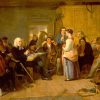
Selected From: Free Church Magazine, January to December, 1848, Vol. V, VI (Edinburgh: Johnstone and Hunter, 1848), 244.
The influence of a mother over the future character and destiny of her child, whether for good or evil, is incalculable. She has the moulding of its moral frame almost as much under her control as the management of its body; and, during the tender years of childhood, the one is almost as yielding and plastic as the other. In both mind and body there may be tendencies which she cannot wholly eradicate or subdue, but she can use means and follow a system which will go far to correct deficiency, to foster excellence, and to modify excess. The maxim is old as the world, that “as the twig is bent, the tree is inclined.” And who can foretell how much of the future welfare or unhappiness of the man depends on the manner in which that influence is employed! Who can say how soon the tendrils of the heart may be taught to bend in the right direction, under the tender hand of maternal discipline?
None knows better than the mother herself how soon her beloved babe begins to know her, to comprehend her meaning, and to accede to her wishes. How soon does it become sensible of kind or unkind treatment—conscious of a smile or a frown—susceptible of joy and grief, love and hatred! How soon, especially, do the evil passions begin to betray themselves—infant pride, infant anger, and even infant revenge! And how soon do these emotions, if not repressed in time, burst out in fits, and acquire the strength of habits! It may be affirmed, without the least extravagance, that the child is capable of moral restraint and training as soon as it is born. It is capable of knowing what is done to it, long before it can know what is done for it—capable of doing good or evil actions.
Now, for the right and faithful discharge of this duty, the gospel holds the mother responsible. It converts her matronly cares into Christian duties, and consecrates her to the office of the maternal ministry over her infant offspring. The Church, at this early age of her membership, can only devolve them into her hands, binding her by a solemn vow to the righteous fulfillment of her duties. Even the father must leave the charge greatly in the hands of the mother, chiefly taking heed lest he frustrate her endeavors by judicious interference. Hers properly is the task to “train up her child in the way in which it ought to go.”
And how powerful are the motives presented to her! “Doth not even nature itself teach” her that it is her duty to advance the best interests of the being whom she has brought into the world, who is part of herself, and who draws his subsistence from her own bosom? And what says the gospel? Does it not teach her to regard that being as an immortal creature, destined to eternal weal or woe, inheriting through her the curse and corruption of a fallen nature, and liable, as such, to misery and death? And does it not teach her that the only way of recovery by which that dear child can escape from everlasting ruin and rise to everlasting happiness, is by the baptism of Christ’s blood, by being “washed, and sanctified, and justified in the name of our Lord Jesus, and by the Spirit of our God”?
How intensely anxious must she be, if she possess the heart of a Christian parent, to compensate, as far as lies in her power, for having brought an immortal being into such fearfully precarious circumstances! How gladly avail herself of every means of grace which God, in his wisdom, has provided; and more especially of baptism, in which “the blood of sprinkling” is sacramentally exhibited, and in which she is invited to dedicate her offspring to the Saviour, obtaining for it the seal of that gracious covenant which provides a remedy for all the evils that have flowed from the penal covenant of works! She will not hesitate in this to follow the example of the Virgin Mary, in her care about the infant Jesus, when she “brought him to Jerusalem to present him to the Lord.”