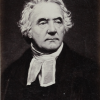
Selected from: “On the Warrant which each man has to appropriate the Calls of the Gospel to himself, and what that is which marks his doing so,” Institutes of Theology (Edinburgh, 1849).
I do not think that enough of stress has been laid by theologians or Christian ministers on the various particular terms in which the overtures of the gospel are couched for presentation to the world. Each man would understand the import of a special message to himself, but he may not see how the Bible can be understood, as being adequately and fully such a message. An express letter from the upper sanctuary, with his name and designation, might satisfy him; but in the general record of Scripture, that name and that designation are nowhere to be found. He reads calls and entreaties and promises innumerable, but there wants something to warrant his own confident appropriation of them. We hold that the want he complains of is not in the Bible, but somewhere else. This, however, he does not perceive, or at least does not proceed upon. He does not see, distinctly or confidently, how this universal can be transmuted into an individual revelation; or what entitles him to lay hold of encouragements and offers as designed particularly for himself, which are only found in a book that circulates at large, and is left, without any specific destination impressed upon it, to go vaguely and diffusively over the face of the earth. And so, in reading the Bible, he holds converse only with generalities. His own heart remains uncheered, his own path unshone upon.
It is needless to expatiate on the power of those terms in which the overtures of the gospel are framed, and by which, without the nomination of a single individual, each individual may hold them as pointedly and specifically addressed to himself—giving them at once a general diffusion among all, and a personal direction to every. Let me only once more enumerate them. All—“Look unto me, all ye ends of the earth, and be saved.” Every—“Every one that asketh receiveth.” Any—“If any man open the door I will enter with him into fellowship.” Whosoever—“Whosoever will, let him drink of the waters of life freely.” He, a pronoun as generic as the human family—“He that believeth shall be saved.” World, a term co-extensive with its rational and accountable generations—“Christ is set forth a propitiation for the sins of the world.” Sinner, a designation that misses no one individual of the species—“Christ Jesus came into the world to save sinners.” I do not see how any designations or terms can at all be devised more comprehensive than these, insomuch that I hold it an indisputable maxim in theology, that the word and the offer of salvation are co-extensive the one with the other: or, of whomsoever it may be said that the word of salvation has reached him, of him also it may be said that the offer of salvation has been made unto him.
There is a conscience within every heart that may be said to intimate individually to each man, both his special delinquencies and his special danger because of them. But as far as Scripture is concerned, he has as good reason to take to himself the comforts of the gospel, as to take to himself the terrors and threatenings of the law. For it has been well remarked, that whatsoever the defect or completeness of the warrant may be on which a man appropriates to himself the declarations of the one, it is in all respects the same with that on which he appropriates the declarations of the other. If he tremble because of the saying, That cursed is every man who breaketh the commandment, why, on the other hand, does he not rejoice in the commensurate saying, That blessed is every man who believeth in the Saviour? If he sink into despondency and dismay, or, to borrow the language of Scripture, if he be weary and heavy laden because of the judgments denounced upon all, why does he not take heart again, when he reads the invitation addressed unto all, Come unto me, all ye who are weary and heavy laden, and I will give you rest? If he gather from the Old Testament, that whosoever sinneth is under condemnation, and so views himself as an outcast from the friendship of God, why is it, when he gathers from the New Testament, that whosoever will may come and drink of the waters of life freely—why is it that he refuses to draw water out of the wells of salvation? In short, the terms in which the gospel holds forth an amnesty to the world, are co-extensive with the terms in which the law holds forth a condemnation to the world. If the man cannot rejoice in the belief that he is included in the gospel’s proclamation of mercy, because he does not read his name or his designation there, why does he tremble in the belief that he is included in the law’s proclamation of vengeance, seeing that he can as little read his name or his designation there? If the overtures of Divine forgiveness, like so many pointless generalities, pass him by, how is it that the terrors of the Divine wrath, couched and conveyed though they are in language of the same generality, have such special application given to them, and so enter his soul like an arrow sticking fast?
Perhaps we can give the reason. Perhaps it is that his sense of guilt is but a product from the workings of conscience alone. It may be only a natural, and not at all a Scriptural conviction—an operation by the law of the heart, and not by the law of revelation. Had his apprehensions of punishment been derived from the Bible, they might have been quieted by the expectations of pardon derived from the same fountain; for certain it is, that as far as the word of God is concerned, the comforts of the gospel are directed as pointedly and specifically to every reader as the menaces of the law. A belief in its statements fully warrants the individual application of them; and if the application be not made, and so the heart retains its despondency, then, making the one the test of the other, from the languor or the non-existence of individual hope, would we infer the languor or the non-existence of faith.
There can be no doubt, then, from the way in which the message of the gospel is constructed, from the very language in which it is framed and by which it announces itself to men, that each individual man has a full warrant in the objective truth of Scripture, for appropriating to himself the calls and the overtures which it addresses to the world. Now the question is, what is the first palpable effect which such an appropriation will have upon him? or, in other words, what is that which most significantly and most decisively marks its having been made? We have no doubt upon the subject, in the case of a general announcement made by any human or earthly superior to a general multitude. Let him only be conceived to cast abroad among them a general promise or invitation, that all who should meet him at an assigned place, should obtain a certain and specified benefit from his hand; or, varying the terms even as the gospel does, that whosoever repaired to that place, or that any who repaired to it, or that every man who repaired to it, should have the benefit realized upon him, there can be no doubt, that in each of these intimations, there are sufficient materials for a warrantable and valid appropriation. They hold forth a distinct pledge and promise to each individual of the assembled multitude; and, whoever he may be, he has but to take an intelligent view of the statement which has been made, and to make an intelligent application of it. Let him only believe in its honesty and truth; and, with the full gait of assurance, may he enter and move onward on the pathway which leads to the place of assignation, and rejoicing in the confident hope of the fulfilment which has been held out to him there.
It cannot be difficult to assign what is the first palpable thing which an appropriation in this instance will lead him to do, and which thing will be at once the effect and the indication of his faith. He will betake himself to the place of invitation. He will enter on the road that leads to it, and move with assured pace, just in proportion to the confidence which he feels in the honesty of the invitation. His very first footstep in the direction of the bidden walk and the bidden way, may he regarded as the first distinct and noticeable evidence of the faith by which he is actuated. Observers do not see the mental phenomenon, or the faith itself; but they see the hopeful and obedient movement, and from this they infer the faith. Even he himself does not look reflexly on the faith that is in him, but his mind simply rests on the truth of the Promiser, and is occupied with the certainty and value of the thing promised. The terms of the invitation were enough to warrant an appropriating faith, and his compliance in deed and in action with the order given, is enough to evidence it. It were difficult for others, perhaps even for himself, to ascertain the faith by the direct view of it as a mental phenomenon. But it may be gathered at once from the broad and palpable exhibition of his obedience.
This applies, in all its parts, to our faith in the gospel. Eternal life is there held out as the gift of God, through Jesus Christ our Lord, and the way is prescribed by which to reach it. We have already, I trust, made it obvious how by the terms in which it is held out, each man within hearing of the gospel has a right to appropriate the thing offered to himself, and to go forth on the bidden walk in the confident possession or confident prospect thereof;—that walk is the walk of repentance, or of new obedience. When the earthly benefactor invited the approach of those whom he addressed, and accompanied the invitation with the promise of some large and liberal gratuity, he did not bid them wait till the faith had arisen in their minds—he bade them instantly to move; and they, by their instant obedience, gave proof of the faith being already within them in vigorous and practical operation. They were not called upon to ascertain it before obedience; they ascertained it by obedience—the obedience to which they were urged at the very outset of this communication. It is true, unless they had put faith in this communication, they would not have stirred, and the doing as they were bid was the immediate effect of their faith, which was therefore anterior in influence and anterior in time to their obedience. But though the faith must have first existed, that is not to say the faith must first be known to exist, ere the obedience is attempted. You do not look reflexly on the faith by an exercise of consciousness, and then start on the bidden career of activity; but the faith immediately prompts the activity, and indeed it is through the medium of the activity that the power and reality of the faith are first and most satisfactorily ascertained.
At all events, there are initial calls to plain and palpable doings from the very commencement; and you respond to these, not by feeling inwardly after the faith, but by following externally the impulse of it—by plainly doing what you are plainly bidden to do. It would be deemed preposterous in the case now specified to lay an arrest on the movement, till by search and entry among the arcana of the mind the faith had been found. Instead of this, you are required on the instant, and with all practical urgency, to enter on the movement, and simply, if the faith exist, whether it be known at the time to exist or not, the movement follows. There is nothing in all this to embarrass either the initial or the progressive footsteps of this process. The man is simply told what he is to expect, and what he has to do for the fulfilment of his expectation; and if he believe what is thus told, he expects and he does accordingly. There is both a mental phenomenon here—that is, the expectation; and an outward movement—that is, the doing: and had the former not been in previous being and operation, the latter, it is undoubted, would not have taken place. But that is not to say we must look inwardly, and take accurate survey of the phenomenon, ere we act outwardly on the plain and palpable direction which has been given to us. The connexion between the inward and the outward will not less surely take effect, although we should not take metaphysic cognizance of the same—just as surely as the satellites of Jupiter would describe their mathematical courses, although no mathematical survey had ever been made of them. A plain man, in the circumstances we have now alleged, will feel no embarrassment. He is told what to hope, and where to go for it; and, without mystification or metaphysics, he hopes as he is told, and goes as he is bidden.
Now to me it appears quite obvious that Christianity, in its initial overtures to man, supplies the materials for just as distinct and intelligible an outset. We have already told how, by the very terms which it uses, it singles out every man as a special object for its invitations and its calls; so that each may proceed on its primary addresses to the world, as if they were made individually to himself. And then if the question be put, In what way shall he respond to these addresses? I would say, just by doing the very first injunctions of performance which it mixes up with the very first announcements of promise. It promises eternal life, and it bids us take the way which leads to it. And our proper response to this is just to depend on the promise, and to do the bidding. There can be no mistake as to the promise—forgiveness to all who will through the blood of a satisfying atonement. There can be no mistake as to the bidding—repentance, and turning unto God, and doing works meet for repentance—ceasing to do evil, and learning to do well. There seems nothing wanting here but the plain understanding of a very plain thing. With but belief in the truth of the message, we see not what should intervene to stay an immediate result, and that at the very first hearing, of a heart animated by the hope, and a hand directed to the obedience of the gospel.
The New Testament presents every man with a view of heaven’s door opened in the distance before him, and calls on every man to enter on the way of holiness which leads to it. We can imagine nothing more lucid than these direct and primary overtures from heaven to earth—so that if sounded forth upon the world by a trumpet of universal proclamation, it were anything rather than a trumpet which sounded uncertainly. Yet who will deny, since theologians have taken it up, and the haze of a thousand controversies has now gathered upon the question, that it is altogether beset with uncertainties? They have clouded, because they have overborne with their endless commentaries, what in itself is conspicuous as noon-day. Men’s minds are lost in the perplexity of long and intricate argumentations, and are bewildered to find that path to heaven, of which, nevertheless, it may be said, that, as delineated and set before us in Scripture, a wayfaring man, though a fool, need not err therein.
The reasons for this unfortunate obscuration are mainly reducible to two. The first is, that although nothing can be more patent than those objective realities, by a faith in which it is that the simple Christian is practically set agoing, yet nothing, at the same time, may be more dark and puzzling to him than the description which an inquisitive theology has attempted to make of the subjective process. In Christianity, both the promise held forth and the direction given are as plain matters, as far as the understanding of them at least is concerned, as any parallel promise with its accompanying direction which can be specified in ordinary life. And yet there is no such case, however familiar, that, if subjected to the same treatment with that of the gospel, might not be involved, even as it has been, in most perplexing metaphysics.
The child whom you call to approach you across the floor, and to receive from your hand the apple which you are holding forth to its view, is at no loss how to proceed in making out the acquisition which you intend for it. Yet the data I contend upon which it acts are not more obvious, more apprehensible, than the data set before us all by the gospel of Jesus Christ, and upon which we are required to go forth on our movement for that heaven which is placed with its open gate and its waving flag of invitation in the perspective before us. The child is exclusively objective in its contemplations. All its regards are directed to outward things: the apple held out for its acceptance—the order to come for it—the path by which it moves towards the object its desires are set upon. It is altogether an objective influence which has set it agoing, and set it rightly agoing. Still, however, there is a real subjective process going on within the recesses of its little bosom, however unconscious it may be, or incapable of reflexly observing its order or its laws. Yet another may accurately describe the process, though it cannot; and among other things may remark, and justly remark, on the precedency of the child’s faith to the child’s obedience. It was faith, in fact, which gave movement and direction to its very first footstep, and which upheld it along the continuous path from its place of departure to its place of arrival. Yet for any practical object, it were of no earthly use to tell the child so; and it were still more preposterous to exact from it the certainty of having the faith, ere it did any of the plain things which it had been bidden do.
But this is just the preposterous thing done by our speculatists and our system-framers in theology, to the man who, under the first invitations of religious earnestness, may be said to be yet in the infancy of his religious course. Instead of being plied with the broadly and conspicuously objective, he is perplexed among the subjective intricacies of a mental and metaphysical process. The assurances of pardon, the calls of repentance are deafened, as it were, by immersion in the depth of inextricable subtleties; and between ministers and hearers, so great is the bewilderment as to verify the observation I have heard from my departed friend, Robert Hall—that the majority of evangelical ministers knew not how to lay down the gospel, so as that a man of plain and ordinary understanding should know how to take it up.
We now proceed to the other check which a misconceived or misapplied orthodoxy lays upon instant obedience: and that is the dread of legality which it has inspired. Men have been so much told of the danger of self-righteousness, that, lest they should incur it, they are fearful of putting their hand to any work of righteousness at all. Men have been told so strenuously, that to seek a justification by works is the high road to perdition, that they are positively afraid of works altogether. To disentangle this perplexity, we ought ever to recollect, that a sense of the necessity of good works and a sense of their merit are in no way necessarily associated. It is hard, indeed, that, as if wire-bound, we must not move a footstep in executing the plain directions of the gospel, because legality may chance to found a claim upon them.
It is with the greatest satisfaction and pleasure that I observe a confirmation of these views in the following sentences from Jonathan Edwards:—“It is quite a wrong notion that some entertain, that the more they do the more they shall depend on it; whereas the reverse is true—the more they do, or the more thorough they are in seeking, the less will they be likely to rest in their doings, and the sooner will they see the vanity of all that they do. So that persons will exceedingly miss, if ever they neglect to do any duty either to God or man, whether it be any duty of religion, justice, or charity, under the notion of its exposing them to trust in their own righteousness. It is very true that it is a common thing for persons, when they seek salvation, to trust in the pains they take; but yet, commonly, those that go on in a more slight way, trust a great deal more securely to their outward services than he that is pressing into the kingdom of God does to his earnestness.”