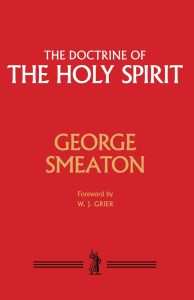
 George Smeaton, The Doctrine of the Holy Spirit (The Banner of Truth Trust, 2016), 400 pages.
Banner of Truth has been reproducing a selection of their earlier publications of classic Reformed works in recent years, including this one, The Doctrine of the Holy Spirit, by George Smeaton. Smeaton (1814–1889)1For a helpful consideration of the life of Smeaton, see John W. Keddie, George Smeaton: Learned Theologian and Biblical Scholar (Darlington, Evangelical Press, 2007). was one of the first-generation Free Church of Scotland ministers in the nineteenth century. At the Disruption of 1843, he left his charge in Falkland to become the minister of the Free Church congregation in Auchterarder, Perthshire. He later served in the chair of divinity in the Free Church College in Aberdeen (1853–1857), before moving to New College, Edinburgh, where he taught New Testament exegesis from 1857–1889. He was highly esteemed as a theologian by his contemporaries and remains so by those familiar with his work today.
The content of this book was first delivered and published as his Cunningham Lectures in 1882. It was reprinted in 1889, and this edition is a re-typeset publication of that work. It is well bound and presented with clear chapter outlines and subject headings. Of particular help are the capitalised and italicised words and phrases in the body of the text that emphasise key points. The work is divided into three main sections. In the first section, it is Smeaton’s aim “to set forth the doctrine of the Holy Spirit Exegetically,” and he does this beginning in Genesis and moving into the New Testament, providing a biblical theological development of the doctrine. Many texts are handled, and because of this, the exegesis of each text is necessarily limited, but overall a comprehensive picture of the doctrine is well established. Appropriate emphasis is placed on the most significant Scriptural passages where particular focus is given to the Holy Spirit, for example (John 14:16 and Rom. 8).
The second section builds upon this biblical foundation by looking at the doctrine of the Spirit dogmatically. Smeaton begins with the personality and procession of the Spirit in relation to the Trinity, before considering the Spirit’s work in the anointing of Christ, the inspiration of the Scriptures, and the regeneration of individuals. The final two chapters in this section consider the Spirit as the Spirit of holiness and the Spirit’s work in the church. Dr. Alexander Stewart of Edinburgh believed that Smeaton was “perhaps the most learned theologian in the Free Church” at the time, and it was the opinion of James MacGregor that Smeaton had “the best constituted mind in Christendom” in his day. The reader will come to appreciate how his friends came to their conclusions. Not only does he deal with all the key aspects of the doctrine with clarity to give us understanding, but the impact of his writing leads the heart to worship. The lasting impression the book left on this reviewer was that of an increasing sense of need of the Holy Spirit for every aspect of Christian life and service, and a heart cry that God would give the Spirit to us as a church, without whom we can do nothing.
The final section is a historical theological survey of the doctrine of the Holy Spirit from the apostolic age up to the nineteeth century. Smeaton moves through the Trinitarian controversies of the early church and the great debate between the Eastern and Western church on the procession of the Spirit. The Pelagian controversy is assessed in its relation to the work of the Holy Spirit; the Reformation of the sixteenth century is then considered in relation to its recovery of the Augustinian doctrine of the Holy Spirit. Smeaton then examines the Puritan era, which he believes to be the period of the greatest development of the doctrine, giving special focus to the writings of John Owen. The post-Reformation departures from orthodox doctrine, for example, Arminianism and liberal Protestantism, are also helpfully critiqued.
Banner of Truth is to be commended for republishing this classic work. It is significant in that it is one of a few volumes in the history of reformed theology that is devoted to the doctrine of the Holy Spirit. There are a few more modern works on the Holy Spirit that readers will also greatly benefit from, of which Sinclair Ferguson’s work is the most profitable. They may have an advantage over Smeaton’s work in that they include historical theological developments from the nineteenth century and interact with more of our contemporary debates. However, none of them surpass this work. More than a century later, we can still agree with B. B. Warfield that Smeaton’s work is one of the best books ever to be published on the subject, and for this reason our review must end with a recommendation. Buy this book and read it. Read it more than once.
Footnotes
- 1For a helpful consideration of the life of Smeaton, see John W. Keddie, George Smeaton: Learned Theologian and Biblical Scholar (Darlington, Evangelical Press, 2007). ↩︎