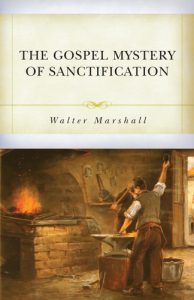
 The Gospel Mystery of Sanctification, Walter Marshall, Joel Beeke, ed. (Grand Rapids, MI: Reformation Heritage Books, 2013), 280 pages.
“Are ye so foolish,” asked Paul of the Galatians, “having begun in the Spirit, are ye now made perfect in the flesh?” (Gal. 3:3) Because of our legal bias, we are prone to strive after perfection according to the tenor of the covenant of works, which is nothing but a striving in the flesh. This causes many to be discouraged, and thereby Satan tempts them to give up seeking after holiness at all. However, the way of being sanctified and thus enabled to perform the duties of the law is revealed only in the gospel. Hence, practical godliness is a “gospel mystery” (1 Tim. 3:16). Contrary to fleshly expectations, the reason that sin will not have dominion over the Christian is because he is not under law (namely, not under it as a covenant), but under grace (Rom. 6:14).
The Lord’s hand shaped Walter Marshall to be an instrument for teaching others to seek holiness in a gospel manner. Even as a minister, Marshall lacked peace of conscience and was much troubled with his sins despite the methods he tried to use to mortify them. He went and consulted Richard Baxter, whose writings he had imbibed, and Baxter told him that he had understood his writings “too legally.” Marshall then consulted Thomas Goodwin and told him the particular sins that were troubling his conscience. Goodwin, according to the original publishers of Marshall’s book, “told him that he had forgot to mention the greatest sin of all, the sin of unbelief, in not believing on the Lord Jesus for the remission of his sins, and sanctifying of his nature.” It was this conversation, and not Baxter’s seemingly self-justifying reply, that was used by the Holy Spirit to reprove Walter Marshall of unbelief, and thus to bring fruit in his life.
Marshall provides counsel to the soul in a series of fourteen “Directions” that build upon one another, methodically uprooting errors that tend toward Arminianism while avoiding the opposite error of antinomianism. The Directions in the former part of the book show the lofty nature of what the law requires, the impossibility of attaining holiness before saving faith in Christ and union to him, and the powerlessness of the law to give us strength for duties. For instance, in the third Direction, Marshall says that “The way to get holy endowments and qualifications necessary to frame and enable us for the immediate practice of the law, is to receive them out of the fulness of Christ, by fellowship with him: and that we may have this fellowship, we must be in Christ, and have Christ himself in us, by a mystical union with him.” Indeed, as the author says, Christ’s “incarnation, death and resurrection, were the cause of all the holiness that was or ever shall be given to man, from the fall of Adam to the end of the world; and that by the mighty power of his Spirit, whereby all saints that ever were, or shall be, are joined together, to be members of that one mystical body whereof he is the head.” Furthermore, while acknowledging that the Lord reserves great comforts for his people until after they have obeyed his commandments, there are important comforts that come before the performance of duty, so that the believer is comforted on every side. (Ps. 71:21) Thus, the ninth Direction tells us that “We must first receive the comforts of the Gospel, that we may be able to perform sincerely the duties of the Law.” It must be the joy of the Lord that is our strength (Neh. 8:10), and the hope of glorification in the perfected image of Christ is the hope that purifies (1 John 3:3).
The tenth Direction, Marshall tells us that, in order to be prepared by the gospel to perform the duties of the law, “we must get some assurance of our salvation, in that very faith whereby Christ is received into our hearts.” This is pivotal to the spiritual counsel laid out in the book, as it shows that a confident trusting upon Christ for one’s own salvation, as freely offered in the gospel, is the root upon which holiness grows, rather than holiness being any kind of warrant to trust upon Christ. In this Direction, Marshall makes the necessary distinction between the direct act of believing in which “I take Christ for mine,” and the act of reflection upon one’s graces that gives rise to sensible assurance in which “I feel that Christ is mine.” The aim here is not at all to discourage the weak believer by saying that he who lacks sensible assurance lacks faith, but rather the aim is to stir up all to the direct exercise of faith in Christ. Rather than waiting to see if we have good qualifications like holiness before we dare to believe, we should believe upon Christ in order to receive all good things out of his fulness.
In the twelfth and thirteenth Directions, Marshall shows us how to strive to press forward in holiness after a gospel manner. The answer does not lie in perfectionism, which denies the presence of the old nature in the believer and unfits us for the duties of confessing our sins, of loathing ourselves for them, and of working out our salvation with fear and trembling. Rather, we are to consider which of our gospel privileges have a special aptitude to help us in particular duties. For instance, when it comes to the Second Commandment, Marshall asks,
“Would you limit yourselves to the observation of God’s own ordinances in his worship? believe that you are complete in Christ, and have all perfection of spiritual blessings in him; and that God will build you up in Christ by the ordinances of his own appointment. This will make you account his ordinances sufficient, and men’s traditions and inventions needless in the worship of God; whereas, if you do not apprehend all fulness in Christ, you will be like the Papists, fond to catch at every straw, and to multiply superstitious observations without end, for the supply of your spiritual wants.”
Noting that Christ’s procurement of holiness for us establishes the means rather than making them void, Marshall gives direction for using means, namely knowledge of the Word, self-examination, meditation on the Word, baptism, the Lord’s Supper, prayer, the singing of Psalms, fasting, vows, and the communion of saints. While the reader may wish that more had been written here as to the positive place of vows and not merely the dangers attending them, there is nonetheless much here that is helpful, particularly the discussions of baptism and of prayer.
With the blessing of God, this book will continue to help souls distinguish between the law and the gospel, and also to see how the uses of the law “sweetly comply” with the gospel, “the Spirit of Christ subduing and enabling man to do that, freely and cheerfully, which the will of God, revealed in the law, requireth to be done” (WCF 19.7).