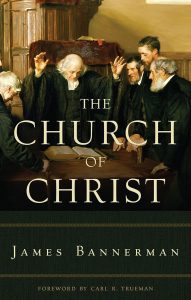
 James Bannerman, The Church of Christ: A Treatise on the Nature, Powers, Ordinances, Discipline, and Government of the Christian Church (The Banner of Truth Trust, 2015), xxv + 1009 pages.
What is the church? How is it to function? These questions occupy the minds of many in the church today. The church in action, the church in mission, the church in culture, the church in community – these are topics filling conferences, sermons, and blog posts.
We have all heard of people who engage in “Church shopping”. It involves the hunt for a church that best fits the sense of felt needs and wishes. Typically, the matters assessed are the pastor, youth ministry, style of worship, and general culture of a congregation. Then there is the constant search for authenticity. The drive for an authentic church led to the emergent and emerging church movements. Even among those who have not adopted the emerging trend, certain traditions are cast aside as relics from the past. Other churches have simply entrenched, being suspicious of change. An earnest student discovers frustration in efforts to grasp the slippery definitions of the word “authentic”. It seems that ideas vary. There is some gravitation towards an idea of being true to oneself and one’s God. It seems there is a wish to escape pretension, showmanship, and hypocrisy.
As with most trends, there is a reaction to an error. Many have become disenchanted with what is felt as the big-business approach to church. This has led some to embrace high church traditions, with its seeming stability. Others have continued to adapt the seeker-sensitive model, developing new ways of reflecting the culture so that the church does not seem so different. Others still simply hold fast, not knowing what else to do. While there is much with which to be concerned about current trends and discussions regarding the church, there is an opportunity to make use of this general unrest. Considering this, second to a faithful study of God’s word, we hope that there will be a keen interest in a reprint by Banner of Truth.
James Bannerman’s The Church of Christ has remained a standard on ecclesiology since its initial production. Originating from his lectures on the topic while serving as Professor of Apologetics and Pastoral Theology, his contribution was born out of tremendous trial. As many of our readers will know, the church in Scotland was forced into thinking through the nature of the church for many decades during the 19th century. The conflict between church, state, and patronage, together with the many questions surrounding a church’s allegiance and attachment to its public confession, its officers’ responsibility before the Lord for the vows made to uphold that confession, and the related struggles and debates all demanded sound footing for decisions surrounding the Disruption of 1843.
Bannerman lived through the Disruption, and taught after it, serving as a professor from 1849-69. This allowed for him to give careful attention to the lessons he learned, refine them through constant study and teaching and provide the world with a standard on the topic. It is important to note that the Free Church not only received rebuke from the assembly which was left behind, but she also received pressure from other denominations who were pleading for her to relinquish certain church principles. Additionally, the Free Church itself experienced inward trials. This forced a careful reading of both scripture and the literature written before, during, and after the Disruption. The fruit is ours to enjoy.
Bannerman’s work is not a difficult read, however, it does demand commitment. He provides a thorough and careful exposition of all essential topics and subtopics relating to the doctrine of the church. While some today may dismiss this approach as unusually prolix, the one who approaches the work with attention will arrive at a far better vantage point from which to address today’s questions. It would be hard to think of a more relevant exercise for people with questions about the church than reading through Bannerman’s work.
His work is divided into four parts: the nature of the church, the power of the church, matters about which church power is exercised, and parties in whom church power is vested. Each of these parts has several divisions, sub-divisions, and chapters. Almost every topic is included: the visible and invisible distinction, the marks of the church, the relationship between church and state, toleration, Christ’s headship, forms of church government, confessions of faith, worship ordinances, holydays, sacraments, and officers of the church. The work is an informed consideration of the main topics relevant to the church.
As with earlier editions, this volume also includes appendices, serving as fuller support for several points made within the book, for example, the establishment principle and the imposition of hands in ordination. Within each of these he covers nearly the whole scope of questions that arise. While he certainly does not use today’s language matters, e.g. “missional” or “emerging,” he does address the essential matters thoroughly.
For those who uphold the whole doctrine of the original Westminster Confession, these pages provide a treasury of insight, support, and encouragement for the biblical teaching they have embraced. There is thorough demonstration of support provided for the establishment principle, purity of worship, and jus divinum Presbyterianism. Additionally, for anyone willing to bear the badge “Presbyterian,” there is a wealth of insight in comparing forms of government, all of which is as relevant today as it was in Bannerman’s. It could be argued that this is more relevant today, seeing how approaches to church government seem to multiply, while never escaping the essential components of either the Popish, Prelactical, Independent, Congregational, or Presbyterian.
Throughout the book, Bannerman approaches his subject as one under authority. In doing so, he reminds us that it is not for the culture to determine “how to do church,” rather it is for the church to discern its calling from Christ the only head. The reader will see this emphasis and balance in the following quotations:
So clear and abundant is the evidence that the Christian Church is something more and higher than a voluntary association of Christians, and that the power of the Church is not merely the surrender, under certain limitations, of the rights of all the members into the hands of a few for the good of the society, but is rather the positive institution of Christ, having its origin and warrant directly from Him. In other words, the source of Church power is not in the members, but in Christ.1Bannerman, Church of Christ, 201.
His own authority in the Christian Church, Christ still keeps in His own hands; and out of the fulness of power in Himself, He personally rules in every act of authority or jurisdiction validly and lawfully done by His servants on earth…For men to attempt, then, to decree what Christ has not decreed,— to enact laws of their own, in addition to His,— to add to His appointments in the Church,—to dictate rites and ceremonies and obligations which He has not recognised,— this is to assume a power not theirs, and to trespass on the office of Head.2Ibid., 218.
The Christian society, as an ordinance Divine and not human…does not exist by voluntary compact; its authority is not founded on the consent or delegation of the members; they did not create the Christian association at first, nor do its order and organization wait upon their permission or appointment. The source of its life and authority is from without, not from within; and the Church of Christ confers upon its members…the privileges peculiar to it as a society.3Ibid., 724.
In addition to the text itself, this volume contains a general index, two pictures: one of New College and one of the esteemed faculty, including James Buchanan, William Cunningham, Rabbi Duncan, James Bannerman, and George Smeaton. This edition was fully re-typeset and contains a brief foreword by Dr. Carl Trueman of Westminster Theological Seminary. Instead of being divided into two volumes, as in former editions, the text is now presented in one volume.
The obvious limitations of this book are its size and its historical distance. Written in the 1800’s, the book naturally has a different character than many books today. It was not composed for today’s reader simply desiring an introduction to gain a general sense of the ground. The references in the footnotes display the type of learning characteristic of Bannerman and his day. The material was produced originally as lectures to students for the ministry. Those students would have had a robust education in the humanities. As such, it is not an introduction to the topic, nor is it written in such a manner as would recommend it to be handed out to anyone who disagrees with the view taken by the Westminster Assembly. However, the value of the book will be appreciated by two sorts of people. The first class includes all church officers. The second class includes all members within the church who wish to gain a thorough understanding of the topic. Anyone who is currently studying the topic due to his personal discontent over the current debates will find this volume to be a treat. Others who are engaging in debate or discussion on this topic will appreciate the full scope of study Bannerman provides.