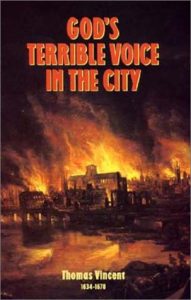
Thomas Vincent, God’s Terrible Voice in the City (Morgan, PA: Soli Deo Gloria Publications, 1997 [1667]), 236 pages.
God is sovereign over every detail of this world. This the Scripture asserts plainly throughout its pages. Recent times have challenged the church to maintain consistency in its understanding and application of this doctrine. If the Lord is sovereign over all, he is sovereign over trials, afflictions, and global catastrophes. The outbreak of COVID-19, the closing of economies, and the uprooting of ways of life familiar to many throughout our nation and world are all under God’s absolute and perfect control. At the time of writing this review, there is an increased attention to perceived and real injustices; there are protests trying to call attention to matters of concern; there are rioters violently disrupting society, looting stores, and murdering various individuals. Many in our nation, and perhaps the world, are concerned at what men are doing. We give attention to the words of men: governors, commentators, protestors, etc. While the unrest and disturbance to our routines fixes our attention upon the words of men, many have neglected to give attention to the word of God. This is true of his written word. However, it is also true of his providential word through the afflictions he has brought upon us.
The Bible teaches us that the Lord speaks to us by his providence. This is not to say that he informs us of new revelations or commandments. It is true that the only inerrant and infallible word is that given us in the holy Scriptures. To this alone are we to look in order to derive our belief and practice. However, Micah 6:9 reminds us that the Lord communicates to us by his providence as well: “The Lord’s voice crieth unto the city, and the man of wisdom shall see thy name: hear ye the rod, and who hath appointed it.” The Lord calls us to attention by the difficulties he brings upon us. All of his providential dealings are to be understood and interpreted by his word. While this may prove difficult, the difficulty does not excuse us from giving diligence to discern the Lord’s message. It is recorded of the children of Issachar that they “were men that had understanding of the times, to know what Israel ought to do,” (1 Chron. 12:32). They were able to discern the providential circumstances that the Lord had arranged and determine the best course of action.
As difficult as our times may feel, thus far these are certainly not “unprecedented,” despite what the majority of men claim. These times are a far cry from the desolation and trauma of what some still remember taking place in the Second World War. Prior to that, the outbreak of the Spanish flu pandemic brought a staggering 20,000,000 to 50,000,000 to their graves, infecting roughly one-third of the world’s population. Yet we cannot ignore that the Lord has used the outbreak of COVID-19 to bring our nation and world to attention. Whatever the reality of immediate danger from the virus might be, our economies have suffered much, jobs have been lost, whole industries upended, and a sense of uncertainty has gripped the world.
The city of London was hit by two great afflictions in the mid-1660s. In 1664, the first instances of what would become known as “The Great Plague” were recorded in London, eventually killing over 100,000 of London’s inhabitants, roughly one-third of the city’s population, with estimates of over 7,000 killed per week at its height in 1665. This, understandably, devastated London. If that were the end of the affliction, London would have had cause to consider what the Lord intended. However, not a year later, the city was hit with another tribulation. In September of 1666, the Great Fire of London swept through, destroying almost 90 percent of the homes in the city. While it is impossible to know how many people were killed by this fire, the known totals are relatively low. However, the impact to the city was immense, since whole rows of houses were turned to ash, while businesses and their commodities were turned to embers, only to cool to dust.
Thomas Vincent (1634–1678), an English minister who served in London during this period, published God’s Terrible Voice in the City in 1667. His book provided an arresting, eyewitness account of these tragedies and declared God’s message to that generation, and to all who experience such afflictive judgments. The title page provides the summary of the book, “1. The sound of the voice in the history of the two late dreadful judgments of plague and fire in London. 2. The interpretation of the voice in a discovery of the cause and design of these judgments.” In short, he provided a quick rehearsal of the events, and an interpretation of the Lord’s purpose, showing the reason for the judgments and exhorting men unto repentance.
The book is divided into eleven sections. In the first four sections, Vincent laid the foundation for understanding how and why God warns and reproves us by providential judgments. The fifth section provides a vivid and engaging account of the plague, detailing the dates, the deaths, and the reactions of the people. The sixth section takes us through the narration of events surrounding the fire of 1666. These two sections particularly draw the reader into a riveting account of these staggering judgments. The narratives are vibrant and lively accounts of these afflictions, drawing the reader to survey the scenes in his mind’s eye. The reader feels himself transported, as if witnessing the unveiling of the tragedies, and feels the weight of these burdens pressing down—if not upon himself, he at least senses the heaviness it must have placed upon those who faced them. Sections seven through nine give glory to God and demonstrate his righteousness in bringing these plagues. In particular, section eight catalogues twenty-five particular and systemic sins, making London worthy of such judgments. Reading through this section brings us to the sober reflection: if true of London, true of America. Section ten shows the design God has of these judgments, while section eleven exhorts the reader unto particular duties God demands be performed.
The book, though over 300 years old, fills a perceived void in Christian literature for our day. While almost all Christian voices unite in acknowledging the affliction, few are willing to perceive the judgment. Moreover, those who may give lip service to the fact that there is a judgment give little attention to identifying sins needing repentance from both tables of the law. Vincent excelled in this throughout the book, giving substantial guidance to cultivate repentance in the fear of God. In doing so, he sounded one note that has been much neglected today: the Lord calls for our humiliation in these tribulations. The key passage of the book, Micah 6:9 (earlier referenced), indicates that the Lord speaks by afflictions. In no way does this indicate a setting aside of the sole authority of Scripture in matters of faith. Vincent clearly asserted the primacy of the Scriptures alone:
God speaketh now unto men externally by his word alone, to some more silently, unto whom he gives his Scriptures only to be read, and brings to view his written word alone, without the advantage of other ordinances, which might more powerfully declare unto them his will. Unto others he speaks more audibly, where the Gospel doth sound in their ears, and with the Scriptures God sendeth his ministers to preach unto them.1Ibid., 5-6.
Instead of cultivating or permitting the setting aside of God’s word as our ultimate and infallible revelation, he simply acknowledged the truth asserted in God’s word, that God warns, corrects, and judges sinners in the occurrences of history. There is a message from God in his trials:
God speaketh by his afflictive providences: there is a voice of God in his rod, as well as in his word, Mic. vi. 9…when God ‘chasteneth, he teacheth,’ Psalm xciv. 12. When God lifteth up his hand, and strikes, he openeth his mouth also, and speaks; and sometimes openeth men’s ears too, and sealeth their instruction, Job xxxiii. 16.2Ibid., 10.
Some who embrace the biblical doctrine of providence, may yet hesitate to acknowledge that God is actively challenging, rebuking, or warning his people, or even an entire generation. While they may be willing to acknowledge that God is in control of these trials, they are unwilling to recognize them as judgments from God. Perhaps this is due to the fanciful spins various individuals have placed upon various events. Another hesitation may come from thinking that this will in some way remove our attention from Scripture, our ultimate authority in matters of faith and practice. But, as in anything else, the abuse of a principle does not detract from its right use. Vincent, himself a Reformed and Puritan minister who held to the Westminster Confession, demonstrated a biblical and sane way to acknowledge the Scripture’s teaching. Throughout the book he asserted the Scripture’s ultimate authority, and he exemplified what it is to submit our understanding of the actions of providence to the clear word of Scripture. Never did he permit or engage in an ungrounded or unwarranted interpretation of providence. Instead, he grounded his understanding in the written word. The adverse providence will never instruct, command, or exhort us unto something outside of Scripture. Rather, it is God’s arrangement of history to call us to attention to consider his word. Thus, Vincent noted,
God’s gentle voice is not heard or minded, therefore he speaks more loudly and terribly, that people might be awakened to hear…God speaks audibly by ministers, and when they are not regarded, he speaks more feelingly by judgments; he speaks first by threatenings, and when they are slighted, he speaks by executions. God first lifts up his voice, and warns by his Word, before he lifts up his arm, and strikes with his rod…3Ibid., 20-21.
We do not need to fear departing from God’s word, if we allow his providence to direct us to it.
Surely we must deal prudently and cautiously when handling God’s providence. When the disciples saw a man born blind and inquired as to who sinned, the man or his parents, Christ corrected them, “Neither hath this man sinned, nor his parents: but that the works of God should be made manifest in him,” (John 9:3). There are afflictions and trials that come that are not in judgment of some secret or notorious sin. This should give us pause, particularly when assessing individual afflictions. However, when citywide, nationwide, and worldwide afflictions come, we have reason to consider the work of God. Certainly, at the least we ought to inquire, “Are there plain, evident, and widespread sins which are neglected?” If we do not even entertain such a question, are we not guilty of ignoring the fact that God’s rod is a message to us? If former generations risked superstitious tendencies in seeing a message in every action, our generation risks naturalistic, even atheistic tendencies in denying that God’s providential works are ordered by him for our instruction.
While not a primary and direct point, we find an example in Vincent that offers correction to our own day. While it appears that many of the established ministers fled during the plague, the ejected ministers (that is, the Puritans) largely remained. They upheld a ministry during the time of the plague:
Now some ministers (formerly put out of their places, who did abide in the city, when most ministers in places were fled and gone from the people, as well as from the disease, into the countries) seeing the people crowd so fast into the grave and eternity, who seemed to cry as they went, for spiritual physicians; and perceiving the churches to be open, and pulpits to be open, and finding pamphlets flung about the streets, of pulpits to be let, they judged that the law of God and nature did now dispense with, yea, command their preaching in public places, though the law of man (it is to be supposed in ordinary cases) did forbid them to do it…when so many of the licensed ones were gone, and as the need of souls was greater than the need of bodies, the sickness of the one being more universal and dangerous than the sickness of the other; and the saving or losing of the soul, being so many degrees beyond the preservation or death of the body; so the obligation upon ministers was stronger, and the motive to preach greater; and for them to have incurred the guilt of soul-murder, by their neglect to administer soul-physic, would have been more heinous and unanswerable: that they were called by the Lord into public, I suppose that few of any seriousness will deny, when the Lord did so eminently own them, in giving many seals of their ministry unto them.4Ibid., 49-50.
Space prevents the further inclusion of the stirring testimony of the Lord’s blessing of this ministry. It is well worth reading. What has been included provides us with two insights. First, Vincent (and the other Puritan ministers) did not see even a real and undeniable plague as a cause to withdraw from public ministry. Second, they considered there to be a higher law than the law of the magistrate.
Regarding the first insight, while he had no words of condemnation to the citizens who fled for preservation of health, he had strong words of reproof to ministers who left their charge when the people stood in need. Compare that to today’s setting. With all the concern about COVID-19, surely all will admit that it does not compare to what those in London faced. London faced an undeniable pandemic of the highest sort. Yet, the Puritan ministers in that city, many if not all of whom were outlawed from preaching by the civil government due to the Act of Uniformity (1662), broke the law, by staying to minister out of love to Christ and love to souls.
Regarding the second insight, Vincent understood that he was forbidden to preach publicly and hold services. To do so was a criminal offense. However, he considered God’s law to demand that he assemble to preach the truth of Christ. While he did not incite rebellion or engage in careless or spiteful statements against the magistrate, he did reject the decree and ministered in the name of Christ to an assembled body. At the very least this ought to challenge the church in the west today, which, in large numbers, justified their closures by the decree of mayors, councils, governors, and other civil authorities. Do civil authorities have the right to close public worship, even during raging health crises? The instances are not entirely parallel, but they are close enough to warrant comparison and to provide guidance and counsel to us today. Vincent and his fellow Puritans exemplified the same reasoning as Peter and the other apostles, “We ought to obey God rather than men” (Acts 5:29).
This is not to say that we should carelessly dismiss civil authorities. We ought always to honor them and obey them in all things civil that are not contrary to Christ’s will. It does mean that we should remember that the public worship of God is not an activity invented and founded by the state. Though they have the responsibility to support the true worship of God, they do not have the right to obstruct or hinder the true worship of God. It is a natural duty resting upon all men from the very fact that we are created by him and for him. The administration of the ordinances of Christ’s worship were committed to the governors of the church, not the state. By all means, let churches determine how to implement safe protocol, let members who are at risk exercise prudence, and let all Christians walk charitably, however, let elders commit to maintaining public worship—not merely virtual, remote options, but actual, public assembling for worship as God has ordained. After all, if “God’s terrible voice” calls us to repentance and not away from it, surely public ministry and worship should increase rather than decrease when he sends such judgments.
It is worth noting that the book deserves a fresh reprinting. There are a few options for one wanting to read the work, though none is ideal. The Soli Deo Gloria reprint is largely unavailable on the used market, though one seems to appear occasionally. The work is available to read online in several places and can be found by a simple internet search using the title. There is a printed form available for purchase, published by Bottom of the Hill Publishing. It is a small paperback, modernizing the language a bit (both Scripture and Vincent’s text). The quality of the physical materials and layout is less than desired, but the quality of the substance remains excellent. If you desire a hard copy, it is worth bearing with the deficiencies of presentation in order to benefit from the content.