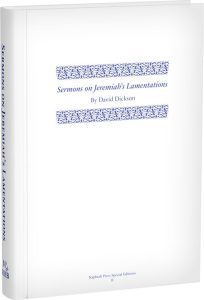
 David Dickson, Sermons on Jeremiah’s Lamentations, Chris Coldwell, ed. (Dallas, TX: Naphtali Press, 2020), 296 pages + indices.
For many the year 2020 was a year of trial. Some faced health crises, others faced trials of conscience, while others faced inconvenience. News media did much to profit from the attention, politicians postured stances for their party, and even churches closed their doors in light of the circumstances. Few voices were heard calling men and women in the church to exercise faith and wait upon God, while walking in the way of love to God and love to man.
However one looks back on the nature of the concern or the response to that concern, few will have noticed the publication of a book most fitting for the circumstances of that season. It was not a bestseller. Nor was it published by anyone of note to contemporary audiences. Its origin preceded the year by almost 400 years. Yet, it was more relevant than most up-to-date comments then circulating on blogs, social media, and news outlets. The book was a series of sermons by David Dickson on the book of Lamentations.
David Dickson (1583-1662) represents a season of the finest theology and pastoral diligence in Scotland’s history and arguably the world. Born in the generation following Knox’s death, he lived through initial controversies and challenges that were brought against the Reformed church. Additionally, alongside the like of Alexander Henderson and Samuel Rutherford, he was instrumental in bringing the church again to a state of purity in doctrine, worship, government, and practice. His life itself is a microcosm of the challenges, victories, doctrine, principles, and faith of the second reformation. Still known today for his commentaries on the books of Psalms and Matthew, he also wrote a commentary on the Westminster Confession of Faith and, with James Durham, developed the Sum of Saving Knowledge. He served as a pastor in Irvine, enjoyed the outpouring of God’s Spirit in revival, suffered exile for his commitment to Christ’s cause, taught a generation of Scotland’s finest preachers at Glasgow and Edinburgh, and died on the cusp of a bitter persecution against the faith. Few men better exemplify the identity of the church of Scotland and the Reformed cause in the heart of the 1600’s than David Dickson.
It is, then, a great benefit to gain access to a sample of his preaching. This collection of sermons was never previously published. The sermons are published from manuscript notes taken by one who heard them originally delivered in 1628. This means that Dickson himself did not develop them for the press. However, they present to us the perspective of his hearers and give us a glimpse into something of his regular ministry as he worked through this oft-neglected portion of God’s word.
As the introduction notices, there were trying circumstances at work in and around 1628. Wars, famine, illness, and earthly uncertainty plagued parts of Scotland and the western world. The church in Scotland and abroad endured trials of persecution, and believers were forced to look unto God in patience and faith. The introduction and footnotes throughout the volume help us enter upon times of significant trial. Reading and meditating upon these sermons are excellent help for difficult seasons and trials to faith.
The book includes a preface with information on editorial decisions and background to the text itself. There is also a very helpful 29-page introduction by Matthew Vogan. This introduction does much to establish the historical setting of the sermons themselves. With a brief survey of Dickson’s ministry, it highlights the circumstances of persecution, revival, fasting, war, famine, pestilence, spiritual decline in Scotland surrounding the time of these sermons. The introduction itself is well worth reading for those interested in this period of Scottish church history. It is particularly useful in setting the context for these sermons.
The sermons are broken up according to each chapter of Lamentations. There are seven sermons on chapter one, four sermons on chapter two, ten sermons on chapter three, four sermons on chapter four, and two sermons on chapter five. Each sermon runs about ten pages. These are easily read in thirty minutes, though, as noted below, the reader should approach them with attention and prayer. Together with two very useful indices (one for scripture references and a second for subjects and authors), the volume is excellently produced and presented.
Lamentations is a brief but heavy book. The subject matter is difficult: affliction, correction for sin, desolation, mourning, trial, patience, waiting. These are not words that appeal to our culture. However, they make up much of Lamentations. Additionally, they represent a significant part of any life in this world. To be acquainted with them and the Lord’s teaching on them is to gain help for important seasons of life. Dickson’s sermons will prove to be an edifying guide as we experience difficulty in life.
Every reader can enjoy and benefit by just picking up and reading this insightful, savory, and edifying volume. That noted, there are a few insights that may help one making it through this valuable series of sermons.
The book is neither a 17th century reprint, nor is it a complete update for modern readers. The editor has sought to balance presenting an older text to us in its own terms with providing useful updates for modern sensitivities. Instead of overhauling the work, the editor has conservatively modernized some spelling and vocabulary, while maintaining certain archaisms and words or phrases from Dickson’s Scots dialect. This may lead some readers to struggle at first reading through the work. Occasionally Dickson’s archaic and/or Scots vocabulary is permitted to stand. Note the following examples as they appear in the text, brackets included:
“This people trowed [trusted; believed] not to see this day come upon them; therefore, he mourned in secret for their pride.”1p. 46.
“Look aye [always] to God, seeing He looks aye [always] to you.”2p. 242.
As the examples show, this is not without assistance to clarify the meaning, but it may take time to become used to this feature. Several of these occur on each page. There are other inclusions in the body of the text, such as necessarily supplied words with footnoted explanations. These features assist the modern reader to gain a feel for Dickson’s approach, though for the first few pages, they may interrupt the rhythm of reading.
Readers may struggle initially with the form of the sermons themselves. Most today will expect a certain form for written sermons: an introduction, several main points, applications, and a conclusion. Readers of the puritans may expect a bit different form: opening the text, identifying or raising doctrine(s), confirming the doctrine, explaining the doctrine, answering objections or questions, and then applying the doctrine to any number of hearers or cases. Dickson’s sermons in this volume certainly do not follow the contemporary form, neither do they strictly follow the customary puritan form. Instead, in this volume he progresses through a particular passage of Scripture, treating portions of the text in sequence. He briefly explains key words and ideas, he identifies a doctrine from the portion of his verse, sometimes answers a raised question, and then applies the identified doctrine through an application or “use.”
This form takes some getting used to. In some ways it is more akin to a running commentary, albeit with a tone and earnestness that is appropriate to preaching. It is in many ways closer to Calvin’s lectures represented in his commentaries, though with fewer if any references to Hebrew or Greek terms. Additionally, it is filled with excellent applications, guidance, and help. Once the reader has persisted through two or so sermons, the form becomes part of the background, and the substance of the sermon comes to the fore.
In light of this, the modern reader should make a commitment to read through the first few sermons, even if there are initial struggles. The benefit and gain of doing so will far outweigh whatever difficulties may at first present themselves.
The reader would do well to slow down in reading. Read the book deliberately, slowly, and prayerfully. Many of the doctrinal insights and applications (uses) last only a paragraph. Some last only a sentence. It is easy to move along quickly. However, it is often worth pausing after each use or application and considering the point Dickson is making, reflecting on our own circumstances, sins, needs, etc. This will be the best way to profit from the sermons.
As one example of Dickson’s typical approach and the kind of pastoral care he shows throughout the sermons, notice his treatment of Lamentations 3:32, in the middle of his sixth sermon on that chapter:
Though he cause grief, yet will he have compassion.” This lets us see, albeit grief coming on us seems to be only wrath without compassion, yet that anger cuts not away His compassion, but a sort of anger and compassion may both stand together. God may have pity in His heart and yet strike with His hand. He may lay on heavy burdens with His hand and yet have great heart rueing within. As a father is moved [grieved] to correct his child, yet he must punish his fault; there is pity in his mind when the rod is used at his hand. So is it with God’s anger to His own; it is mixed with compassion. Hear [hear is] the reason of the mixture of the cup of the godly: there are many mercies in it and much bitterness, because of God’s disposition. There are many comforts in it because of his pity, a mixture of anger because He is provoked, so that there is to be found both a sweet smell and His compassion, and a bitter taste of His indignation felt in that composition, which the Lord presents to His own to work in them faith, repentance and a new life.
Use. You who feel God’s anger and suspect [question] His love, know that God can both be angry, strike, and love you also.3p. 204.
The work is highly recommended to several classes of readers. The first of which is ministers of the word. Here is a volume of sermons from an exemplary representative of the finest theology of the second reformation era. It is not that ministers should necessarily model their form of preaching after this volume. However, there is an excellent example of scriptural faithfulness, doctrinal orthodoxy, and pastoral wisdom. The sermons illustrate what Reformed preaching should possess, perhaps not as regards the strict form, but most certainly in the relationship of doctrine, practice, and experience. Each minister would do well to ensure these elements are clearly represented within his sermons, however the form of his sermon develops.
The volume is also recommended for another class of readers, namely those interested in the history of the Church of Scotland generally as well as the second reformation particularly. One thing it shows is the focus of the ministry of this generation was upon the care of souls: teaching, warning, encouraging, exhorting, applying. Though a professor of theology, Dickson was no doctrinaire. He labored to bring out the meaning of the text, yet did so without prolonged discussions on mood, voice, and tense. He was never content to assert the meaning. He proclaimed it and applied it to different hearers and cases before him. This helps the student of history see well the tone and character of the second reformation pulpit.
Finally, the volume would prove to be a blessing for Christians desiring to see how faith comes under the afflicting, yet loving, providence of God. Dickson is a helpful guide through this excellent book God has provided his church. When afflictions are heavy and difficult, Lamentations provides us help in exercising faith, expressing our grief, and coming under the Lord’s rod in humble and believing submission as we look to him for help. Dickson’s gifts and graces are used to bring that word near unto us for our benefit in such seasons.